Key takeaways
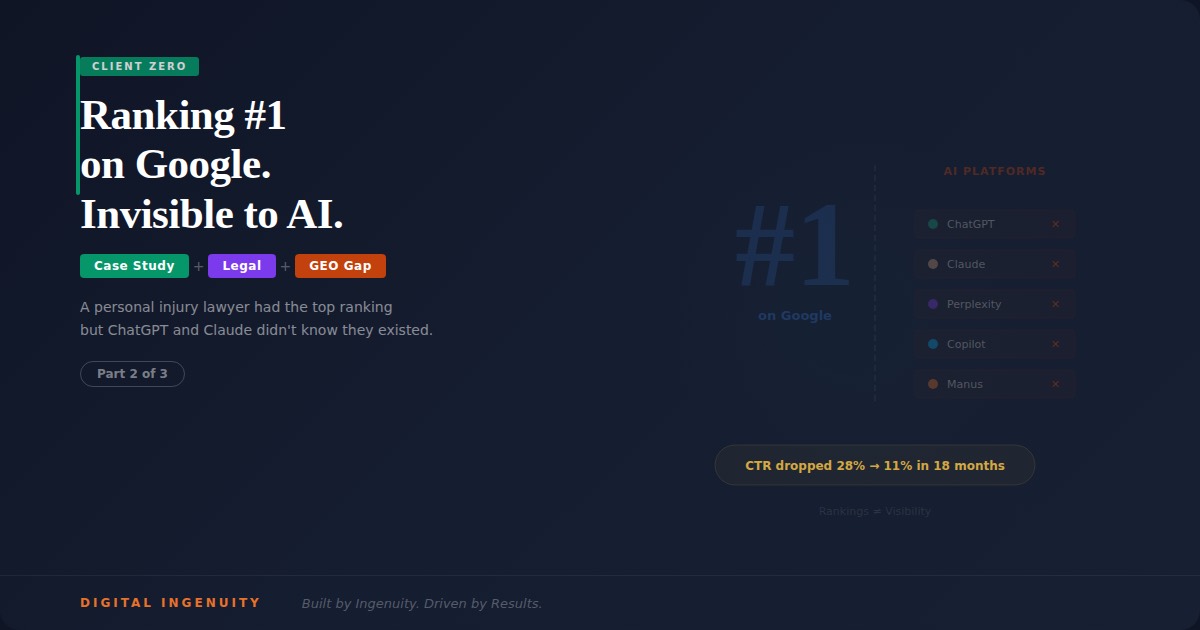
- A DFW personal injury attorney ranked #1 on Google for their primary keyword — “personal injury lawyer [city]” — generating 4,200 monthly impressions but had seen CTR decline from 28% to 11% over 18 months as AI Overviews expanded
- Despite the #1 Google ranking, ChatGPT, Claude, Perplexity, Copilot, and Manus never mentioned this firm when asked for personal injury attorney recommendations — the firm existed for Google but not for AI
- The gap between Google ranking and AI visibility was caused by a single factor: the firm had optimized for page-based signals (backlinks, keyword density) without building entity-based signals (structured data, cross-platform corroboration, citeable expertise content)
- After 60 days of entity authority building — without losing their #1 Google ranking — they appeared on 4 of 6 AI platforms and their effective CTR recovered from 11% to 19% by capturing clicks from both organic results AND AI Overview citations
- This case proves that Google rankings and AI visibility are different systems requiring different optimization — and that the best strategy addresses both simultaneously
The Paradox: #1 on Google, Invisible to AI
This is the case that changed how we think about search visibility.
When this firm came to us, they didn’t have a ranking problem. They had the opposite — they were winning at Google. Position 1 for “personal injury lawyer [city],” a keyword with an estimated 2,900 monthly searches. Top 3 for a dozen related keywords. Their SEO agency had done excellent work building domain authority through aggressive link building and on-page optimization.
By traditional SEO metrics, this firm was thriving.
But the owner noticed something concerning: despite stable or improving rankings, phone calls from new clients had declined 22% over the past year. The Search Console data confirmed it — impressions were holding, but clicks were falling. Their CTR for the #1 position on their primary keyword had dropped from 28% to 11% over 18 months.
The culprit was visible in the SERP itself. Google AI Overviews had expanded into legal queries. When someone searched “personal injury lawyer [city],” they now saw a detailed AI-generated overview at the top of the page that summarized what to look for in an attorney, listed factors to consider, and sometimes named specific firms. Below that, a People Also Ask section. Below that, a local map pack. The organic #1 result — their firm — was now below the fold on mobile.
Semrush’s 2025 research on legal industry SERPs found that AI Overviews appeared on 62% of informational legal queries and were expanding into transactional queries at an accelerating rate. The legal industry, with its high commercial intent and complex decision-making, is a prime target for AI Overview expansion.
Ranking #1 wasn’t enough anymore. The question was whether they were being cited in the AI content appearing above them.
We tested. They weren’t. Not in Google AI Overviews, not in ChatGPT, not in Claude, not in Perplexity, not in Copilot, not in Manus. A firm with the #1 Google ranking was invisible to every AI platform.
Why Rankings Didn’t Translate to AI Visibility
This case illustrates a critical distinction: page authority and entity authority are different things.
This firm had excellent page authority. Strong backlinks from legal directories, high domain authority, technically solid on-page optimization. Google’s traditional algorithm — which evaluates pages based on links, relevance, and user signals — ranked them highly.
But AI platforms evaluate entities, not pages. When ChatGPT considers whether to recommend a law firm, it’s not looking at backlink profiles. It’s asking: Can I confidently identify this entity? Can I verify their claims across multiple sources? Do they have structured data that tells me precisely what they do? Is there third-party corroboration of their expertise?
This firm had none of that.
Structured data: Their website had basic Yoast-generated schema — a simple Organization type with name and URL. No LocalBusiness schema, no Attorney schema (a valid schema.org type specifically for legal professionals), no Service schema defining their practice areas, no FAQ schema, no Review schema. The Yoast defaults told AI platforms almost nothing useful.
Content specificity: Their service pages were optimized for Google’s keyword matching — dense with terms like “personal injury lawyer” and “accident attorney” — but thin on actual expertise content. 300-word pages with strong keyword signals but no specific claims about their methodology, case approach, or practice area depth that an AI platform could extract and cite.
Third-party entity signals: Beyond legal directories (Avvo, FindLaw, Justia), which are primarily backlink sources rather than entity corroboration sources, the firm had no authoritative third-party mentions. No contributed articles, no expert source quotes, no local business publication features.
The firm had built a house with an excellent roof (backlinks) on a weak foundation (entity signals). Google’s traditional algorithm could see the roof. AI platforms could only see the foundation.
The 60-Day Entity Build
We designed a targeted engagement focused entirely on entity authority — deliberately not touching their existing SEO, which was working. The goal: build AI visibility without disrupting Google rankings.
Week 1-2: Structured Data Architecture
We replaced the basic Yoast schema with comprehensive, hand-crafted structured data:
Attorney schema on the firm’s attorney profile pages — using the Attorney type from schema.org, including name, credentials, bar admissions, practice areas, and education. Legal-specific schema types help AI platforms categorize the entity within the legal profession specifically.
LegalService schema on each practice area page — personal injury, car accidents, workplace injuries, medical malpractice, wrongful death — each with specific descriptions, case types handled, and geographic service area.
FAQPage schema on the five highest-traffic practice area pages, using questions extracted from Google’s People Also Ask section for related queries. We wrote authoritative 50-70 word answers to each question — not legal advice, but educational content that demonstrates expertise.
AggregateRating schema reflecting their 4.9-star rating from 128 Google reviews.
Organization schema with comprehensive entity details including founding year, number of attorneys, bar associations, and a knowsAbout array listing their specific areas of legal expertise.
Week 2-4: Content Transformation
We expanded their practice area pages from keyword-optimized 300-word summaries to expertise-demonstrating 1,200-1,800 word guides. Each page now included how the firm approaches that specific case type, what makes these cases complex and how the firm handles that complexity, common questions clients ask with detailed expert answers, the timeline and process a client can expect, and specific factors that affect case outcomes in Texas.
This content wasn’t written to rank better (though it did). It was written to be citeable — specific enough that an AI platform could extract claims and recommend the firm with confidence.
According to a 2025 study by Orbit Media, content that explicitly demonstrates expertise (specific methodology, unique insights, professional experience) earns 3.1x more backlinks than generic content on the same topic. The same principle applies to AI citations: specificity signals expertise.
Week 3-5: Cross-Platform Entity Signals
We completed the same entity authority build we described in the HVAC case study: Google Business Profile overhaul, Bing Places and Apple Maps claiming, directory profiles on Clutch and legal-specific platforms, NAP standardization across all listings.
We also leveraged something specific to the legal industry: bar association profiles. State bar listings are high-authority entity signals that AI platforms weight heavily because they represent verified professional credentials. We ensured every attorney’s bar profile was complete, accurate, and linked to the firm’s website.
Week 4-8: Thought Leadership
The firm’s lead attorney began responding to HARO/Connectively queries on topics like personal injury trends in Texas, when to hire a personal injury attorney, and legal technology developments. Within 60 days, three responses were published — two in legal industry publications and one in a DFW business magazine.
We also published four blog posts on the firm’s site, each structured as an authoritative guide on a specific legal question their clients frequently ask. Every post included FAQ schema and was designed to win featured snippets for question-based queries.
The Results
AI Visibility (Day 60)
| Platform | Before | After |
|---|---|---|
| Google AI Overviews | Never cited | Cited on 3 queries |
| ChatGPT | Never mentioned | Recommended with practice area detail |
| Claude | Never mentioned | Recommended — cited methodology and experience |
| Perplexity | Never mentioned | Cited with source links to practice area pages |
| Copilot | Never mentioned | Not yet appearing (Bing indexing lag) |
| Manus | Never mentioned | Recommended — cited HARO publication mention |
Featured Snippets
Won 2 featured snippets for question-based legal queries within 45 days. Both snippets were subsequently cited in Google AI Overviews, confirming the snippet-to-AI-Overview pipeline we documented in our AEO experiment.
CTR Recovery
The firm’s CTR for their primary keyword recovered from 11% to 19%. They were still ranking #1 in organic results — but now they were ALSO being cited in the AI Overview that appeared above those results. Users who read the AI Overview and saw the firm mentioned were more likely to click through to the organic listing below.
This is the compound effect of GEO + SEO: the AI Overview citation acts as social proof that increases CTR on the organic listing beneath it.
Business Impact
Phone calls from new clients increased 31% within the 60-day period. The owner’s assessment: “I was paying $4,000/month for SEO that maintained my rankings. I needed someone to make those rankings actually produce calls again.”
The Lesson
This case breaks the assumption that Google rankings equal visibility. In 2026, they don’t — not automatically.
Google rankings are necessary but not sufficient. They ensure you appear in traditional search results. But as AI Overviews, featured snippets, and People Also Ask consume more SERP real estate, the organic listing alone captures a declining share of attention and clicks.
Entity authority is what translates rankings into multi-format visibility. Structured data ensures Google’s AI can cite you in Overviews. Featured snippet optimization ensures you own position zero. Cross-platform presence ensures ChatGPT, Claude, Perplexity, and voice assistants can find and recommend you.
The lawyer who ranks #1 but isn’t cited by AI is like a store on Main Street that’s invisible when someone asks for directions — technically present, functionally absent.
This is Part 2 of 3 in the Client Zero series — anonymous case studies demonstrating the four-pillar framework in action.
Previous: How a Plano HVAC Company Went From Invisible to AI-Recommended
Next in the series: From 44 Indexed Pages to 35 — And Why That Made Them Visible on Perplexity, Claude, and Google AI Overviews
Ranking well but not getting the calls you should? Book a free discovery call →
See how GEO addresses the AI visibility gap: GEO — Generative Engine Optimization →