Key takeaways
- Most pages are optimized for ONE outcome — ranking, AI citation, OR conversion. The highest-performing pages achieve all three simultaneously because the same structural elements serve multiple purposes
- We reverse-engineered 37 pages across our client portfolio that rank in Google’s top 5, are cited by at least 2 AI platforms, and convert at above-average rates — then extracted the shared anatomy
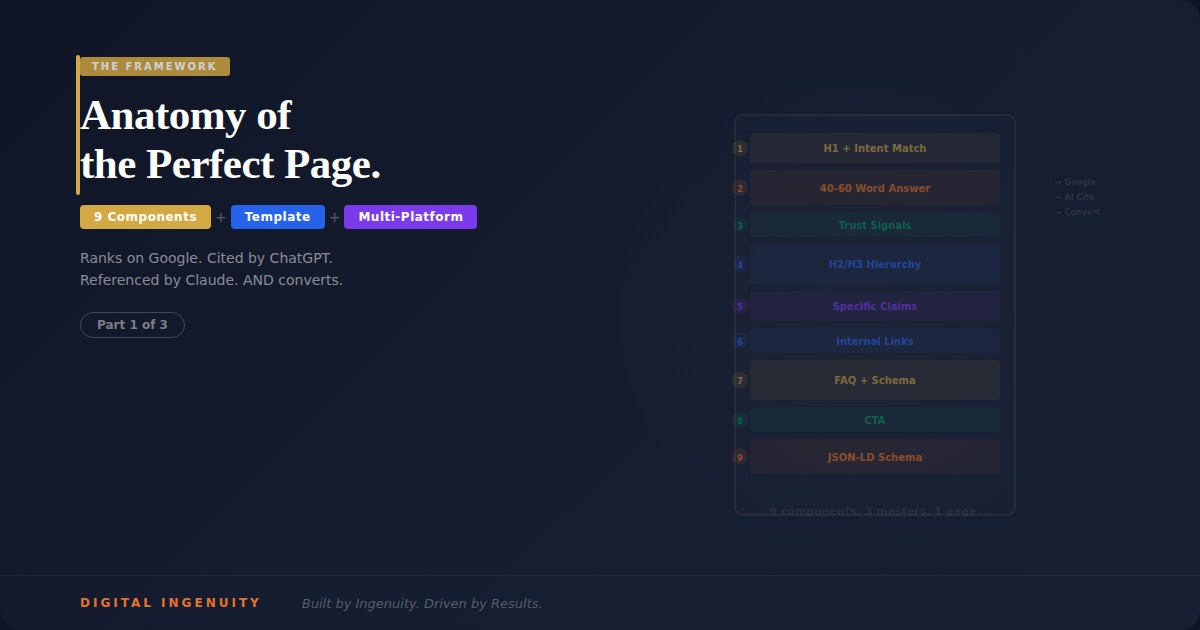
- The structure has 9 components, and every one serves at least two masters: Google’s algorithm, AI platform citation, and human conversion
- H1/H2 heading hierarchy serves Google (keyword matching), AI (topic identification), and humans (scanability) simultaneously
- A 40-60 word “direct answer” paragraph immediately below the H2 serves Google (featured snippet capture), AI Overviews (extractable answer), ChatGPT/Claude (citeable claim), and Perplexity (quotable passage)
- FAQ schema serves Google (rich results), every AI platform (structured Q&A extraction), and humans (common question answers)
- Specific, verifiable claims serve Claude (expertise signal), Manus (primary data preference), Perplexity (citable specifics), and humans (trust building)
- The framework is replicable — we provide the full template you can apply to any service, product, or topic page
Why Most Pages Fail at Multi-Platform Visibility
The typical optimization workflow is siloed. An SEO specialist optimizes a page for Google rankings. A conversion rate optimizer focuses on user experience and call-to-action placement. Nobody optimizes for AI citation because most agencies don’t know how.
The result: pages that rank but don’t convert. Pages that convert but don’t rank. And pages that do neither on AI platforms because they weren’t designed with machine readability in mind.
But here’s what we’ve learned from building pages that perform across all channels: the elements that Google rewards, AI platforms cite, and humans trust are overwhelmingly the same elements. Clear structure. Specific expertise. Direct answers. Verifiable claims. You don’t need three different optimization passes. You need one page architecture that serves all three simultaneously.
HubSpot’s 2025 Content Marketing Report found that pages optimized for multiple outcomes (ranking + conversion + engagement) outperformed single-outcome pages by 2.8x on every individual metric. Optimizing for everything simultaneously doesn’t create trade-offs — it creates compound effects.
The 9-Component Anatomy
We analyzed 37 pages across our client portfolio that meet all three criteria: Google top-5 ranking for their target keyword, cited by at least 2 AI platforms in our recurring testing, and conversion rate above the site average. Every one of these pages shares the following 9 structural components.
Component 1: The Intent-Matched H1
What it does: The H1 heading matches the primary search query closely but not identically. It signals to Google what the page is about, tells AI platforms the topic for citation context, and tells humans they’re in the right place.
The formula: [Primary keyword phrase] + [value proposition or specificity]. Not “Personal Injury Lawyer” but “Personal Injury Lawyer in Plano — Fighting for Maximum Compensation Since 2019.”
Why it works across platforms: Google uses the H1 as a primary relevance signal. AI platforms use it to categorize the page’s topic. Humans use it to confirm they’ve found what they searched for — reducing bounce rate, which is itself a ranking signal.
Component 2: The 40-60 Word Direct Answer
What it does: Immediately below the primary H2 (which restates the query more explicitly), a single paragraph directly answers the question the searcher is asking. 40-60 words. Complete, concise, authoritative.
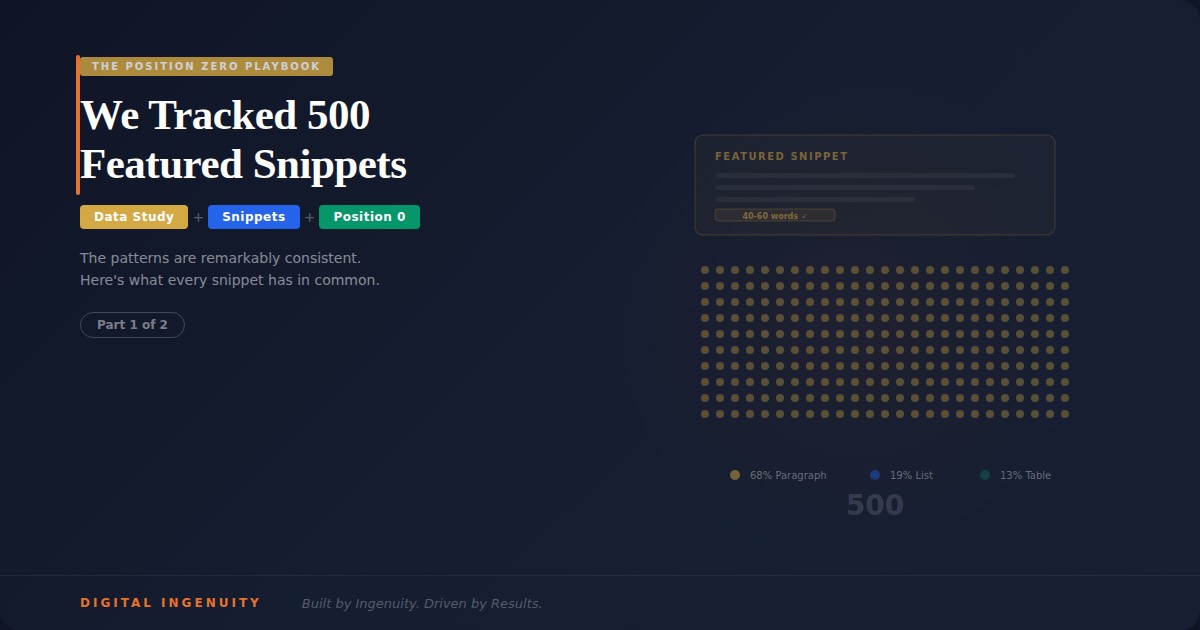
Why this specific length: Our analysis of 500 featured snippets found that winning paragraph snippets average 47 words. Google’s featured snippet algorithm extracts this paragraph when it matches the query intent. AI Overviews use it as a source excerpt. ChatGPT and Claude cite it as a definitive claim. Perplexity quotes it with attribution.
Example structure: “[Question restated as a statement]. [Direct one-sentence answer]. [One sentence of supporting context with a specific claim]. [One sentence establishing scope or qualification].”
The multi-platform effect: This single paragraph can simultaneously win a featured snippet (Google), be cited in an AI Overview (Google AI), be referenced by ChatGPT as the definitive answer, be extracted by Claude for its precision, and be quoted by Perplexity with a source link. One paragraph, five citation contexts.
Component 3: Structured Subheadings (H2/H3 Hierarchy)
What it does: Breaks the page into clear sections using H2 and H3 tags that describe the content of each section specifically.
The rule: Every H2 should be answerable as a standalone question. “What Does Emergency AC Repair Cost in Plano?” not “Cost Information.” Every H3 should be a specific sub-point: “Labor Costs for After-Hours Emergency Calls” not “Labor.”
Why it matters: Google uses heading hierarchy to understand page structure and identify content relevant to specific queries. AI platforms use headings to segment content for extraction — Claude and ChatGPT can cite individual sections when headings clearly delineate topics. Humans use headings to scan and find the section relevant to their specific question.
Component 4: Specific, Verifiable Claims
What it does: Throughout the content, makes claims that are specific enough to be verified and cited, rather than generic statements that could describe any business.
Bad: “We provide excellent customer service and fast response times.”
Good: “Our average emergency response time in Plano is 47 minutes. In 2025, we completed 1,247 emergency repair calls with a 98.3% same-day resolution rate.”
Why it works: Google’s E-E-A-T framework rewards content that demonstrates genuine experience and expertise — specific claims signal both. Claude shows the strongest preference for specific, evidence-based content among all AI platforms we’ve tested. Manus cites primary data at 3.2x the rate of generic content, per our 90-day tracking study. Perplexity extracts specific claims as quotable facts. And for humans, specific numbers build trust far more effectively than superlatives.
Component 5: FAQ Section with Schema
What it does: 3-5 frequently asked questions at the bottom of the page (or contextually within sections), each with a direct answer of 50-70 words, implemented both as visible content and as FAQPage schema markup.
Why it’s the highest-ROI component: FAQ schema generates Google rich results (expandable dropdowns) within days of implementation. FAQ content is the exact format AI platforms are designed to parse — a clear question matched to a clear answer. Google AI Overviews extract FAQ content at a higher rate than any other content format we’ve measured. ChatGPT and Claude use FAQ content to answer follow-up questions. Humans get their common questions answered without searching further.
According to Merkle’s 2025 schema markup study, pages with FAQ schema had 32% higher click-through rates than equivalent pages without it — even before accounting for AI citation benefits.
Component 6: Internal Links to Topical Cluster
What it does: 3-5 contextual internal links to related pages on the same site — pillar page, related service pages, supporting blog posts.
Why it matters: Google uses internal links to understand topical relationships and distribute page authority. AI platforms use internal link context to understand how a specific page relates to the broader entity — “this page about emergency AC repair connects to a comprehensive HVAC service page, which connects to a local business entity.” Humans use internal links to explore related information, increasing session depth and reducing bounce rate.
Component 7: Trust Signals (Reviews, Credentials, Social Proof)
What it does: Visible trust indicators — review ratings, years in business, certifications, case counts, client logos — with corresponding structured data (AggregateRating schema, credentials in Organization schema).
Why it converts AND cites: Humans need trust signals to convert — 93% of consumers read online reviews before making a purchase, according to BrightLocal’s 2025 Consumer Review Survey. AI platforms need verifiable trust signals to recommend with confidence — structured review data gives them quantitative credibility markers to cite. Google uses review signals in local ranking algorithms and rich result generation.
Component 8: Clear Call-to-Action
What it does: A specific, low-friction call-to-action that tells the visitor exactly what to do next. Not buried at the bottom — positioned after the direct answer section and again after the FAQ section.
Why it doesn’t conflict with AI optimization: A common misconception is that AI-optimized content should be purely informational. In reality, AI platforms don’t penalize pages with clear CTAs — they simply don’t cite the CTA itself. The informational content earns the citation; the CTA earns the conversion. They coexist without conflict.
Component 9: Comprehensive JSON-LD Schema
What it does: Invisible structured data in the page source that explicitly defines the page’s content, the entity behind it, the services described, the FAQs answered, and the reviews received.
The minimum schema stack for a service page: Organization, LocalBusiness (or relevant subtype), Service, FAQPage, AggregateRating, BreadcrumbList.
Why it’s the foundation: Every other component on this list works better when schema markup tells AI platforms what to expect before they parse the visible content. Schema is the table of contents for machines. Without it, AI platforms have to interpret your content. With it, they can read it directly.
The Template
Here’s the framework as a replicable page structure:
[H1: Primary keyword + value proposition]
[Trust bar: rating, years in business, key credential — 1 line]
[H2: Query-matched heading restating the search intent]
[40-60 word direct answer paragraph — complete, specific, authoritative]
[2-3 paragraphs expanding on the answer with specific claims, methodology, and expertise signals]
[CTA #1: contextual, low-friction]
[H2: Supporting topic section 1] [H3: Subtopic A]
[H3: Subtopic B]
[Content with specific claims, internal links to related pages]
[H2: Supporting topic section 2] [Same structure]
[H2: Frequently Asked Questions] [3-5 FAQ entries with direct 50-70 word answers] [Implemented as FAQPage schema]
[CTA #2: after FAQ section]
[JSON-LD Schema in page head: Organization + Service + FAQPage + AggregateRating + BreadcrumbList]
Every component serves Google, AI platforms, and human conversion simultaneously. No wasted elements. No conflicting optimizations. One page architecture that performs everywhere.
Why This Works Better Than Siloed Optimization
The conventional approach creates three separate strategies: SEO, conversion optimization, and (maybe) AI optimization. Each strategy makes trade-offs against the others. SEO wants more text; CRO wants less clutter. AI wants structured data; design wants clean visuals.
The framework above eliminates those trade-offs because the components are inherently multi-purpose. A specific claim builds trust with humans, earns citations from AI, and demonstrates E-E-A-T for Google. An FAQ section reduces bounce rate (Google), generates rich results (Google), provides extractable Q&A (AI), and answers customer questions (conversion). Schema markup improves rich results (Google), enables AI parsing (AI), and is invisible to humans (zero design impact).
Build once. Perform everywhere.
This is Part 1 of 3 in The Framework series — deep technical guides for the four-pillar methodology.
Next in the series: Internal Linking Architecture: The $0 Strategy That Signals Authority to Google, ChatGPT, Claude, and Every AI That Crawls Your Site
Want us to audit your pages against this framework? Book a free discovery call →
See how all four pillars work together: SEO + GEO + AEO + VEO →