Key takeaways
- The marketing industry has a branding problem: hundreds of agencies have rebranded as “AI-powered” or “AI marketing” without changing what they actually deliver
- According to a 2025 MarketingProfs survey, 73% of marketing agencies now include “AI” somewhere in their service descriptions — but fewer than 12% offer services specifically designed for AI platform visibility
- The difference between AI-assisted marketing (using ChatGPT to write blog posts faster) and AI-optimized marketing (engineering your digital presence to be cited by ChatGPT, Claude, Perplexity, and Manus) is the difference between using a tool and building for a platform
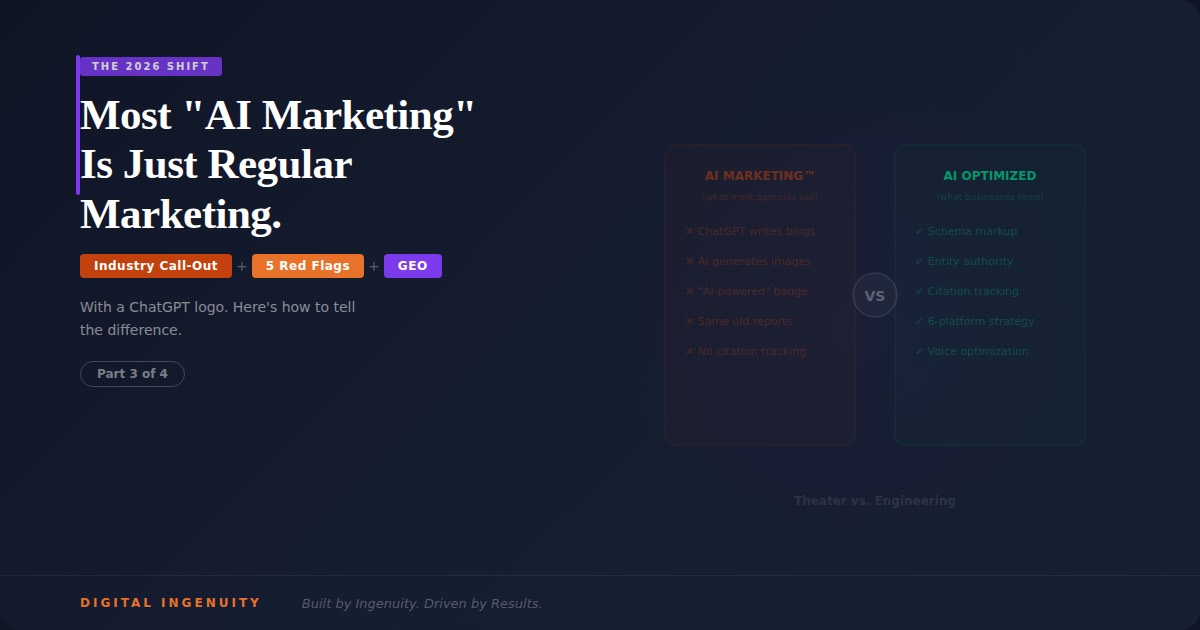
- Five red flags that an “AI marketing” agency is just doing traditional marketing with new branding: they can’t explain how ChatGPT decides who to recommend, they don’t mention structured data, they don’t track AI citations, their “AI” offering is just AI-generated content, and they can’t name specific AI platforms beyond ChatGPT
- The businesses that will be disadvantaged aren’t the ones who skip AI marketing entirely — they’re the ones who pay for “AI marketing” that doesn’t actually address AI platform visibility, wasting budget and time while competitors build real entity authority
The Great AI Rebrand of 2024-2026
Something happened across the marketing industry in 2024. Overnight, it seemed like every agency became “AI-powered.”
Website copy got updated. New service pages appeared. Logos got refreshed. LinkedIn posts started featuring ChatGPT screenshots. The messaging shifted from “data-driven marketing” to “AI-powered marketing solutions.”
And behind the curtain, for the vast majority of these agencies, absolutely nothing changed about the actual work they deliver.
We know this because we talk to the clients who come to us after working with these agencies. They paid for “AI marketing” and received the same keyword research, the same blog posts (now written by ChatGPT instead of a human, which is worse), the same monthly reports, and the same mediocre results. The only thing that was AI about their experience was the agency’s updated website.
HubSpot’s 2025 State of Marketing Report found that while 81% of marketers say they use AI in their workflow, only 14% reported fundamentally changing their strategy or service delivery because of AI. The other 67% are using AI as a production tool — writing copy faster, generating social posts, creating images — without rethinking what they deliver or how they measure success.
That’s not AI marketing. That’s marketing with an AI stapler.
The Critical Distinction
There are two fundamentally different things happening under the “AI marketing” umbrella, and confusing them is costing businesses money:
AI-Assisted Marketing (What most agencies sell)
Using AI tools to do traditional marketing more efficiently. ChatGPT writes blog posts. Midjourney generates images. Jasper creates ad copy. AI helps with brainstorming, research, and first drafts.
This is a legitimate use of technology. There’s nothing wrong with using AI tools to improve efficiency. But it’s a productivity improvement, not a strategic transformation. The output is still the same — blog posts, social media content, ad copy, email campaigns — it’s just produced faster.
The problem: calling this “AI marketing” implies that the agency has expertise in AI as a marketing CHANNEL, not just as a marketing TOOL. And those are very different things.
AI-Optimized Marketing (What businesses actually need)
Engineering your digital presence so that AI platforms — ChatGPT, Claude, Gemini, Perplexity, Copilot, Manus, and whatever launches next — recognize, trust, and recommend your business.
This requires understanding how each AI platform selects sources to cite. It requires implementing structured data that AI systems read natively. It requires building entity authority signals that cross-reference across platforms. It requires tracking your visibility on AI platforms over time and adjusting strategy based on citation data.
This is what we call Generative Engine Optimization (GEO), and it’s a fundamentally different discipline from traditional marketing — or from using AI as a writing tool.
The Five Red Flags
Here’s how to tell whether an “AI marketing” agency is delivering genuine AI-optimized marketing or just traditional marketing with new branding:
Red Flag 1: They Can’t Explain How AI Platforms Choose Who to Recommend
Ask them: “How does ChatGPT decide which businesses to recommend when someone asks for a service provider?” If they can’t give you a specific, detailed answer about entity signals, structured data, content authority, and third-party corroboration — they don’t understand the platform they claim to optimize for.
In our research, we’ve identified six specific entity signals that determine whether AI platforms cite your business. Any agency claiming AI expertise should be able to articulate these signals clearly.
Red Flag 2: They Don’t Mention Structured Data
Structured data (schema markup) is the most direct communication channel between your website and AI platforms. It’s the difference between asking AI to interpret your marketing copy and telling AI exactly who you are, what you do, and where you operate.
Our schema experiment demonstrated that structured data alone can move a business from AI-invisible to AI-cited in 30 days. Any agency claiming AI expertise that doesn’t prioritize structured data implementation is missing the most fundamental technical requirement.
If their service description doesn’t mention schema, Organization markup, LocalBusiness markup, or structured data — they’re not doing AI optimization.
Red Flag 3: They Don’t Track AI Citations
Ask: “Can you show me whether ChatGPT, Claude, or Perplexity currently recommends my business?” If they’ve never tested this and can’t provide data, they’re not monitoring the channels they claim to optimize.
Our 90-day tracking study showed that AI citations change week to week — 34% variation across platforms. Monitoring requires systematic, ongoing tracking. An agency that optimizes for AI without measuring AI citations is flying blind.
Red Flag 4: Their “AI” Offering Is Just AI-Generated Content
If the primary way they use AI is to generate blog posts, social media content, or ad copy — that’s AI-assisted production, not AI marketing strategy.
Worse, AI-generated content without human expertise and editing often performs poorly. Google’s helpful content system, updated in 2024, specifically targets content that reads as mass-produced or lacks genuine expertise. A Surfer SEO study from 2025 found that AI-generated content without substantial human editing ranked 38% lower on average than human-written content targeting the same keywords.
AI-generated content published at scale is the 2026 equivalent of keyword-stuffed content from 2008 — it might feel productive, but it actively harms your search visibility.
Red Flag 5: They Can’t Name Specific AI Platforms Beyond ChatGPT
The AI search landscape includes ChatGPT, Claude, Gemini, Perplexity, Microsoft Copilot, and Manus — each with different data sources, different citation preferences, and different optimization requirements.
An agency that only talks about ChatGPT is like an SEO agency that only optimizes for Google and ignores Bing, voice search, and featured snippets. ChatGPT is the most visible AI platform, but it’s one of at least six that influence business discovery.
Our cross-platform research shows that businesses optimized for only one AI platform are invisible on approximately half the others. Cross-platform strategy isn’t optional.
Why This Matters for Your Budget
The real cost of AI marketing theater isn’t just the agency fee. It’s the opportunity cost.
While you’re paying an agency $2,000/month for “AI-powered SEO” that’s actually just ChatGPT-written blog posts, your competitors might be implementing structured data, building entity authority across six AI platforms, claiming voice search listings on Bing Places and Apple Maps, and winning featured snippets that feed into AI Overviews.
Every month of AI marketing theater is a month your competitors use to build real entity authority. And entity authority compounds — the businesses that establish it first create advantages that become increasingly difficult to overcome.
McKinsey’s 2025 State of AI report found that companies implementing AI strategically (rather than superficially) saw 3-5x greater ROI from their digital marketing investments compared to companies that adopted AI tools without strategic integration. The gap between strategic and superficial AI adoption is widening.
What Genuine AI Marketing Looks Like
For transparency, here’s what we actually do when we say we engineer AI search visibility:
We implement comprehensive structured data — Organization, LocalBusiness, Service, FAQ, Review, Speakable, and BreadcrumbList schema across your website. This speaks directly to AI platforms in their native data language.
We build cross-platform entity authority — consistent presence across Google, Bing, Apple Maps, Clutch, DesignRush, UpCity, and industry-specific directories. AI platforms cross-reference these sources to verify your entity.
We engineer content for citation — not just for ranking. Content structured with clear headings, direct answers, FAQ formatting, and specific claims that AI platforms can extract and cite confidently.
We monitor AI citations across platforms — automated tracking of whether ChatGPT, Claude, Perplexity, Copilot, and Manus mention your business, how consistently, and for which queries.
We optimize for voice — Speakable schema, conversational query targeting, and cross-platform voice assistant listing optimization across Siri, Alexa, and Google Assistant.
We track results across the full landscape — not just Google rankings, but AI citation rates, featured snippet ownership, voice visibility, and entity authority progression.
That’s not using AI as a stapler. That’s building for a world where AI platforms are a primary customer discovery channel.
The Question to Ask
Before hiring any “AI marketing” agency, ask one question:
“Can you show me, right now, whether ChatGPT, Claude, and Perplexity recommend my business — and if not, can you explain specifically what needs to change and how you’ll track progress?”
If they can answer this clearly, specifically, and with evidence of methodology — you’ve found an agency that understands AI as a channel.
If they deflect, generalize, or pivot to talking about AI-generated content — you’ve found an agency that rebranded, not retooled.
This is Part 3 of 4 in The 2026 Shift series — forward-looking thought leadership.
Previous: The Death of the 10 Blue Links Was Exaggerated
Next in the series: The Businesses That Will Dominate Search in 3 Years Are Making These Moves Right Now
Want to work with an agency that builds for AI platforms, not just talks about them? Book a free discovery call →
See our approach to Generative Engine Optimization: GEO →