Key takeaways
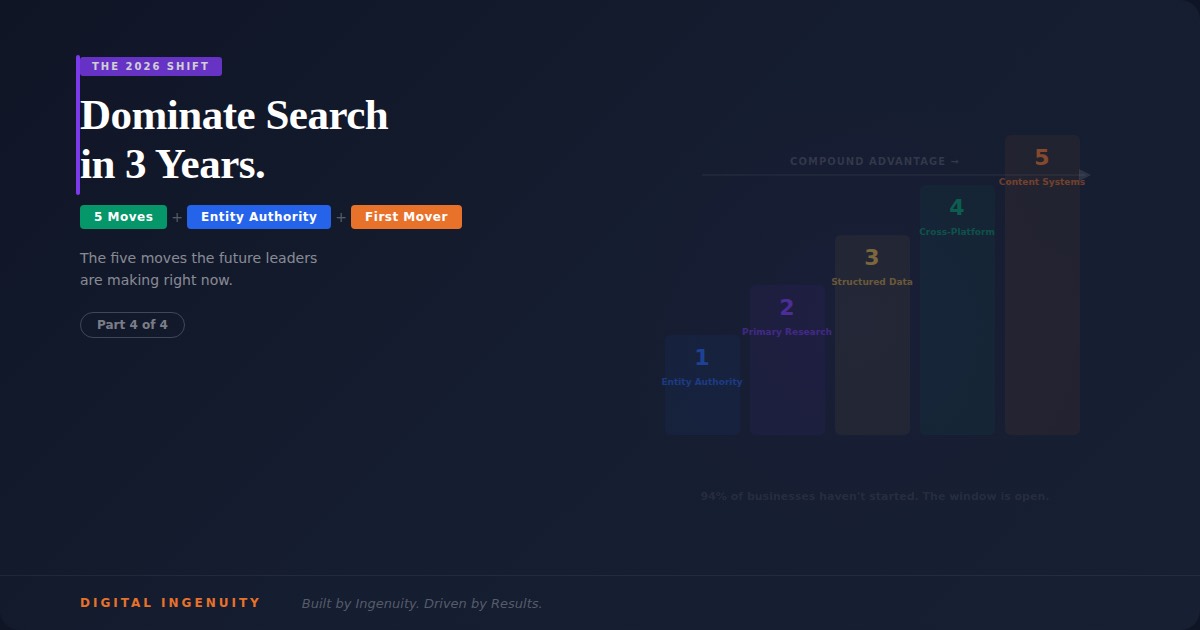
- Based on our research — 3,900 AI-generated responses tracked over 90 days, 500 featured snippets analyzed, 50 business websites audited — we’ve identified five strategic moves that the future search leaders are making today
- Move 1: Building entity authority, not just page authority. Structured data, cross-platform presence, third-party corroboration — the signals AI platforms use to decide who to trust
- Move 2: Creating primary research content that becomes the source other sites cite. Original data, experiments, and case studies — the content type Manus cites at 3.2x the rate of derivative content
- Move 3: Implementing comprehensive structured data as a foundational layer. The businesses in our schema experiment went from AI-invisible to AI-cited in 30 days through structured data alone
- Move 4: Claiming and optimizing cross-platform presence — Google, Bing, Apple Maps, directories — because each AI platform and voice assistant draws from different data sources
- Move 5: Treating content as an engineered system, not a marketing activity. Topical clusters, internal linking architecture, strategic series — quality over volume
- The window for first-mover advantage is open now but closing. 94% of businesses in our audit had zero AI search optimization. Early movers build compounding authority that late movers can’t easily replicate
The Advantage of Acting Early
In every technological shift, there’s a window where early adopters build advantages that become permanent. Google’s early algorithm rewarded any website with relevant content and a few backlinks — the businesses that established authority early still benefit from decades of accumulated trust. Amazon’s early marketplace sellers built review histories and search rankings that new entrants struggle to overcome.
AI search is in that window right now.
According to our 50-website audit, 94% of businesses have zero optimization for AI search. No structured data targeting AI platforms. No entity authority building. No cross-platform presence strategy. The overwhelming majority of businesses haven’t begun adapting to a shift that’s already affecting their revenue.
This creates asymmetric opportunity. The businesses that move now aren’t competing against well-optimized rivals — they’re entering an empty field. And entity authority, once established, compounds over time in a way that’s increasingly difficult for competitors to replicate.
Forrester Research’s 2025 analysis of digital maturity found that companies in the top 20% of digital readiness captured 80% of digital revenue growth in their respective industries. The same concentration effect is emerging in AI search visibility.
Move 1: Building Entity Authority
Entity authority is the composite signal that tells AI platforms your business is real, trustworthy, and worth recommending. It’s not a single metric — it’s the sum of multiple signals that AI systems evaluate holistically.
What the future leaders are doing now:
They’re implementing Organization and LocalBusiness schema that explicitly defines their business as an entity — with name, address, services, founding date, leadership, service area, and review data in structured format. This isn’t optional optimization. It’s how you introduce yourself to AI systems in their native language.
They’re building consistent NAP (Name, Address, Phone) data across every platform on the web. AI systems cross-reference this data to verify entity identity. Inconsistency — different business names, different addresses, different phone numbers across directories — signals unreliability.
They’re earning third-party mentions through expert source responses (HARO/Connectively), contributed articles, and industry directory profiles. As our 90-day tracking study found, third-party corroboration is one of the three characteristics that make AI citations persist rather than fluctuate.
Why this compounds: Every new third-party mention, every new directory listing, every new review makes the entity signal stronger. AI platforms that cite you once become more confident citing you again. Google’s Knowledge Graph adds data about your entity over time. The authority builds on itself.
What’s NOT entity authority: Keyword-stuffed content. Generic marketing copy. Backlinks from low-quality directories. Social media follower counts. These are either noise or actively harmful signals.
Move 2: Creating Primary Research
Our tracking study found that Manus cited primary research — original data, experiments, case studies with specific numbers — at 3.2x the rate of derivative content. That’s the most dramatic content-type preference we observed on any platform.
But Manus isn’t alone. Every AI platform we tested showed preference for original, citeable content. Claude favored content demonstrating genuine expertise. Perplexity favored content with citations and transparent methodology. ChatGPT favored comprehensive content that synthesized unique insights.
What the future leaders are doing now:
They’re documenting their work as research. Instead of just building websites for clients, they’re tracking the before/after metrics and publishing the results. Instead of just implementing SEO strategies, they’re running controlled experiments and sharing the data. Instead of just auditing competitors, they’re aggregating audit data across dozens of sites and identifying patterns.
This is exactly what we’ve done with The Search Lab series — running experiments across six AI platforms, tracking results over 90 days, and publishing methodology-transparent findings. That content is citeable in a way that “10 Tips for Better SEO” never will be.
According to Orbit Media’s annual blogging survey, only 3% of bloggers publish original research. In a BuzzSumo analysis of content that earns backlinks, original research generated 6x more backlinks than any other content type. The supply is low, the demand is high, and AI platforms specifically seek it out.
The framework: Take something your business does routinely and turn it into data. Audit 50 websites in your industry and publish the patterns. Test a specific tactic and document the timeline. Survey your customers and share the findings. Track a metric over time and report the trend.
Primary research doesn’t require a laboratory or a PhD. It requires documenting what you already know from experience in a structured, data-driven format.
Move 3: Implementing Comprehensive Structured Data
If there’s one move that offers the highest ROI for the lowest effort, it’s structured data implementation.
In our schema experiment, adding structured data to a site with zero schema — without changing any visible content — produced a 69.6% increase in organic impressions, an 87.6% increase in organic clicks, and AI platform citations from ChatGPT, Claude, Perplexity, Copilot, and Manus within 30 days.
What the future leaders are implementing:
Organization schema with comprehensive entity details. LocalBusiness schema with geographic information. Service schema defining specific offerings. FAQ schema on key service pages and content. Review/AggregateRating schema from actual review data. Speakable schema marking content sections for voice assistant readback. BreadcrumbList schema for site hierarchy clarity.
Google’s own documentation on structured data has expanded significantly in recent years. In 2025, Google added structured data support for additional schema types and enhanced their Rich Results Test to validate more complex nested schema. This signals continued investment in structured data as a ranking and citation input.
Why most businesses haven’t done this: It’s invisible. Business owners can’t see structured data on their website. It doesn’t change how the site looks. There’s no visual improvement to show a client. As a result, many agencies deprioritize it in favor of more visible changes — new designs, new content, new social media posts.
But AI platforms don’t see your design. They see your data. And structured data is the single most impactful thing you can do to make that data clear.
Move 4: Claiming Cross-Platform Presence
Each AI platform and voice assistant draws from different data sources. Google Assistant uses Google’s ecosystem. Siri uses Bing and Apple Maps. Alexa uses Bing and Amazon’s data. Copilot draws from Bing’s index and LinkedIn. Perplexity runs real-time web searches.
What the future leaders are doing now:
They’re claiming and fully optimizing listings on Google Business Profile, Bing Places, AND Apple Maps Connect. They’re creating profiles on Clutch, DesignRush, UpCity, and industry-specific directories. They’re maintaining active LinkedIn company pages (Copilot gives weight to LinkedIn signals). They’re ensuring consistent information across every platform.
According to Moz’s 2025 Local Search Ranking Factors study, citation consistency across the web remained the #3 most important ranking factor for local search — and its weight has increased year over year as Google has placed greater emphasis on entity verification.
The math is simple: If Siri and Alexa together represent 55% of the US smart speaker market (per Voicebot.ai), and both pull from Bing — then a business without Bing Places is invisible on the majority of voice platforms. Claiming a Bing Places listing takes 15 minutes. The ROI is asymmetric.
Move 5: Treating Content as an Engineered System
The future leaders have abandoned the “publish 4 blog posts per month” model. They’re building content systems — strategic architectures designed for compound effect.
What this looks like in practice:
Instead of disconnected blog posts on random topics, they build topical clusters: a pillar page that covers a broad topic comprehensively, supported by 3-8 detailed posts that explore specific subtopics, all interlinked to create topical depth that Google and AI platforms recognize as authority.
Instead of measuring content by volume, they measure by performance per page. Our content deletion experiment proved this: removing 60% of a client’s blog posts increased organic traffic 41% because the remaining content was concentrated authority rather than diluted noise.
Instead of publishing for publishing’s sake, they publish for citation. Every piece of content is designed to answer a specific question well enough that AI platforms extract and cite it. FAQ formatting, direct answers, structured headings, and specific claims — engineered for machine consumption as much as human reading.
Andy Crestodina at Orbit Media has been tracking this trend in his annual blogging survey: the average blog post takes 4 hours and 10 minutes to write in 2025, up from 2 hours and 24 minutes in 2015. The bloggers producing the best results are investing more time per post, not producing more posts. Quality over volume isn’t just our opinion — it’s the documented trend across the entire content marketing industry.
The Window Is Open
Right now, 94% of businesses haven’t started adapting to AI search. That’s the opportunity.
In 2-3 years, the early movers will have accumulated structured data that’s been indexed for years, entity authority corroborated across dozens of sources, AI citation history that builds platform trust, a content library designed for compound citation effects, and cross-platform presence that covers every discovery channel.
Late movers will start from zero on all five dimensions, competing against businesses with 2-3 years of compounded advantage.
The first movers in SEO circa 2005 are still benefiting from the domain authority they built two decades ago. The first movers in AI search optimization in 2026 will carry a similar advantage through the next decade of search evolution.
The five moves outlined above are the foundation. None of them require massive budgets. All of them require intentionality and consistency. The businesses that make these moves now — while competitors are still running 2022 playbooks — will be the ones AI platforms cite in 2029.
This is Part 4 of 4 in The 2026 Shift series — forward-looking thought leadership.
Previous: Why Most “AI Marketing” Is Just Regular Marketing With a ChatGPT Logo
Start from the beginning: Search in 2027: Five Predictions
Ready to start building for 2029? Book a free discovery call →
See the full four-pillar framework: SEO + GEO + AEO + VEO →