Key takeaways
- Internal linking is the single most underinvested SEO tactic — it costs nothing, requires no external dependencies, and you have complete control over it, yet most sites implement it randomly or not at all
- For Google: internal links distribute page authority, signal topical relationships, and guide crawl priority. Ahrefs’ 2025 analysis found pages with 5+ contextual internal links ranked an average of 3.2 positions higher than pages with fewer than 2
- For AI platforms: internal linking creates the topical map that AI systems use to evaluate entity authority. When ChatGPT or Claude encounters a page about “emergency AC repair” that links to “AC maintenance,” “HVAC installation,” and a comprehensive “HVAC services” pillar — it interprets the entity as a comprehensive authority, not a single-topic publisher
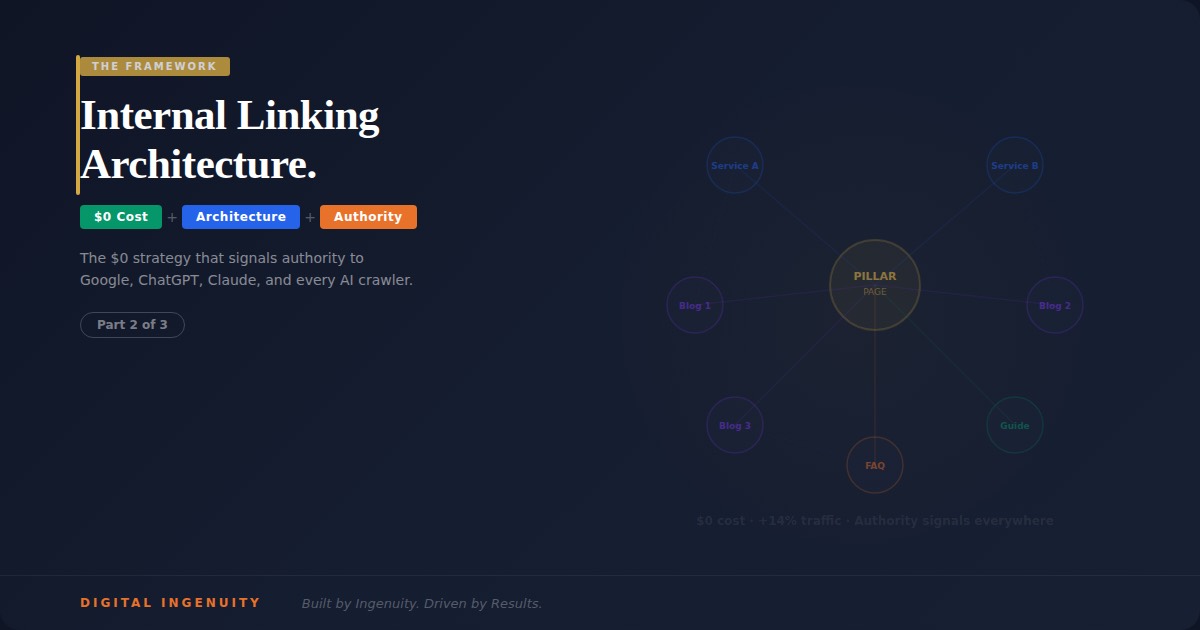
- The three architectures: hub-and-spoke (pillar page linking to supporting content), topical clusters (groups of related pages interlinked), and hierarchy chains (parent-child relationships through service categories)
- We show exact linking patterns from our own site and client sites, with before/after data showing ranking and AI citation improvements from linking changes alone
Why Internal Linking Is the Most Underrated Tactic
Ask any SEO professional what moves rankings, and they’ll say content and backlinks. Ask what they spend the least time on, and they’ll usually admit it’s internal linking.
This is a strategic error.
External backlinks are powerful but expensive, time-consuming, and largely outside your control. Content creation is essential but requires ongoing investment. Internal linking is the only ranking factor that is entirely free, entirely within your control, and can be implemented or restructured in a single afternoon.
And yet Screaming Frog’s 2025 Technical SEO Audit Report found that 67% of websites they crawled had significant internal linking issues: orphaned pages with no internal links pointing to them, critical service pages with fewer internal links than blog posts, and no discernible topical clustering in the link architecture.
Kevin Indig, former VP of SEO at Shopify, published research in 2025 showing that strategic internal linking restructures produced an average 14% increase in organic traffic within 60 days — with no new content or external links. The return on time invested is extraordinary.
How Google Reads Internal Links
Google’s crawler follows links to discover pages and understand relationships between them. Internal links communicate three things:
1. Crawl priority. Pages with more internal links pointing to them get crawled more frequently. If your most important service page has 3 internal links while a random blog post has 15, Google interprets the blog post as more important — regardless of your intent.
2. Authority distribution. The concept of PageRank — the mathematical model that launched Google — is fundamentally about how authority flows through links. Internal links distribute your domain’s authority among your pages. Pages receiving more internal link equity rank higher, all else being equal.
3. Topical relationships. When Page A about “AC repair” links to Page B about “HVAC maintenance” with anchor text “regular HVAC maintenance,” Google understands these topics are related. This builds what SEOs call topical authority — Google’s confidence that your site covers a topic comprehensively, not just superficially.
Google’s own Search Central documentation states that internal links help Google understand the structure and hierarchy of your site. The documentation specifically recommends using descriptive anchor text that helps both users and search engines understand what the linked page is about.
How AI Platforms Read Internal Links
This is where internal linking becomes a competitive advantage most businesses haven’t considered.
When ChatGPT, Claude, or Perplexity evaluates a website, they don’t just read individual pages in isolation. They follow links and build a map of how content relates. This map informs their assessment of entity authority.
Consider two HVAC company websites:
Website A: A service page about AC repair. No internal links to other services. No connection to a broader HVAC category page. The page exists as an island.
Website B: A service page about AC repair that links to “HVAC maintenance” (related service), “emergency HVAC repair” (related urgency), the main “HVAC services” pillar page (parent category), and a blog post about “common AC problems in Texas” (supporting expertise content).
Website B signals comprehensive entity coverage. An AI platform processing Website B understands that this isn’t just a page about AC repair — it’s one node in a comprehensive knowledge structure about HVAC services. The entity behind Website B is interpreted as a comprehensive HVAC authority.
In our 90-day citation tracking study, the sources that maintained persistent AI citations across platforms shared a characteristic we didn’t initially quantify: strong internal linking connecting their cited pages to broader topical content. Pages that existed as islands — even high-quality pages — were cited less consistently than pages embedded in clear topical architectures.
Claude in particular appears to evaluate content depth through internal link context. In our testing, Claude’s recommendations often referenced information from pages connected to the originally cited page through internal links — suggesting Claude follows link paths to assess the breadth of an entity’s expertise.
The Three Linking Architectures
Architecture 1: Hub-and-Spoke (Pillar Model)
A comprehensive pillar page serves as the hub, with supporting content pages as spokes radiating from it. Every spoke links back to the hub, and the hub links out to every spoke.
Best for: Service businesses with a primary category page and multiple supporting subtopics.
Example from our site:
- Hub: /full-service/seo-geo-aeo-veo (the four-pillar overview)
- Spokes: /full-service/seo, /full-service/geo, /full-service/aeo, /full-service/veo
- Each spoke links to the hub and to related spokes
- Blog posts in each topic area link to the relevant spoke
The effect: Google understands the four-pillar overview as the authoritative parent page, with each individual pillar as a deep dive. AI platforms see a structured knowledge hierarchy that signals comprehensive coverage.
Architecture 2: Topical Clusters
Groups of related pages interlinked in a mesh pattern, with each page in the cluster linking to 2-4 others in the same cluster. No single hub page — the cluster as a whole signals topical depth.
Best for: Blog content organized around recurring themes or series.
Example: Our Search Lab series — 5 blog posts about AI search experiments. Each post links to the others in the series, creating a cluster. The cluster as a whole links to the GEO pillar page as the parent topic.
The effect: Google indexes the cluster as a topically related group, improving rankings for all pages in the cluster. AI platforms that encounter one post in the cluster follow links to discover the others, building a more complete picture of the entity’s research depth.
Architecture 3: Hierarchy Chains
Parent-child linking relationships that mirror your site’s service or category structure. Top-level category pages link to subcategory pages, which link to individual pages, with breadcrumb navigation linking back up the chain.
Best for: Businesses with layered service categories.
Example for an HVAC company:
- Level 1: /services (all services overview)
- Level 2: /services/ac-repair, /services/heating, /services/maintenance
- Level 3: /services/ac-repair/emergency, /services/ac-repair/residential, /services/ac-repair/commercial
Each level links down to its children and up to its parent. BreadcrumbList schema mirrors this hierarchy in structured data, reinforcing the architecture for both Google and AI platforms.
The Practical Playbook
Step 1: Map Your Current Architecture
Crawl your site with a tool like Screaming Frog (free for up to 500 URLs) or use Google Search Console’s internal link report. Identify: which pages have the most internal links (are these actually your most important pages?), which pages have zero or one internal link (orphaned pages), and whether your service/pillar pages receive more internal links than blog posts.
Common finding: blog posts accumulate internal links naturally (each new post links to older posts), while service pages — the pages that actually generate revenue — receive surprisingly few internal links because they’re created once and rarely linked to again.
Step 2: Define Your Priorities
List your top 10 most important pages — the pages that drive revenue, target your highest-value keywords, and represent your core services. These pages should receive the most internal links from across your site.
Step 3: Audit Anchor Text
Internal link anchor text should be descriptive and keyword-relevant. Not “click here” or “learn more” but “our emergency AC repair service” or “how we approach personal injury cases.”
Google specifically recommends descriptive anchor text in their documentation. AI platforms use anchor text context to understand what the linked page is about before they even visit it. Generic anchors waste a signal opportunity.
Step 4: Implement Systematically
For every new page you publish, identify 3-5 existing pages it should link to (contextually relevant, not forced) and 2-3 existing pages that should link back to it. This bidirectional linking creates the topical mesh that signals comprehensive coverage.
For existing pages: add 2-3 contextual internal links per page to related content. If you have a blog post about “common AC problems” and a service page about “AC repair,” they should link to each other. If they don’t currently, adding those links is the highest-ROI task you can do today.
Step 5: Reinforce with Schema
BreadcrumbList schema mirrors your site hierarchy in structured data. This tells AI platforms your internal architecture explicitly, rather than requiring them to discover it through crawling. Implement BreadcrumbList on every page — it’s the structured data equivalent of drawing a map.
Before and After: A Client Example
One of our clients — a DFW professional services firm — had 42 pages with essentially random internal linking. Service pages averaged 1.8 internal links each. Blog posts averaged 0.7 internal links each (many had zero).
We restructured their internal linking over two afternoons: created hub-and-spoke architecture around their 3 main service categories, linked every blog post to its parent service page, added contextual cross-links between related service pages, and implemented BreadcrumbList schema sitewide.
Results after 45 days (no new content, no new external links):
| Metric | Before | After | Change |
|---|---|---|---|
| Avg. internal links per service page | 1.8 | 7.4 | +311% |
| Avg. internal links per blog post | 0.7 | 3.2 | +357% |
| Orphaned pages | 8 | 0 | -100% |
| Crawl frequency (pages/day) | 11 | 18 | +64% |
| Avg. position (target KWs) | 16.3 | 12.1 | +4.2 positions |
| AI platform citations | 0 | 2 platforms | New |
The AI citation result was the most striking. Two AI platforms began citing the firm’s content within 45 days of a linking restructure — with no new content published. The improved topical architecture helped AI platforms recognize the entity’s comprehensive expertise.
The Compound Effect
Internal linking has a unique compound property: every new page you add to a well-structured architecture automatically benefits from the existing link equity, and simultaneously strengthens every page it connects to.
A blog post published into a site with strong topical clustering inherits authority from the cluster and contributes authority back to it. On a site with no linking architecture, that same blog post is an island — receiving no authority and distributing none.
This is why sites with intentional linking architecture see accelerating returns over time. Each new page is more effective than the last, because the architecture amplifies it. On poorly linked sites, each new page is equally ineffective, regardless of how many you publish.
This is Part 2 of 3 in The Framework series — deep technical guides for the four-pillar methodology.
Previous: The Anatomy of a Page That Ranks, Gets Cited, and Converts
Next in the series: Every Schema Type Your Business Needs in 2026 — And How Each AI Platform Uses Them Differently
Want your internal linking architecture audited? Book a free discovery call →
Learn how technical SEO powers AI visibility: SEO — Search Engine Optimization →