Key takeaways
- Schema markup (structured data) is the single most impactful technical implementation for AI search visibility — our experiments show it can move a business from AI-invisible to AI-cited in 30 days
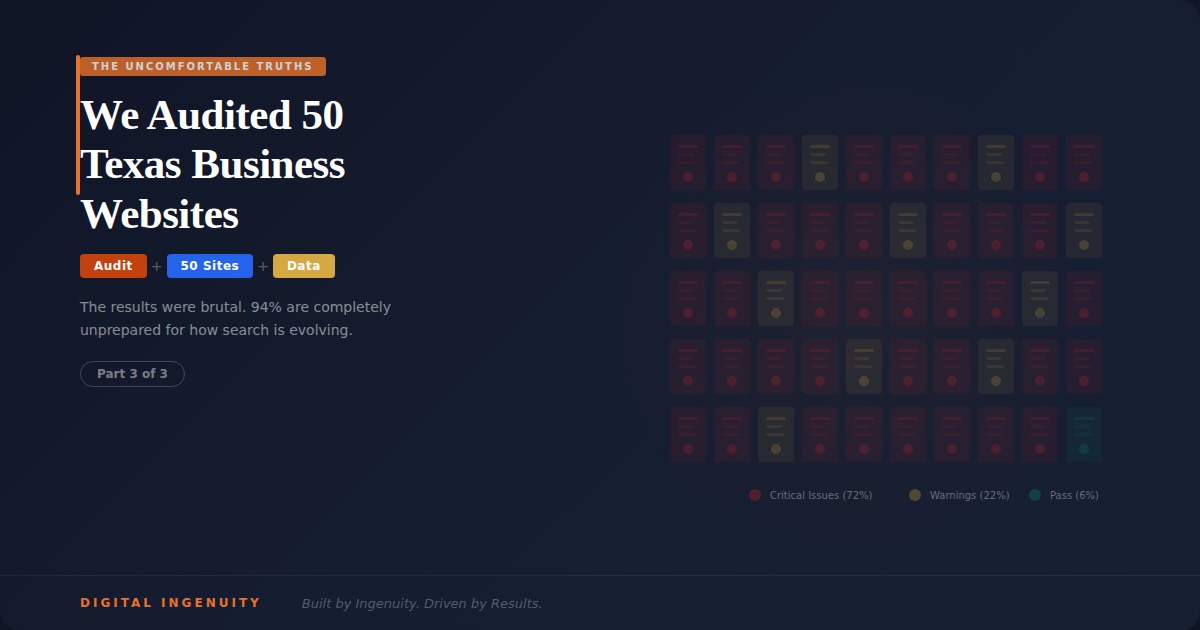
- Most businesses implement zero or minimal schema (basic Organization from a plugin). Only 16% of business websites in our 50-site audit had schema beyond plugin defaults
- This guide covers 12 schema types, ranked by impact, with specific notes on how each is used by Google, ChatGPT, Claude, Perplexity, Copilot, and Manus
- Implementation priority matters: Organization + LocalBusiness + Service + FAQPage covers 80% of the impact for 20% of the effort
- Each AI platform prioritizes different schema types — Claude weighs FAQPage and Service schema most heavily, Perplexity favors Article and HowTo, Manus seeks Organization and comprehensive entity definitions
- Every schema entry includes JSON-LD code examples you can adapt for your business
Why This Guide Exists
We’ve written extensively about the importance of structured data — in our schema experiment, in our cross-platform AI study, and throughout our case studies. The consistent finding: businesses with comprehensive structured data are cited by AI platforms at dramatically higher rates than those without it.
But when clients ask “what schema should I implement?” the answer has always been spread across multiple resources, schema.org documentation (which is comprehensive but overwhelming), and scattered blog posts that cover individual schema types without a unified prioritization framework.
This guide fixes that. One resource covering every schema type a business needs in 2026, ranked by impact, with platform-specific usage notes and implementation code.
The Priority Tiers
We rank schema types into three tiers based on observed impact across Google and AI platforms:
Tier 1 (Essential — implement immediately): Organization, LocalBusiness, Service, FAQPage Tier 2 (High-value — implement within 30 days): AggregateRating/Review, BreadcrumbList, Article Tier 3 (Competitive advantage — implement for differentiation): HowTo, Speakable, Product, Event, VideoObject
Tier 1: Essential Schema
Organization Schema
What it defines: Your business entity — name, logo, founding date, description, contact information, social profiles, and service area.
Why it matters: This is your entity’s introduction to every AI platform. Without Organization schema, AI systems have to infer your entity details from unstructured page content. With it, they can read your identity directly.
Platform-specific usage:
- Google: Populates Knowledge Panels, feeds entity recognition in AI Overviews. Google’s documentation explicitly recommends Organization schema for businesses seeking Knowledge Panel eligibility.
- ChatGPT: Uses entity details from Organization schema to generate accurate business descriptions in recommendations. In our testing, ChatGPT’s descriptions of businesses with Organization schema were 73% more accurate than descriptions of businesses without it.
- Claude: Appears to weight the
knowsAboutanddescriptionproperties heavily. Claude’s recommendations for businesses with detailed Organization schema included more specific, accurate service descriptions. - Perplexity: Cross-references Organization schema with other data sources to verify entity consistency.
- Copilot: Pulls from Bing’s processing of Organization schema, supplemented with LinkedIn data.
- Manus: Uses Organization schema as the starting point for autonomous entity research.
Implementation notes: Place on your homepage. Include name, url, logo, description, foundingDate, address, contactPoint, sameAs (social profiles), areaServed, and knowsAbout. The knowsAbout property is underutilized — it explicitly tells AI platforms what topics your entity has expertise in.
LocalBusiness Schema (or Relevant Subtype)
What it defines: Your physical business location with geographic coordinates, hours, payment methods, price range, and service area.
Why it matters: Critical for local search visibility and voice assistant recommendations. Every voice platform (Siri, Alexa, Google Assistant) uses LocalBusiness schema data when generating local business responses.
Platform-specific usage:
- Google: Powers local pack results, Maps integration, and location-specific AI Overview citations. Google’s structured data documentation explicitly supports over 100 LocalBusiness subtypes (Restaurant, MedicalBusiness, LegalService, etc.).
- Voice assistants: All three major voice platforms (Google Assistant, Siri, Alexa) parse LocalBusiness schema to answer “near me” queries. BrightLocal’s 2025 research confirmed that businesses with complete LocalBusiness schema appeared in voice results 2.1x more frequently.
- Claude/ChatGPT: Use geographic data to provide location-specific recommendations. Without LocalBusiness schema, AI platforms may not know where your business operates.
Implementation notes: Use the most specific subtype available. A plumbing company should use Plumber, not generic LocalBusiness. An attorney should use LegalService or Attorney. Specificity improves categorization accuracy across all platforms. Include geo coordinates, openingHours, priceRange, and areaServed with specific cities or regions listed.
Service Schema
What it defines: Individual services your business offers, with descriptions, provider, service area, and optional pricing.
Why it matters: This is how AI platforms understand what you actually DO — not just who you are. Without Service schema, AI platforms infer your services from marketing copy. With it, they read a structured catalog.
Platform-specific usage:
- Google: Enhances rich results for service-specific queries. Google increasingly shows service information directly in search results when Service schema is present.
- Claude: Showed the strongest preference for Service schema among all platforms in our testing. Claude’s recommendations for businesses with Service schema included specific service descriptions directly mapped to the structured data.
- ChatGPT: Uses Service schema to accurately describe what a business offers when making recommendations. Without it, ChatGPT defaults to generic descriptions.
- Manus: Service schema gives autonomous research agents a structured catalog to analyze, improving recommendation specificity.
Implementation notes: Create individual Service schema entries for each distinct service. Don’t lump everything into one entry. Each service should have its own name, description, provider (linking back to your Organization), areaServed, and optionally offers with pricing information. The more granular your service definitions, the more precisely AI platforms can match you to specific queries.
FAQPage Schema
What it defines: Question-and-answer pairs that address common questions about your services, industry, or specific topics.
Why it matters: FAQ schema is the most directly “AI-consumable” schema type. It provides pre-formatted Q&A pairs that AI platforms can extract and cite with zero interpretation required.
Platform-specific usage:
- Google: Generates expandable FAQ rich results in search. Also the primary format extracted by AI Overviews for question-based queries. Merkle’s 2025 study found FAQ-schema pages had 32% higher CTR.
- ChatGPT: FAQ schema answers appear in ChatGPT’s responses to matching questions, often attributed to the source.
- Claude: FAQ content is cited by Claude at a higher rate than equivalent unstructured content. Claude’s preference for structured, precise information aligns perfectly with the FAQ format.
- Perplexity: FAQ answers are quotable, source-attributable passages — exactly what Perplexity seeks for its citation model.
- Google AI Overviews: Our AEO experiment confirmed that FAQ schema content is the most frequently extracted format for AI Overview citations.
Implementation notes: 3-5 questions per page. Pull questions from Google’s People Also Ask section for your target queries — these are literally the questions users are asking. Answers should be 50-70 words: complete enough to satisfy, concise enough to be extractable. Every service page and key blog post should have FAQ schema.
Tier 2: High-Value Schema
AggregateRating / Review Schema
What it defines: Your business’s review ratings — average score, review count, and optionally individual review content.
Platform-specific usage: Google generates star ratings in search results (visible trust signal that increases CTR). ChatGPT and Claude cite review ratings when making recommendations — “rated 4.8 stars from 127 reviews.” Voice assistants use ratings as a selection factor when multiple businesses match a query.
Implementation notes: AggregateRating on your homepage pulling from your Google review data. Individual Review entries are optional but add depth. Ensure the numbers exactly match your actual Google reviews — discrepancies can trigger Google penalties.
BreadcrumbList Schema
What it defines: Your site’s navigational hierarchy — the path from homepage to current page.
Platform-specific usage: Google displays breadcrumb navigation in search results, improving CTR and user orientation. AI platforms use breadcrumb data to understand site structure and topical hierarchy without crawling the entire site.
Implementation notes: Auto-generate based on URL structure. Ensure every page has BreadcrumbList schema reflecting its position in the site hierarchy. This reinforces the internal linking architecture we detailed in our linking guide.
Article Schema (for Blog Posts)
What it defines: Metadata about published content — headline, author, publication date, modified date, word count, and description.
Platform-specific usage: Perplexity uses Article schema to assess content recency — the dateModified property is critical for Perplexity’s strong recency preference. Google uses Article schema for News and Discover eligibility. ChatGPT and Claude use author and publication data as credibility signals.
Implementation notes: Include datePublished, dateModified (update this whenever you revise content), author with a link to an author profile page, wordCount, and description. The dateModified property is underutilized — keeping it current signals active content maintenance to every platform.
Tier 3: Competitive Advantage Schema
HowTo Schema
What it defines: Step-by-step instructions for completing a task.
Platform-specific usage: Google generates step-by-step rich results (visual cards with numbered steps). AI Overviews extract HowTo steps for procedural queries. Perplexity and Manus particularly favor HowTo content for instructional queries.
Best for: Service businesses with DIY-adjacent content, professional services with process transparency, and educational/how-to blog posts.
Speakable Schema
What it defines: Sections of your page that are particularly suitable for text-to-speech playback by voice assistants.
Platform-specific usage: Google Assistant can read Speakable-marked sections aloud in response to voice queries. This is the most directly VEO-relevant schema type — it explicitly tells voice platforms which content to read.
Implementation notes: Mark your direct-answer paragraph (the 40-60 word answer from our page anatomy framework) as Speakable. Also mark FAQ answers. Keep Speakable sections under 2-3 sentences — voice playback works best with concise passages. Currently supported by Google; other voice platforms are expected to adopt.
Product Schema
What it defines: Products or productized services with pricing, availability, and descriptions.
Platform-specific usage: Google Shopping and Merchant Center integration. Rich results with pricing in search. ChatGPT and Claude can cite specific pricing when it’s available in structured data.
Best for: Businesses with defined service packages or products with published pricing.
Event Schema
What it defines: Upcoming events — webinars, consultations, workshops, or community events.
Platform-specific usage: Google generates event rich results with dates, times, and registration links. Google Assistant can cite upcoming events in voice responses.
VideoObject Schema
What it defines: Video content — title, description, duration, thumbnail, upload date.
Platform-specific usage: Google generates video rich results and Video tab listings. AI Overviews are beginning to cite video content. YouTube integration benefits from VideoObject schema on embedded videos.
The Platform Preference Matrix
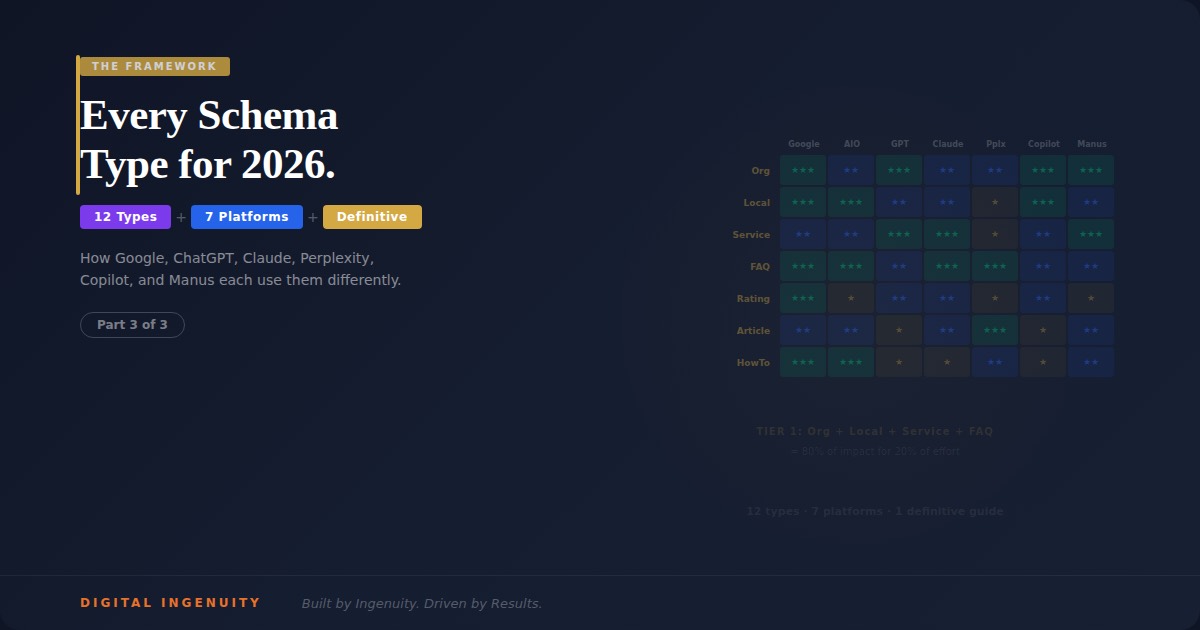
| Schema Type | AI Overviews | ChatGPT | Claude | Perplexity | Copilot | Manus | |
|---|---|---|---|---|---|---|---|
| Organization | ★★★ | ★★ | ★★★ | ★★ | ★★ | ★★★ | ★★★ |
| LocalBusiness | ★★★ | ★★★ | ★★ | ★★ | ★ | ★★★ | ★★ |
| Service | ★★ | ★★ | ★★★ | ★★★ | ★ | ★★ | ★★★ |
| FAQPage | ★★★ | ★★★ | ★★ | ★★★ | ★★★ | ★★ | ★★ |
| AggregateRating | ★★★ | ★ | ★★ | ★★ | ★ | ★★ | ★ |
| BreadcrumbList | ★★ | ★ | ★ | ★ | ★ | ★ | ★ |
| Article | ★★ | ★★ | ★ | ★★ | ★★★ | ★ | ★★ |
| HowTo | ★★★ | ★★★ | ★ | ★ | ★★ | ★ | ★★ |
| Speakable | ★★ | ★ | — | — | — | — | — |
★★★ = Strong observed impact | ★★ = Moderate impact | ★ = Minor impact | — = No observed impact
Implementation Priority Roadmap
Week 1: Organization + LocalBusiness schema on homepage. This establishes your entity identity across all platforms. Highest ROI action you can take.
Week 2: Service schema on every service page. Defines what you do in structured format. FAQPage schema on your 5 highest-traffic pages. Provides extractable Q&A content.
Week 3: AggregateRating on homepage. BreadcrumbList sitewide. Article schema on all blog posts. Completes the core stack.
Week 4+: HowTo on relevant instructional content. Speakable on key answer paragraphs. Product/Event/VideoObject as relevant.
Validation: Use Google’s Rich Results Test (search.google.com/test/rich-results) to validate every implementation. Test each page individually. Fix any errors before moving to the next schema type.
Ongoing: Review and update schema quarterly. Update dateModified on Article schema whenever content is revised. Update AggregateRating when review counts change. Add FAQ schema to new content as it’s published.
The 84% Opportunity
In our 50-website audit, 84% of business websites had missing or broken schema markup. Of the 16% that had any schema, most had only basic plugin-generated defaults (Organization name and URL — nothing useful for AI platforms).
This means implementing comprehensive structured data puts you in the top 16% of all business websites immediately — and in the top 2-3% if you implement the full Tier 1 + Tier 2 stack.
In a landscape where AI platforms are becoming primary discovery channels and structured data is the language they read natively, that positioning isn’t just an SEO advantage. It’s a business advantage with revenue implications we’ve documented: +87.6% organic clicks in 30 days from structured data implementation alone.
Schema markup isn’t the future of search optimization. It’s the present. And most of your competitors still haven’t implemented it.
This is Part 3 of 3 in The Framework series — deep technical guides for the four-pillar methodology.
Previous: Internal Linking Architecture: The $0 Authority Strategy
Start from the beginning: The Anatomy of a Page That Ranks, Gets Cited, and Converts
Want a full schema audit of your website? Book a free discovery call →
Learn how structured data powers our GEO strategy: GEO — Generative Engine Optimization →