Key takeaways
- The “SEO is dead” narrative resurfaces every year, and every year it’s wrong — but the 2026 version of this narrative is directionally more correct than previous iterations, which makes it more dangerous
- Google’s 10 blue links aren’t dead, but they’re sharing the page with AI Overviews, featured snippets, People Also Ask, local packs, and knowledge panels — organic results are getting squeezed into a smaller percentage of the visible SERP
- According to SparkToro’s 2025 data, Google still processes over 8.5 billion searches per day. Even if AI platforms capture 15-20% of discovery queries, Google organic remains the largest single source of business discovery by a wide margin
- The mistake isn’t continuing to invest in SEO — it’s investing in SEO exclusively while ignoring the channels growing around it
- ChatGPT, Claude, Perplexity, Copilot, and Manus aren’t replacing Google. They’re creating parallel discovery channels that compound with strong SEO rather than compete with it
- The winning strategy isn’t “pivot from SEO to AI” — it’s “build an SEO foundation strong enough that AI platforms cite you as a trusted source”
The Annual Death of SEO
Every year since roughly 2012, someone declares that SEO is dead. Social media will replace search. Voice search will replace typed queries. AI will replace everything.
And every year, Google processes more searches than the year before. According to Internet Live Stats, Google handled approximately 8.5 billion searches per day in 2025. StatCounter’s global data shows Google maintaining 91.5% of the worldwide search engine market share.
SEO is not dead. The businesses that rank well on Google still capture an enormous, valuable stream of customer attention.
But — and this is the important part — the SEO purists who use these statistics to argue that nothing has changed are also wrong. Something HAS changed. It’s just not what the “SEO is dead” crowd claims.
What’s Actually Happening: The SERP Is Fragmenting
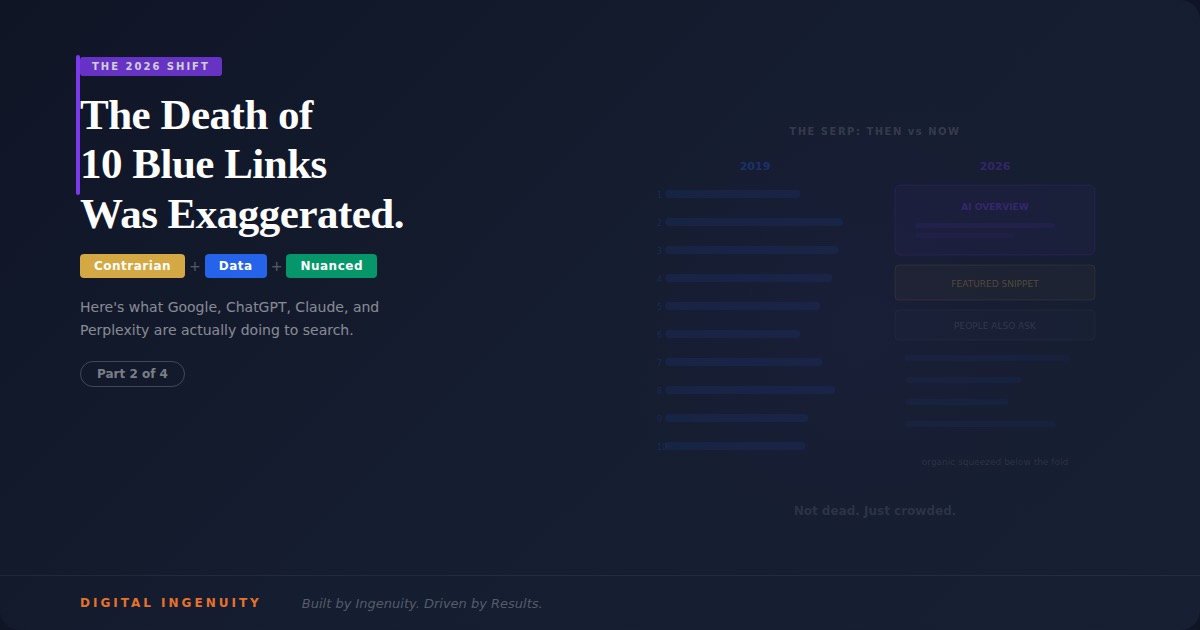
The 10 blue links still exist on most Google searches. But they’re no longer the main feature. They’re one component of an increasingly complex results page.
A typical informational Google search in 2026 shows:
- AI Overview at the top (when triggered)
- Featured snippet or knowledge panel
- People Also Ask accordion
- Organic results beginning below the fold
- Related searches at the bottom
Searchmetrics’ 2025 SERP Feature Study found that the average first-page Google result now competes with 4.2 SERP features above, beside, or interspersed with organic listings. In 2019, that number was 1.8.
The organic links aren’t gone. They’re just fighting for attention against more features, in less prominent positions, below more AI-generated content. The click-through rate for position 1 organic has declined from roughly 31% in 2019 (per Advanced Web Ranking data) to approximately 19-22% in 2025 — not because people stopped clicking, but because more options above the organic results capture attention first.
This is the nuance the “SEO is dead” crowd misses: organic traffic is declining as a percentage of total search activity, but the absolute volume of organic clicks is still massive because total search volume keeps growing.
What Each Platform Is Actually Doing
Rather than treating “AI search” as a monolith, let’s look at what each major platform is doing and what it means:
Google: Absorbing, Not Replacing
Google isn’t killing its own organic results. It’s surrounding them with features that keep users on Google’s properties longer. AI Overviews, featured snippets, and knowledge panels all serve this purpose — they answer questions without the user leaving Google.
For businesses, this means the path to visibility has forked. You can still rank in organic results (and should). But you can also be cited in AI Overviews, featured in snippets, and displayed in knowledge panels. Each of these is a separate visibility channel within Google’s ecosystem, and each requires different optimization.
The businesses winning on Google in 2026 aren’t just ranking — they’re appearing in multiple SERP features simultaneously. A single search for your primary keyword might show your business in the AI Overview, in a featured snippet, AND in the organic results. That’s compound visibility within a single platform.
ChatGPT: Creating a Parallel Channel
ChatGPT isn’t trying to be a search engine. It’s a recommendation engine. When someone asks ChatGPT for a business recommendation, the response format is fundamentally different from Google’s — it’s conversational, opinionated, and decisive.
Importantly, ChatGPT’s recommendations are influenced by the same content that drives Google rankings. The businesses ChatGPT recommends tend to have strong organic presence, authoritative content, and comprehensive entity signals. In our cross-platform experiment, there was significant overlap between businesses ranking well on Google and businesses ChatGPT recommended — but the correlation wasn’t perfect. Some businesses ranked highly on Google but were absent from ChatGPT, and vice versa.
ChatGPT represents additive discovery — a channel that runs alongside Google, not instead of it. Businesses with strong SEO get a head start on ChatGPT visibility, but they need additional optimization (entity authority, structured data, content specificity) to fully capitalize.
Claude: Rewarding Expertise
Claude has carved a distinctive niche. In our testing, Claude was the most discerning platform about content quality. It recommended businesses with deep, specific expertise content and avoided those with generic marketing copy, regardless of their Google rankings.
Claude’s preference for structured, precise information suggests it’s evaluating content through an expertise lens that’s different from Google’s algorithm. Google can rank a page based on backlinks, domain authority, and user signals even if the content is average. Claude appears to evaluate the content itself more directly.
This creates an interesting dynamic: Claude rewards the businesses that invest in genuinely authoritative content — the same content that makes every other platform more likely to cite you.
Perplexity: Real-Time Research Engine
Perplexity operates as a real-time search-and-synthesis platform. Unlike ChatGPT and Claude, which draw from trained knowledge, Perplexity runs live web searches for every query and synthesizes results with source attribution.
This makes Perplexity the most SEO-adjacent AI platform — if you rank well on Google, Perplexity is more likely to find and cite you. But Perplexity adds a layer: it evaluates the quality and specificity of the content it finds, and it favors recent content over older material.
According to Perplexity’s own published statistics, their platform processes over 100 million queries per month, growing roughly 30% quarter over quarter. That’s not replacing Google — but it’s a meaningful and growing channel.
Copilot and Manus: Different Data Ecosystems
Copilot draws from Bing’s index and Microsoft’s ecosystem. Manus deploys autonomous research agents across multiple sources. Both represent channels where Google-only optimization isn’t sufficient.
The common thread across all platforms: none of them is replacing Google. All of them are creating additional channels where your business can be discovered. The businesses appearing across all of them are the ones with the strongest entity authority — the same foundation that strong SEO builds.
The Real Risk: Optimization Monoculture
The actual danger isn’t that SEO is dying. It’s that businesses practicing SEO exclusively are building a monoculture — dependent on a single channel that’s becoming a smaller percentage of total customer discovery.
Farmers learned this lesson centuries ago: planting a single crop makes you vulnerable to a single disease. Businesses dependent entirely on Google organic traffic are vulnerable to any change Google makes — algorithm updates, AI Overview expansion, SERP feature changes.
The businesses that will thrive through 2027 and beyond are the ones treating SEO as the foundation — not the entirety — of their search visibility strategy. Strong SEO powers AI visibility. Featured snippet ownership feeds AI Overview citations. Structured data enables entity recognition across every platform. Quality content earns citations everywhere.
The four-pillar framework we use (SEO, GEO, AEO, VEO) isn’t about abandoning SEO for AI. It’s about building an SEO foundation strong enough to compound across every discovery channel that sits on top of it.
The Practical Takeaway
If someone tells you SEO is dead, they’re wrong. If someone tells you SEO alone is enough, they’re also wrong.
Google organic search remains the single largest source of business discovery. It will remain so through 2027 and likely beyond. Continue investing in technical SEO, content quality, and ranking improvement. That foundation is not optional.
But layer on top of it. Add structured data so AI platforms can read your entity signals. Optimize for featured snippets so AI Overviews cite you. Build cross-platform presence so Copilot, Siri, and Alexa can find you. Create content specific enough that Claude recognizes your expertise.
The 10 blue links aren’t dead. They’re just not alone anymore. And the businesses that thrive are the ones visible everywhere, not just in one place.
This is Part 2 of 4 in The 2026 Shift series — forward-looking thought leadership.
Previous: Search in 2027: Five Predictions
Next in the series: Why Most “AI Marketing” Is Just Regular Marketing With a ChatGPT Logo
Want to build beyond the 10 blue links? Book a free discovery call →
Learn about our four-pillar approach: SEO + GEO + AEO + VEO →