Key takeaways
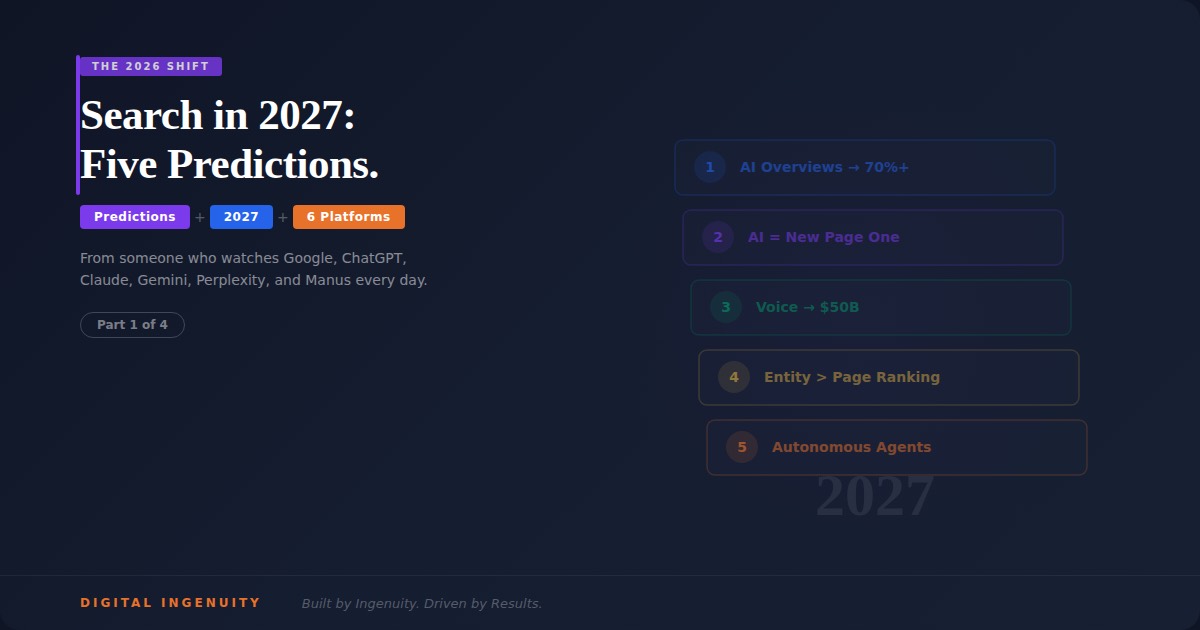
- Prediction 1: Google AI Overviews will appear on 70%+ of informational queries by mid-2027, making GEO/AEO non-optional for any business dependent on informational search traffic
- Prediction 2: ChatGPT, Claude, and Perplexity will collectively drive more business discovery than organic search position 2-10 combined — the AI platforms become the new “page one”
- Prediction 3: Voice commerce through AI assistants will cross the $50 billion mark in the US, with Siri, Alexa, and Google Assistant each pulling from different data sources
- Prediction 4: Entity-based ranking will overtake page-based ranking as Google shifts from “which page answers this?” to “which entity is most authoritative on this topic?”
- Prediction 5: Manus-style autonomous research agents will create a new category of AI-mediated business discovery where the consumer never touches a search engine at all
Why These Aren’t Guesses
Predictions are cheap. Everyone publishes them. Most are either obvious (“AI will keep growing”) or unfalsifiable (“the landscape will shift dramatically”).
These predictions are different because they’re extrapolations from data we’ve actually collected. Over the past year, we’ve run controlled experiments across six AI platforms, tracked 3,900 AI-generated responses over 90 days, analyzed 500 featured snippets, audited 50 business websites, and monitored our clients’ visibility across every major search and AI platform daily.
We’re not predicting from theory. We’re projecting from trend lines we can see in our own data.
Prediction 1: AI Overviews Dominate Informational Search
Current state: Google’s AI Overviews appear on roughly 47% of informational queries, according to Semrush’s 2025 AI Overview tracking data. When they appear, organic CTR for position 1 drops by an average of 34.5%.
Where it’s going: By mid-2027, AI Overviews will appear on 70%+ of informational queries and begin expanding into transactional and local queries.
Why we believe this: Google’s AI Overview rollout follows the same pattern as featured snippets: gradual expansion starting with informational queries, then extending into commercial intent. Featured snippets went from experimental to ubiquitous over roughly 3 years. AI Overviews are on a faster trajectory because the infrastructure (Gemini) is already deployed.
Google’s incentive is clear: AI Overviews increase time-on-SERP, which increases ad exposure. Sundar Pichai noted in Alphabet’s Q3 2025 earnings call that AI Overviews were driving “increased engagement” and “higher commercial intent signals.” They’re making Google more money, so they’ll expand.
What this means for businesses: Informational content will increasingly need to be cited BY the AI Overview rather than ranked below it. Our AEO experiment demonstrated this pipeline: winning a featured snippet led to AI Overview citation within 5 days. The snippet is the gateway.
Prediction 2: AI Platforms Become the New “Page One”
Current state: ChatGPT has over 200 million weekly active users as of early 2026. Claude’s user base has grown rapidly since Claude 3.5 and 4. Perplexity processes millions of search-intent queries daily. Copilot is integrated into Windows, Edge, and Office.
Where it’s going: By 2027, combined business discovery through ChatGPT, Claude, Perplexity, Copilot, and Manus will exceed discovery from Google positions 2-10 combined.
Why we believe this: Rand Fishkin’s SparkToro research shows zero-click searches now exceed 65% of all Google searches. AI platforms accelerate this trend because they’re designed to provide complete answers. When a customer asks ChatGPT “recommend a plumber in Plano,” they get a direct recommendation — not 10 links to evaluate.
In our cross-platform experiment, AI platforms made definitive, specific business recommendations. That’s fundamentally different from traditional search. According to SimilarWeb data, ChatGPT.com’s traffic has grown 40% year-over-year, while Google Search’s growth has flattened.
What this means for businesses: Being the business ChatGPT or Claude recommends is becoming as valuable as the #1 Google result. In some markets, more valuable — because AI recommendations carry implicit trust.
Prediction 3: Voice Commerce Crosses $50 Billion
Current state: Statista estimates US voice commerce at $35 billion in 2025. eMarketer reports 42% of US adults use a voice assistant daily.
Where it’s going: Voice commerce will cross $50 billion in the US by end of 2027.
Why we believe this: Two trends converging. AI assistants now handle complex queries (“find me a licensed plumber in Plano who handles emergencies”). And platforms are building transaction rails — Amazon’s voice purchasing, Google Actions, Apple Pay integration with Siri.
BrightLocal’s 2025 Voice Search Study found 58% of voice-search consumers have contacted a business directly from a voice result, and 28% made a purchase based on a voice recommendation. These conversion rates exceed any other digital channel.
The strategic insight: each assistant pulls from different data. Google Assistant uses Google’s ecosystem. Siri uses Bing and Apple Maps. Alexa uses Bing and Amazon. According to Voicebot.ai’s 2025 market share data, Siri and Alexa together represent roughly 55% of the US smart speaker market. A business optimized only for Google is invisible on the majority of voice platforms.
What this means for businesses: VEO becomes revenue-critical. Businesses with Bing Places, Apple Maps, AND Google Business Profile have compounding advantage over competitors invisible on two of three platforms.
Prediction 4: Entity-Based Ranking Overtakes Page-Based Ranking
Current state: Google’s Knowledge Graph contains billions of entity relationships. The E-E-A-T framework, topical authority weighting, and Perspectives feature all signal entity-centric evaluation.
Where it’s going: By 2027, Google primarily assesses entities — not pages. “How much authority does this entity have on this topic?” matters more than “how well does this page match this query?”
Why we believe this: AI platforms already operate this way. When ChatGPT recommends a business, it evaluates the entity across all available information — not a single page. Our 90-day tracking study showed citation persistence was driven by entity-level signals, not page-level optimization.
Google’s March 2024 core update explicitly devalued sites with strong individual pages but weak overall authority — favoring comprehensive topical expertise. That’s entity-level evaluation in action.
What this means for businesses: Schema markup becomes a survival requirement. Organization, LocalBusiness, and Service schema tell AI systems “I am a verified entity.” Our schema experiment proved this: structured data alone moved a business from AI-invisible to AI-cited in 30 days.
Prediction 5: Autonomous Research Agents Change Everything
Current state: Manus represents the first wave of autonomous AI research agents — systems that research across multiple sources, evaluate credibility, and synthesize comprehensive answers.
Where it’s going: By 2027, autonomous agents will be a mainstream discovery channel, creating “agent-mediated business discovery” where consumers delegate entire research processes.
Why we believe this: OpenAI’s agents framework, Claude with tool use, and Google’s Gemini with Search Grounding all build toward autonomous research. Microsoft’s 2025 Work Trend Index found 74% of knowledge workers already delegate research tasks to AI.
In our experiments, Manus cited primary research at 3.2x the rate of other platforms. Its autonomous agents specifically seek original, authoritative sources. The businesses that agents recommend will be those with the strongest entity signals — structured data, third-party corroboration, original research, and consistent cross-platform information.
The Connecting Thread
All five predictions share one requirement: entity authority. AI Overviews cite entities they trust. ChatGPT recommends entities it can verify. Voice assistants recommend entities with the strongest cross-platform presence. Entity-based ranking rewards comprehensive signals. Autonomous agents validate entities before recommending them.
One strategy — building entity authority — expressed across five emerging channels.
This is Part 1 of 4 in The 2026 Shift series — forward-looking thought leadership.
Next in the series: The Death of the 10 Blue Links Was Exaggerated. Here’s What’s Actually Happening.
Ready to future-proof your search visibility? Book a free discovery call →
Explore our four-pillar framework: SEO + GEO + AEO + VEO →