Key takeaways
- The Central Texas I-35 corridor between DFW and Austin is one of the fastest-growing regions in the state, with Waco, Temple, and Killeen experiencing population surges
- Digital competition in these mid-size markets is dramatically lower than in DFW, Houston, or Austin — creating a first-mover advantage for businesses that invest now
- Military communities (Fort Cavazos/Killeen) create unique marketing dynamics: high population turnover means constant demand for local services
- University markets (Baylor in Waco, Texas A&M in College Station) drive seasonal search patterns and young, digitally engaged consumer bases
- The four-pillar approach (SEO + GEO + AEO + VEO) delivers outsized results in mid-size markets where most competitors haven’t moved beyond basic Google listings
The I-35 Corridor Is Texas’s Hidden Growth Engine
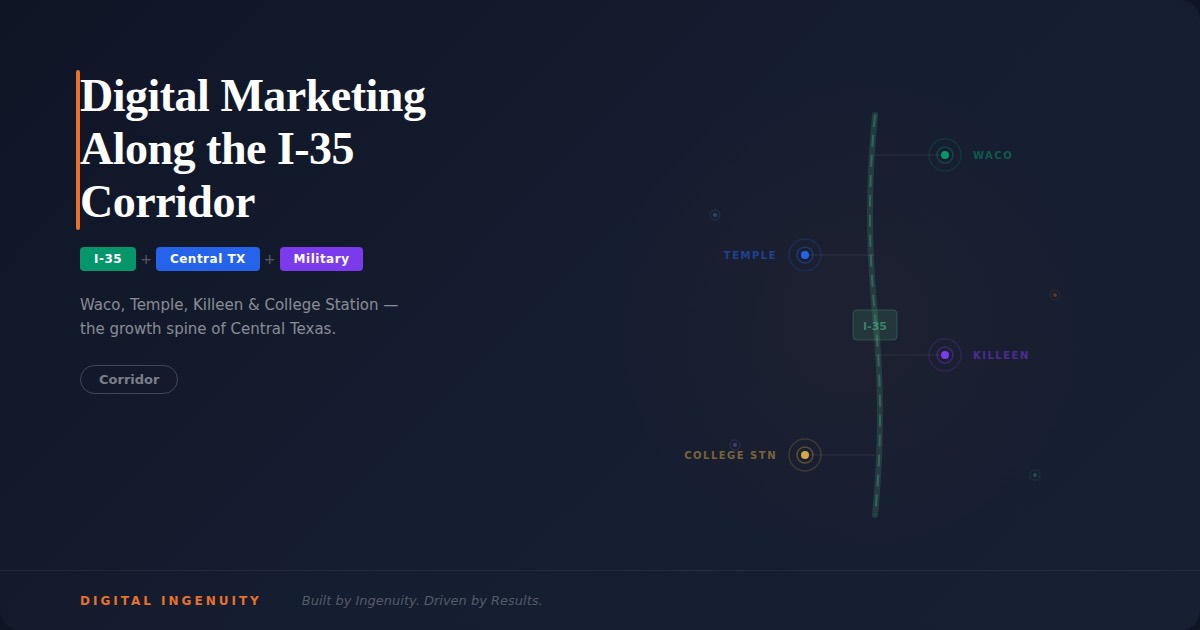
Drive south from Dallas on I-35, and within 90 minutes you’re in a stretch of Central Texas that most digital marketers overlook entirely. That oversight is a strategic error — and an enormous opportunity for the businesses paying attention.
Waco has undergone a renaissance. What was once a pass-through city between Dallas and Austin has become a destination. The Magnolia brand put Waco on the national map, but the transformation runs deeper: downtown revitalization, Baylor University’s campus expansion, a growing tech and entrepreneurial community, and residential development that’s attracting DFW and Austin transplants priced out of those metros.
Temple anchors the Baylor Scott & White healthcare system — one of the largest employers in Central Texas. The city’s medical economy drives demand for everything from healthcare marketing to home services, restaurants, and professional services. Temple’s steady, healthcare-driven growth creates a stable market with consistent demand.
Killeen, adjacent to Fort Cavazos (formerly Fort Hood), is one of the most unique marketing environments in Texas. The military installation houses tens of thousands of soldiers and their families, creating a consumer base with extremely high turnover — families rotating in every two to three years, all needing local services immediately. This creates permanent, renewable demand that never saturates.
College Station revolves around Texas A&M University — the largest university in Texas by enrollment. The Aggie network is legendarily loyal, and businesses that establish relationships with students, faculty, and the broader university community build brand loyalty that extends far beyond Central Texas as graduates disperse across the state.
Why Mid-Size Markets Are the Smart Play
Here’s the math that most businesses miss: the cost to achieve dominant search visibility in a mid-size Texas market is a fraction of what it costs in DFW or Houston, but the revenue per customer is often comparable.
An HVAC company in Waco charges similar rates to an HVAC company in Dallas. A personal injury attorney in Temple commands similar case values to a counterpart in Fort Worth. But the competitive intensity for digital visibility in these markets is dramatically lower. Where a Dallas business might need 12 months and significant investment to crack the Local 3-Pack for a competitive keyword, a Waco business can often achieve the same result in 60 to 90 days with foundational optimization.
The AI search opportunity is even more pronounced. In major metros, early adopters are already investing in GEO and AEO. In Central Texas markets, virtually no one is optimizing for AI search yet. A business that starts now will be the only authority AI systems can cite for its category in its market — a compounding advantage that becomes harder to challenge with every passing month.
Market-by-Market Strategies
Waco: The Renaissance City
Waco’s transformation creates two distinct marketing opportunities. First, the tourism and hospitality economy driven by Magnolia, the Silos, and Waco’s growing cultural attractions creates demand for event-driven, seasonal content. Second, the residential growth creates expanding demand for home services, healthcare, dining, and professional services.
For local businesses in Waco, the content strategy should reflect both dimensions. Tourism-oriented content captures high-volume seasonal traffic: “things to do in Waco this weekend,” “best restaurants near Magnolia Silos,” “Waco family activities.” Residential-oriented content targets evergreen service queries: “Waco HVAC repair,” “best dentist in Waco,” “Waco home inspection.”
Baylor University adds a university marketing dimension. Student-oriented businesses benefit from back-to-school content cycles, campus-area optimization, and social proof from the Baylor community. The key is creating content that demonstrates genuine Waco knowledge — not generic template pages with “Waco” substituted.
Review velocity in Waco is still relatively modest compared to major metros. Where a Dallas business might need 200+ reviews to compete, a Waco business with 50 to 100 quality reviews and consistent velocity can dominate its category. This is the window that closes as more businesses invest in reputation management.
Temple: Healthcare Hub Marketing
Temple’s economy centers on Baylor Scott & White Medical Center, and the healthcare ecosystem creates ripple effects across every industry. The thousands of healthcare workers, administrators, and their families represent a stable, well-compensated consumer base with consistent demand for housing, dining, retail, and services.
For healthcare practices specifically, Temple presents a unique challenge: competing for visibility alongside a dominant hospital system. Independent practices and specialists succeed by targeting specific procedures, conditions, and patient needs that the large system doesn’t focus on in its marketing. Long-tail content targeting specific medical queries — structured for AEO to capture featured snippets — positions independent practices as accessible experts.
For non-healthcare businesses, the strategy is simpler: Temple’s overall digital competition is low, and the population is growing steadily. Businesses that invest in comprehensive local SEO now — complete Google Business Profile, city-specific landing pages, citation consistency, and review generation — will establish positions that become expensive for competitors to challenge.
Killeen: The Military Marketing Machine
Killeen’s military community creates a marketing dynamic unlike any other Texas city. Every year, thousands of military families rotate into Fort Cavazos and immediately need every local service: housing, moving, HVAC, dental, auto repair, childcare, restaurants, and more. These families search aggressively on mobile devices, often before they even arrive in the area.
The content strategy for Killeen businesses should address this incoming population directly. Landing pages targeting “Killeen HVAC for military families,” “PCSing to Fort Cavazos,” and “best dentist near Fort Cavazos” capture high-intent traffic from families actively relocating. Content that demonstrates understanding of military life — PCS timelines, TRICARE considerations for healthcare providers, military discount programs — builds trust with a community that values businesses supporting the military.
Review management is especially important in Killeen because military families rely heavily on word-of-mouth and reviews from other military families. Google reviews, Yelp, and military-specific platforms like SpouseBuzz and MilitaryByOwner all influence decision-making. A strong, recent review profile signals trustworthiness to a community that’s constantly seeking reliable local services in an unfamiliar city.
College Station: The Aggie Advantage
College Station is a university market, and successful marketing here means understanding the rhythms of Texas A&M. Student population fluctuates seasonally (fall and spring semesters vs. summer), game days drive massive traffic spikes, and the Aggie network’s loyalty creates long-term brand relationships.
Businesses that lean into the Aggie identity — without being inauthentic — earn customer loyalty that extends beyond the College Station market. Students who discover a great restaurant, barbershop, or service provider during their four years at A&M carry that recommendation with them after graduation. The network effect of the Aggie community means a satisfied customer in College Station can generate referrals across the entire state.
For game day businesses, event-driven SEO targeting queries like “restaurants near Kyle Field,” “College Station tailgate catering,” and “things to do game day weekend College Station” captures high-value traffic during the fall football season.
For year-round businesses, the strategy focuses on the permanent College Station community — faculty, staff, and families — plus the student population. Content should address both audiences, and review profiles should reflect consistent service across both.
The Four-Pillar Advantage in Mid-Size Markets
The four-pillar framework delivers outsized results in Central Texas markets precisely because the competitive bar is lower.
In DFW, implementing GEO means competing against agencies and brands that are already investing in AI search optimization. In Waco, Temple, Killeen, and College Station, implementing GEO means your business is likely the only one in your category that AI systems can cite. When a Killeen resident asks ChatGPT “Who’s the best plumber in Killeen?” and your business is the only plumber with structured, authoritative content optimized for AI citation, you own that answer entirely.
The same logic applies to AEO and VEO. Featured snippet positions in mid-size markets are easier to capture because fewer competitors are creating structured, answer-optimized content. Voice search responses default to the single most authoritative local result, and in markets with limited competition, establishing that authority takes months rather than years.
This is the first-mover advantage window. As digital marketing adoption increases in Central Texas markets, the businesses that invested early will have compounding visibility that latecomers can’t match without significantly greater investment.
Building Momentum: The I-35 Content Strategy
For businesses that serve multiple I-35 corridor markets, the content strategy should create a web of interlinked authority.
Start with a comprehensive pillar page for each city you serve — unique content demonstrating genuine knowledge of that market. Then build supporting blog content targeting long-tail queries specific to each market. Internal linking between city pages, service pages, and blog content creates the authority web that both Google and AI systems reward.
For example, an HVAC company serving the entire I-35 corridor would build individual city pages for Waco, Temple, Killeen, and College Station, each with unique content about serving that community. Blog posts targeting “HVAC maintenance tips for Central Texas summers,” “foundation and ductwork concerns in Bell County,” or “energy efficiency for Killeen military housing” would link to the relevant city pages, building topical authority for each market simultaneously.
This compound approach — location pages supported by targeted content, all monitored through SearchLight™ — is how mid-size market businesses build dominant positions before their competitors realize the game has changed.