Key takeaways
- The DFW metroplex is the fastest-growing metro in the U.S. with 7.5M+ residents, making digital visibility both critical and fiercely competitive
- Traditional SEO alone no longer cuts it — AI search engines like ChatGPT and Google’s AI Overviews are reshaping how DFW consumers find businesses
- “Near me” queries dominate local search, and Google Business Profile optimization is the single highest-ROI activity for most DFW businesses
- Different DFW submarkets (Uptown Dallas vs. Fort Worth Stockyards vs. Frisco’s corporate corridor) require completely different marketing approaches
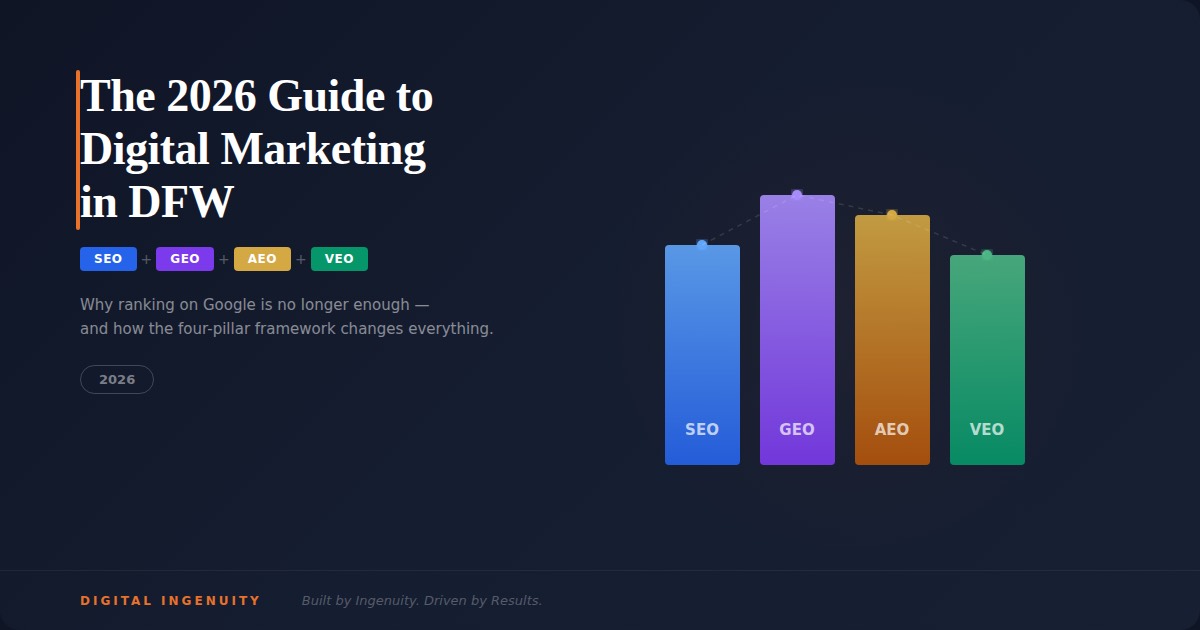
- The businesses winning in DFW are engineering visibility across all four channels: traditional search, AI search, featured snippets, and voice assistants
Dallas-Fort Worth Is a Different Animal
If you’re running a business in the DFW metroplex, you already know this market doesn’t play by the same rules as the rest of Texas — or the rest of the country. With a population exceeding 7.5 million people spread across four major counties, dozens of distinct cities, and hundreds of neighborhoods, DFW isn’t really one market at all. It’s a constellation of overlapping markets, each with its own competitive dynamics, customer demographics, and search behavior patterns.
What works in Uptown Dallas doesn’t necessarily work in the Fort Worth Cultural District. The keywords driving leads in Frisco’s corporate corridor bear almost no resemblance to what converts in Arlington’s entertainment district. A dental practice in Plano competes against a completely different set of rivals than a dental practice in Denton — even though they’re separated by fewer than 30 miles.
This complexity is precisely why most digital marketing strategies fail in DFW. Agencies that treat the metroplex as a single market end up with generic campaigns that rank nowhere because they’re competing against businesses with hyperlocal strategies engineered for their specific submarket.
The DFW Digital Marketing Landscape in 2026
Three trends are reshaping the landscape, and businesses that ignore any one of them are leaving revenue on the table.
AI Search Has Arrived — And DFW Consumers Are Using It
When someone in North Dallas asks ChatGPT, “Who’s the best HVAC company in Plano?” or opens Google and gets an AI Overview summarizing the top options before they ever see an organic result, the businesses that appear in those AI-generated answers capture the first impression. The businesses that don’t appear might as well not exist for that interaction.
AI search adoption in tech-forward markets like DFW is outpacing the national average. The metroplex’s younger demographics, high smartphone penetration, and tech-industry workforce mean that a significant and growing percentage of local searches now involve AI-generated answers — whether through ChatGPT, Google’s AI Overviews, Perplexity, or voice assistants. This is where Generative Engine Optimization (GEO) becomes essential.
“Near Me” Queries Are Getting More Specific
“Near me” search queries convert at dramatically higher rates than generic queries because the intent is immediate and local. When someone searches “emergency plumber near me” at 11 PM, they’re not researching — they’re buying.
But the landscape has gotten more specific. Users now search for combinations: “affordable family dentist near me,” “organic restaurant near me with outdoor seating,” “24-hour tire shop near me.” In DFW, the geographic complexity makes this optimization even more critical. A business in Richardson might be invisible to a searcher in nearby Garland despite being only miles apart — unless the business has engineered its local signals to cover a broader service area.
Review Velocity Determines Visibility
In competitive DFW categories like home services, legal, and healthcare, the businesses appearing in Google’s Local 3-Pack typically have 50% or more reviews than businesses ranked fourth through tenth. The difference between a 4.2 and a 4.7 rating in a competitive DFW submarket can translate to a 40% or greater difference in lead volume. Reputation management isn’t optional here — it’s a competitive requirement.
Submarket Strategies: One Size Does Not Fit All
![DFW Submarkets Map]
Dallas Proper: High Competition, High Reward
Dallas — from Uptown and Downtown to Deep Ellum, Oak Cliff, and North Dallas — is the most competitive digital marketing environment in the metroplex. The key to winning is specificity: targeting neighborhoods rather than the entire city, building content around Dallas-specific culture and landmarks, and maintaining aggressive review generation.
For service businesses, the competition for Google Maps visibility is intense. The winners have complete Google Business Profiles, consistent NAP data across 100+ directories, localized landing pages targeting specific Dallas neighborhoods, and a steady stream of recent five-star reviews.
Fort Worth: The Underestimated Opportunity
Fort Worth has historically received less attention from digital marketers than Dallas, which creates a genuine opportunity. Competition for many high-value keywords is meaningfully lower on the Fort Worth side, yet population and economic activity continue growing rapidly.
Fort Worth has its own identity — the Stockyards, the Cultural District, TCU, the medical district — and businesses that create content reflecting Fort Worth’s distinct character outperform those treating it as “Dallas’s neighbor.” Industries with particularly strong opportunity include home services, healthcare, legal, and hospitality.
Frisco and the Collin County Corridor
Frisco has been the fastest-growing city in America, and the broader Collin County corridor — including Plano, McKinney, and Allen — represents one of the most affluent and digitally engaged consumer bases in the state. PGA headquarters, the Dallas Cowboys Star complex, and a wave of corporate relocations have transformed this corridor into an economic center.
Businesses in Collin County face a unique challenge: their customers are highly sophisticated digital consumers who research extensively. The four-pillar approach is particularly effective here because these consumers are early adopters of AI search tools.
Arlington and Mid-Cities
Arlington’s entertainment district — AT&T Stadium, Globe Life Field, Six Flags — drives tourism and event-based search traffic. But Arlington also has a massive everyday economy requiring year-round local SEO. The Mid-Cities corridor (Irving, Grand Prairie, Euless) is often overlooked, creating opportunities for businesses willing to invest in hyperlocal content.
Denton and Northern Suburbs
Denton and the northern suburbs (Lewisville, Carrollton, Flower Mound) represent growing markets with distinct characteristics. Denton’s university population creates demand for student-oriented services, while the broader northern suburbs are experiencing rapid residential growth.
The Four-Pillar Framework for DFW
![Four Pillars Compound Effect]
The DFW market’s complexity demands more than a single-channel approach. Here’s how the four-pillar framework applies specifically to DFW.
SEO — The Foundation. For DFW businesses, SEO means hyperlocal optimization: city-specific landing pages, Google Business Profile engineering, citation consistency across DFW-specific directories, and technical architecture that ensures efficient crawling and indexing.
GEO — The AI Advantage. DFW’s tech-savvy population means AI search adoption is ahead of the national curve. Most local businesses haven’t even heard of GEO. The businesses that start now build compounding AI visibility that latecomers can’t match.
AEO — The Zero-Click Play. Featured snippets and AI Overviews now dominate the top of search results for many DFW service queries. Answer Engine Optimization engineers your content to be the source those features cite.
VEO — The Voice Opportunity. With smart speakers in a majority of DFW homes, voice search represents a massive opportunity. When someone says “Hey Google, find me a plumber in Plano,” the assistant gives one answer. VEO ensures that answer is your business.
Industry-Specific Strategies for DFW
Home Services: DFW’s massive housing stock creates enormous demand. Winners have separate landing pages for every city they serve, 200+ Google reviews, and content addressing North Texas challenges (extreme heat, hail damage, foundation issues from clay soil).
Legal: The DFW legal market is one of the most competitive nationally. Firms winning organically invest in content targeting specific practice areas and locations simultaneously — not broad terms.
Automotive: With dealerships lining every major highway, the winners have moved beyond inventory listings to genuine content authority: comparison guides, maintenance resources, and location-specific pages.
Healthcare and Fitness: Independent practices need aggressive local SEO and review management. Gyms and studios need social proof, class schedule optimization, and “near me” visibility.
What Most DFW Businesses Get Wrong
The most common mistake is treating DFW as a single market. A business optimizing for “Dallas” alone is invisible in Fort Worth, Frisco, Arlington, and every other submarket. Each city needs its own strategy and landing page.
The second mistake is ignoring AI search. When a large and growing share of searches involve AI-generated answers before users see organic results, optimizing exclusively for traditional rankings means invisible for that traffic.
The third mistake is neglecting reviews. In DFW’s competitive landscape, a business with 30 reviews is invisible next to a competitor with 300.
Building a Strategy That Compounds
The businesses seeing the strongest growth in DFW share a common approach: they’re engineering a system where every optimization compounds the others. Strong local SEO earns Google visibility, which generates reviews, which improves rankings, which earns featured snippets, which voice assistants read aloud, which AI systems cite. Each win creates the next win.
Businesses that start building this compounding system now will be nearly impossible to catch in 12 to 18 months. That’s the power of an engineered system versus disconnected marketing campaigns.