Key takeaways
- We sell agency SEO starting at $999/month, and we’re going to tell you honestly when you should NOT hire us and do it yourself instead
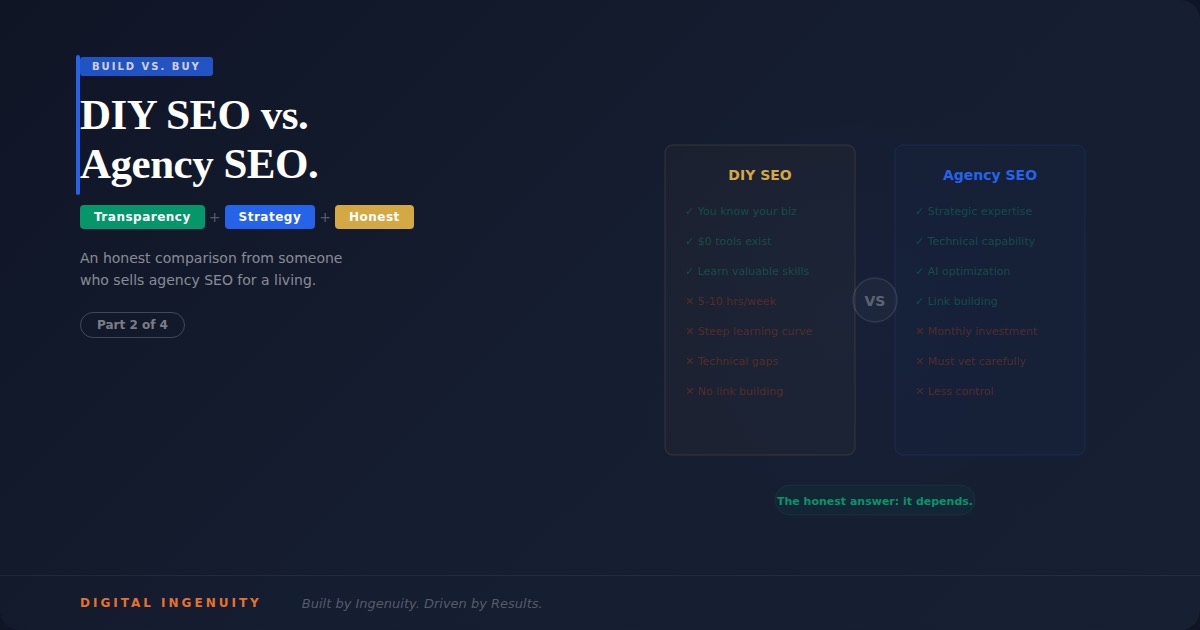
- DIY SEO works well when: you have 5-10 hours/week to dedicate, you’re willing to learn technical concepts, your market isn’t intensely competitive, and you’re patient enough to learn from mistakes
- Agency SEO makes sense when: your time is worth more than $100/hour, you’re in a competitive market, you need results within a specific timeframe, or you’ve been doing DIY for 6+ months without meaningful progress
- The biggest DIY risk isn’t doing SEO poorly — it’s doing SEO that feels productive but accomplishes nothing, wasting months on activities that don’t move rankings
- The biggest agency risk isn’t the cost — it’s hiring the wrong agency that locks you into contracts and delivers reports instead of results
- Hybrid approach often works best: learn the fundamentals yourself, handle content creation and basic on-page optimization in-house, bring in an agency for technical SEO, link building, and AI search strategy
- The tools available in 2026 make DIY more viable than ever for basic SEO — but the gap between basic and advanced has widened significantly with AI search, voice search, and structured data requirements
Why We’re Writing This
We’re going to say something unusual for an agency: you might not need us.
That’s uncomfortable to publish on our own blog. We’re a business that sells SEO services. Every potential client who reads this and decides to do SEO themselves is a client we don’t get. Our marketing team would prefer we write “10 Reasons You Need an Agency” and call it a day.
But here’s our philosophy: if we’re honest with you about when you need us and when you don’t, and you decide to hire us anyway, you’ll stay longer and get better results because the engagement is built on trust, not persuasion. And if you decide to DIY, you’ll remember that we were the agency that told you the truth — and you’ll come to us when you actually need help.
So here’s the honest comparison. No spin.
What DIY SEO Actually Looks Like in 2026
Let’s start with what you’re signing up for if you do SEO yourself.
The Time Commitment
Effective DIY SEO requires a minimum of 5-10 hours per week. Not 5-10 hours of reading about SEO. Five to ten hours of doing SEO — auditing your site, researching keywords, writing and optimizing content, building internal links, claiming directory listings, monitoring Search Console, requesting indexing, analyzing competitors, and troubleshooting technical issues.
If you don’t have 5-10 hours per week to dedicate consistently for at least 6 months, DIY SEO will produce frustration, not results. SEO compounds over time, but only if the inputs are consistent.
The Learning Curve
SEO in 2026 has a steeper learning curve than SEO in 2019. Back then, you could learn the basics (keywords, meta tags, backlinks) and make meaningful progress. Today, you need to understand technical concepts like Core Web Vitals optimization, structured data implementation, server-side rendering versus client-side rendering, crawl budget management, canonical URLs, and JavaScript rendering.
You also need to understand the emerging disciplines: how AI platforms select sources to cite, how featured snippets are won, how voice assistants choose which business to recommend. These aren’t optional anymore — they’re where the growth is happening.
The good news: the information is freely available. Google’s own documentation is excellent. Moz, Ahrefs, Search Engine Journal, and dozens of other sites publish educational content. YouTube has thousands of SEO tutorials. You can absolutely learn this.
The bad news: there’s also a tremendous amount of outdated, incorrect, and actively harmful SEO advice online. Techniques that worked in 2018 can get your site penalized in 2026. The challenge isn’t finding information — it’s knowing which information to trust.
What You Can Do Well on Your Own
Keyword research: Tools like Google Keyword Planner (free), Ubersuggest (free tier), and Answer the Public give you solid keyword data. You can identify what your customers search for and build a content plan around it.
On-page optimization: Writing good meta titles and descriptions, using proper heading hierarchy, creating quality content around target keywords, and adding alt text to images. These are learnable skills that don’t require technical expertise.
Google Business Profile optimization: Completing your GBP, posting regularly, responding to reviews, adding photos, and seeding Q&As. This is high-impact and entirely DIY-able.
Content creation: If you know your industry (and you do), you can write better content about your services than most agency content writers. Nobody understands your business like you do.
Basic technical checks: Google Search Console is free and tells you about crawl errors, indexing issues, and Core Web Vitals problems. You can learn to read and act on this data.
Local citations: Claiming and completing your listings on Yelp, Bing Places, Apple Maps, and industry directories. Time-consuming but straightforward.
Where DIY Gets Dangerous
Technical SEO: Implementing structured data, fixing crawl issues, optimizing server response times, resolving JavaScript rendering problems, managing redirects, and handling site migrations. One technical mistake can undo months of progress. A misconfigured robots.txt can deindex your entire site.
Link building: Earning high-quality backlinks from authoritative sites requires outreach skills, relationships, and strategies that take years to develop. DIY link building often results in either no links (wasted time) or bad links from low-quality sites (active harm).
Competitive strategy: Understanding why your competitor ranks above you, what specific actions will close the gap, and which battles are worth fighting versus which keywords you should abandon. This requires experience analyzing hundreds of competitive landscapes.
AI search optimization: Knowing which schema types each AI platform prioritizes, how to engineer content for citation by ChatGPT, Claude, Perplexity, Copilot, and Manus, and how to build entity authority across platforms. This discipline is so new that most agencies don’t know how to do it — let alone DIYers.
What Agency SEO Actually Looks Like
Now let’s be equally honest about what you get from an agency.
What a Good Agency Provides
A good agency brings strategic thinking, not just task execution. They’ve seen hundreds of sites across dozens of industries. They know which tactics move rankings and which waste time. They have systems for link building that you can’t replicate alone. They have technical expertise that would take you years to develop. They stay current on algorithm changes, AI platform updates, and emerging best practices as a full-time job.
A good agency also provides accountability and consistency. SEO requires sustained effort over months. When you’re doing it yourself alongside running your business, SEO is the first thing that gets dropped when you’re busy. An agency keeps the work moving regardless of how hectic your month gets.
What You’re Really Paying For
At $999/month (our starting tier), here’s what a typical month includes: strategic keyword analysis, technical site monitoring, content optimization for 3-5 pages, structured data maintenance, link prospecting and outreach, Search Console monitoring, monthly performance reporting, and strategic planning for the next month. That’s roughly 8-12 hours of specialized work.
If you value your own time at $100/hour (which is below what most business owners effectively earn), doing those same 8-12 hours yourself costs you $800-1,200 in opportunity cost — and your execution will be less effective because you’re learning on the job rather than applying years of experience.
The math only works in favor of DIY if your time is worth less than ~$80/hour AND you’re willing to accept slower results due to the learning curve.
What a Bad Agency Provides
Automated reports that nobody reads. Keyword rankings for terms nobody searches. Directory submissions to sites that don’t matter. Templated monthly emails that say “we’ve made progress” without specifics. Blog posts written by someone who’s never spoken to you and doesn’t understand your industry. Monthly bills that feel productive but produce no measurable business impact.
If your current agency can’t tell you exactly what they did last month, why they did it, and what business impact it had — you have a bad agency. The industry is full of them.
We wrote about this in detail in our marketing agency red flags post. Read that before signing with any agency, including us.
The Honest Decision Matrix
Here’s the framework we actually use when someone asks us whether they should hire us:
DIY is the right move if:
- You have 5-10 hours/week to commit consistently
- Your market isn’t highly competitive (you’re not competing with national brands for the same keywords)
- You’re comfortable learning technical concepts
- You’re patient — willing to invest 6-12 months before expecting significant results
- Your business model doesn’t depend on a specific timeline for growth
- You enjoy this kind of work (it matters more than people think)
An agency makes sense if:
- Your time is worth more than $100/hour
- You’re in a competitive market where experienced strategy matters
- You need results within a defined timeframe
- You’ve been doing DIY for 6+ months with minimal progress
- You need technical capabilities (structured data, AI optimization, link building) beyond your skillset
- You want to focus on running your business while someone else handles search visibility
A hybrid approach works best if:
- You want to learn and stay involved without doing everything yourself
- You can handle content creation but need help with technical and strategic work
- You want to build internal capability over time while getting professional results now
The Hybrid Approach We Actually Recommend
For many businesses, especially small businesses watching their budget, the smartest approach isn’t pure DIY or full agency. It’s strategic hybridization.
You handle:
- Content creation (you know your business better than any writer we’d assign)
- Google Business Profile management (it’s your business, your voice)
- Review solicitation (your customers, your relationships)
- Basic on-page optimization (we’ll teach you the framework)
- Social media and community engagement
The agency handles:
- Technical SEO (site architecture, schema, Core Web Vitals, crawl optimization)
- Link building (outreach, relationship-based acquisition)
- AI search strategy (GEO, AEO, VEO — the emerging disciplines)
- Competitive analysis and strategic direction
- Performance monitoring and course correction
This approach typically costs less than full-service agency SEO because you’re handling the labor-intensive but learnable tasks in-house. The agency focuses on the specialized work that requires expertise you can’t easily develop on your own.
What We’d Tell You Over Coffee
If we were having this conversation over coffee instead of on a blog, here’s what we’d say:
Start with DIY. Seriously. Learn the basics. Set up Search Console. Optimize your Google Business Profile. Write some quality content. See how it goes for 3 months.
If after 3 months you’re making progress and enjoying the work, keep going. You’ll save money and build a valuable skill set. We’ll still be here if you need us later.
If after 3 months you’re frustrated, overwhelmed, or not seeing any movement — that’s when an agency conversation makes sense. You’ll come into that conversation educated. You’ll know the right questions to ask. You’ll be a better client because you understand what SEO actually involves. And you’ll be able to evaluate whether an agency is actually delivering value.
The worst decision is hiring an agency before you understand what they should be doing. That’s how you end up paying $1,200/month for automated reports and blog posts nobody reads.
The second worst decision is spending 12 months doing DIY SEO ineffectively when your business needed professional help from month 4. There’s a real cost to slow progress in a competitive market.
Know your situation. Be honest about your time, skills, and competitive landscape. Then make the call that matches your reality, not your budget anxiety.
This is Part 2 of 4 in the Build vs. Buy series — challenging conventional marketing wisdom.
Previous: Why Your $50/mo Wix Site Is Costing You $5,000/mo in Lost Revenue
Next in the series: WordPress vs. Headless vs. Engineered: Which Architecture Actually Ranks — And Which One AI Can Parse?
Ready for the professional conversation? Book a free discovery call →
Learn what our SEO engagements include: SEO — Search Engine Optimization →