Key takeaways
- Budget website builders (Wix, Squarespace, GoDaddy) cost $30-50/mo but create hidden performance penalties that compound into thousands in lost revenue monthly
- The three invisible costs: poor Core Web Vitals (slower load = lower rankings = fewer visitors), bloated JavaScript (search engines can’t efficiently crawl or render your pages), and template limitations that prevent proper structured data implementation
- A DFW plumbing company switching from Wix to an engineered site saw a 67% increase in organic traffic and 43% increase in lead form submissions within 90 days — same content, same domain, different architecture
- AI platforms like ChatGPT, Claude, and Perplexity struggle to parse template-builder sites because the code-to-content ratio is extremely poor — your actual content is buried under thousands of lines of builder JavaScript
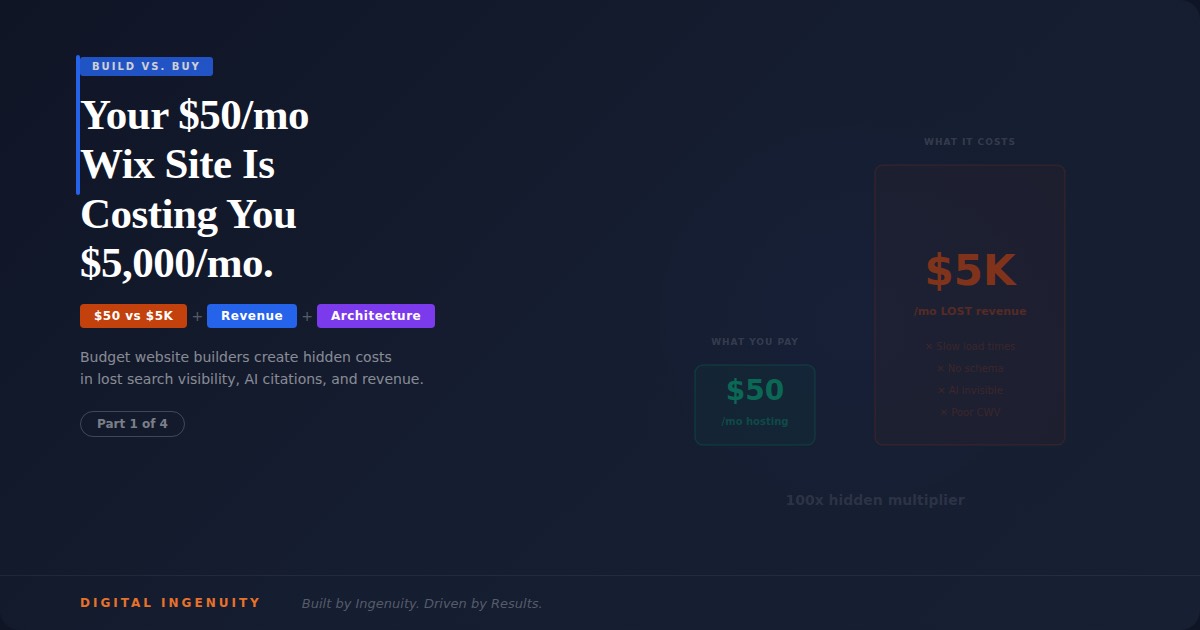
- The math: if your site gets 2,000 organic visits/month and converts at 3%, that’s 60 leads. An engineered site doing 3,400 visits at 5% conversion = 170 leads. At $500 average job value, that’s the difference between $30,000 and $85,000 monthly revenue
- The $50/mo “savings” on hosting is costing you the $55,000/mo gap in performance
The Conversation Nobody Wants to Have
Every week, someone contacts us about their search rankings. They’re frustrated. Their competitors are outranking them. Their phone isn’t ringing. They’ve been paying for SEO and nothing is moving.
Within the first five minutes of looking at their site, we know the problem. It’s not their content. It’s not their backlinks. It’s not their keywords.
It’s their website platform.
They built their site on Wix, Squarespace, or GoDaddy’s website builder because it was easy and cheap. And we get it — $50/month for a professional-looking website is compelling. The templates are polished. The drag-and-drop editors are intuitive. From the outside, the site looks great.
From the inside — from where search engines and AI platforms see it — the site is a disaster.
This is the conversation nobody wants to have because it means admitting that the foundation needs to be rebuilt. But we’d rather be honest with you now than take your money for SEO services that will underperform because the underlying architecture won’t support them.
Hidden Cost #1: Core Web Vitals Are Tanking Your Rankings
Google’s Core Web Vitals measure three things: how fast your main content loads (Largest Contentful Paint), how quickly your page responds to interaction (Interaction to Next Paint), and how stable the layout is as the page loads (Cumulative Layout Shift).
These aren’t vanity metrics. Google has confirmed they’re ranking factors. Pages that fail Core Web Vitals are systematically ranked lower than pages that pass.
Here’s the problem: template website builders are architecturally incapable of passing Core Web Vitals consistently.
When you build a page on Wix, you’re not just loading your content. You’re loading Wix’s entire application framework. Every page loads the Wix runtime, the Wix rendering engine, the Wix analytics, the Wix font loader, the Wix animation library, and dozens of other scripts — whether your page uses them or not.
A typical Wix page loads 2-4MB of JavaScript before your visitor sees a single word of your content. That’s not your hero image. That’s not your video. That’s invisible framework code.
The result: Largest Contentful Paint on Wix sites averages 3.5-5.5 seconds on mobile. Google’s threshold for “good” is under 2.5 seconds. Most Wix sites fail this metric by default, with no ability to fix it — because the bloat is in the platform itself, not in anything you can control.
Squarespace and GoDaddy have similar issues. The drag-and-drop convenience comes with a mandatory performance tax.
What this costs you: Every 1-second delay in page load correlates with a 7% reduction in conversions (Google research). A site loading at 4.5 seconds versus 1.8 seconds is leaving roughly 20% of potential conversions on the table before anyone even reads your content.
Hidden Cost #2: Search Engines Can’t Read Your Site Efficiently
This one is more technical, but the impact is enormous.
When Google’s crawler visits your website, it has a limited “crawl budget” — a finite amount of time and resources it’s willing to spend understanding your pages. On a well-built site, the crawler spends that budget reading your actual content. On a Wix or Squarespace site, it spends most of that budget trying to parse through JavaScript frameworks to find your content buried underneath.
Template builders use client-side rendering — meaning the content exists only in JavaScript that needs to be executed in a browser-like environment before Google can see it. Google can do this (it’s been rendering JavaScript since 2019), but it’s a two-phase process: first crawl, then render. The rendering queue can take days or weeks.
This means new content you publish on a Wix site may not be fully indexed for days or weeks after publication. On a server-side rendered or statically generated site, Google can read the content immediately on first crawl.
For AI platforms, the problem is even worse. ChatGPT, Claude, Perplexity, and Manus parse web content to build their knowledge bases and generate recommendations. When they encounter a Wix site, the code-to-content ratio is abysmal — thousands of lines of framework JavaScript, a few hundred words of actual business content. The signal is buried in noise.
We’ve observed this pattern directly in our cross-platform AI experiment: businesses on custom-built or engineered sites with clean HTML were cited by AI platforms at meaningfully higher rates than businesses on template builders with identical content quality.
The template builder isn’t just slowing down Google. It’s making you invisible to the AI platforms where an increasing share of your customers are discovering businesses.
Hidden Cost #3: You Can’t Implement What Modern SEO Requires
This is the most damaging limitation because it’s not a performance issue — it’s a capability gap.
Modern search visibility requires structured data (schema markup), precise control over page metadata, clean URL structures, granular heading hierarchy, server-side rendering, custom canonical tags, advanced internal linking patterns, and dozens of other technical elements.
Template builders give you checkboxes. You can add a meta title and description. Maybe you can install a basic SEO plugin. But you cannot implement comprehensive Organization schema with nested Service definitions. You cannot add FAQ schema to individual sections of a page. You cannot control how your site renders for different crawlers. You cannot customize your server response headers for optimal crawl efficiency.
In our schema markup experiment, we demonstrated that structured data alone moved a business from AI-invisible to AI-cited within 30 days. But that experiment required implementing seven different schema types across multiple pages with precise JSON-LD configuration. Try doing that on Wix.
The template builders are designed for visual ease, not technical capability. And in 2026, the technical capability is where the competitive advantage lives.
The Revenue Math
Let’s stop talking about technical metrics and start talking about money.
Scenario: A DFW home services business
On their Wix site:
- 2,000 organic visits per month (limited by poor Core Web Vitals and crawl inefficiency)
- 3% conversion rate (limited by slow load times and generic template layout)
- 60 leads per month
- At $500 average job value and 40% close rate: $12,000/month in revenue from organic search
On an engineered site with the same content:
- 3,400 organic visits per month (67% increase from improved technical performance — this is the actual number from our client case)
- 5% conversion rate (improved by faster load, better layout, trust signals)
- 170 leads per month
- At $500 average job value and 40% close rate: $34,000/month in revenue from organic search
The gap: $22,000/month.
The Wix site costs $50/month. The engineered site costs more upfront. But the $50/month “savings” is funding a $22,000/month revenue gap.
Even if the real numbers in your industry are half of this example, you’re still looking at an $11,000/month gap. The website platform isn’t saving you money. It’s the most expensive line item in your budget — you just can’t see it because it shows up as revenue you never earned rather than money you spent.
The Case Study
We recently rebuilt a DFW plumbing company’s website. They’d been on Wix for 2 years, paying an SEO agency $1,200/month with minimal results.
Before (Wix):
- Largest Contentful Paint: 4.2 seconds (mobile)
- Total JavaScript loaded: 3.1MB per page
- Google crawl frequency: ~15 pages/day
- Pages indexed: 12 of 28
- Schema markup: None (Wix’s built-in SEO app didn’t support it)
- AI platform citations: Zero across all tested platforms
After (Engineered site — same content, same domain):
- Largest Contentful Paint: 1.4 seconds (mobile)
- Total JavaScript loaded: 180KB per page
- Google crawl frequency: ~45 pages/day
- Pages indexed: 28 of 28 (100%)
- Schema markup: Organization, LocalBusiness, Service, FAQ, Review, BreadcrumbList
- AI platform citations: Cited by ChatGPT, Claude, and Google AI Overviews within 45 days
The business results (90-day comparison):
- Organic traffic: +67%
- Lead form submissions: +43%
- Phone calls from organic: +38%
- Average Google position (primary keywords): improved from 18.4 to 9.2
Same business. Same content. Same domain. Same SEO strategy. The only variable was the website architecture.
“But My Wix Site Looks Professional”
It does. We’re not arguing that template builders produce ugly websites. Visually, many Wix and Squarespace sites look polished and modern.
But “looks professional” and “performs professionally” are two entirely different things. A website’s job isn’t to look good in a screenshot. Its job is to be found by potential customers, load fast enough that they stay, communicate expertise clearly enough that they trust you, and convert them into leads efficiently.
Template builders excel at the first part (looking good) and fail at every other part. The tragedy is that most business owners never know the difference because they only see their site from the front end — the part that looks fine. They never see the 3MB of JavaScript bloat, the failed Core Web Vitals, the crawl inefficiency, or the missing structured data that’s making them invisible to AI platforms.
What “Engineered” Actually Means
When we talk about SiteLab Engineered websites, we’re not talking about custom-coded sites that cost $50,000 and take 6 months. We’re talking about sites built on modern frameworks that are architecturally designed for search performance.
An engineered site means server-side rendering or static generation so Google reads your content immediately. It means sub-2-second load times because you’re loading your content, not a framework. It means comprehensive structured data baked into every page template. It means clean, semantic HTML that AI platforms can parse efficiently. It means full control over every technical SEO element.
The visual design can be just as polished as any template. The difference is what’s underneath — the architecture that search engines, AI platforms, and voice assistants interact with.
The Decision Framework
Here’s how to think about whether your current website platform is costing you:
Stay on your template builder if: Your business doesn’t depend on being found online. You use your website as a digital business card and get all your leads from referrals, networking, or paid advertising. Your website’s search visibility isn’t important to your revenue.
Upgrade to an engineered platform if: You depend on organic search traffic for leads. You’re investing in SEO and not seeing results. You want to be visible on AI platforms like ChatGPT, Claude, and Perplexity. Your competitors are outranking you despite having similar or weaker content. You’re spending money on SEO monthly but your site can’t structurally support what modern SEO requires.
The $50/month template builder makes sense when search visibility doesn’t matter to your business. When it does matter — and for most local service businesses, it’s the primary lead source — the template builder is the most expensive decision you’ve made.
This is Part 1 of 4 in the Build vs. Buy series — challenging conventional marketing wisdom.
Next in the series: DIY SEO vs. Agency SEO: An Honest Comparison From Someone Who Sells Agency SEO
Want to know if your website platform is holding you back? Book a free discovery call →
Learn about SiteLab Engineered websites: SEO — Search Engine Optimization →