Key takeaways
- We compared three website architecture approaches — traditional WordPress, headless CMS, and engineered static/SSR builds — across five performance dimensions that determine search and AI visibility
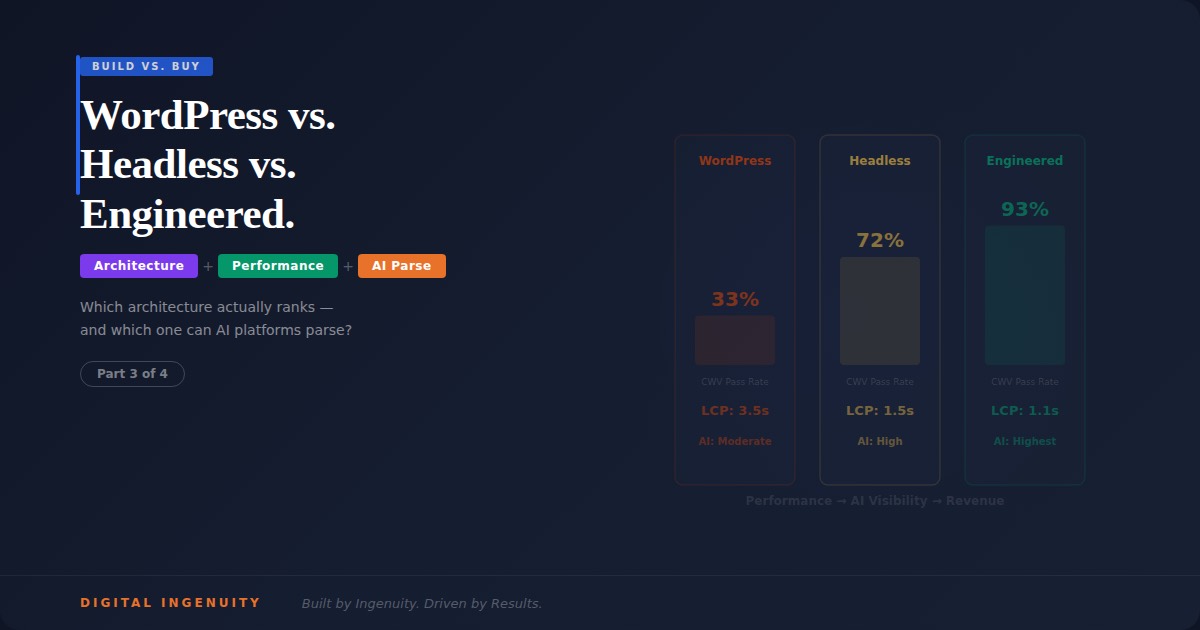
- WordPress: The most common platform, highly flexible with plugins, but carries significant performance overhead. Average Core Web Vitals pass rate of 33% for WordPress sites. Schema markup possible but dependent on plugin quality. AI platforms can parse WordPress content but struggle with heavily plugin-dependent sites
- Headless CMS (Contentful, Sanity, Strapi with a custom frontend): Decouples content from presentation, enabling fast static builds. Core Web Vitals pass rates around 65-80%. Full schema control. Clean HTML output that AI platforms parse efficiently
- Engineered builds (custom frameworks with pre-rendering/SSR like SiteLab): Purpose-built for search performance from the ground up. Core Web Vitals pass rates above 90%. Complete technical control. Cleanest possible output for AI parsing
- The architecture debate isn’t about which platform is “best” — it’s about which architecture matches your performance requirements. A well-optimized WordPress site can outperform a poorly built custom site. But at the highest competitive levels, architecture becomes the differentiator
- For AI search specifically: the cleaner your HTML output and the more structured your data, the more likely ChatGPT, Claude, Perplexity, and Manus are to parse, understand, and cite your content
Why Architecture Matters More Than It Used To
Five years ago, the website platform debate was mostly about convenience and cost. WordPress was dominant. Wix and Squarespace served small businesses. Custom builds were for enterprises with big budgets. The performance differences between platforms existed but weren’t decisive — Google’s algorithm could compensate for moderate technical deficiencies if your content and backlinks were strong.
That equation has changed.
Google’s Core Web Vitals became a ranking factor. AI platforms entered the picture, and they have strong preferences for how content is structured and served. Voice assistants need machine-readable data to generate recommendations. The technical bar for competitive search visibility has risen sharply.
Architecture isn’t just a developer decision anymore. It’s a business strategy decision with direct revenue implications.
The Three Contenders
WordPress (Traditional)
WordPress powers roughly 43% of websites globally. It’s the default choice for good reason — massive plugin ecosystem, familiar editing experience, and enough flexibility to build nearly anything.
The SEO case for WordPress: Plugins like Yoast and RankMath make basic on-page SEO accessible. WordPress generates clean permalinks, supports proper heading hierarchy, and allows meta tag customization. For basic SEO needs, WordPress is more than adequate.
The SEO case against WordPress: Performance overhead. A typical WordPress page load involves querying a MySQL database, executing PHP server-side, loading the active theme’s CSS and JavaScript, loading plugin scripts (often 15-30 plugins), rendering the page, and sending it to the browser. Each plugin adds JavaScript. Each adds potential render-blocking resources. A WordPress site with WooCommerce, a page builder, analytics, chat widget, and SEO plugin easily loads 2-4MB of scripts.
Core Web Vitals reality: According to the Chrome User Experience Report (CrUX), only about 33% of WordPress sites pass all three Core Web Vitals thresholds. That means two-thirds of WordPress sites are carrying a ranking penalty from performance alone.
AI parsing ability: WordPress generates reasonably clean HTML when using a lightweight theme. But sites using visual page builders like Elementor, Divi, or WPBakery produce heavily nested, class-bloated markup that increases the code-to-content ratio dramatically. AI platforms have to wade through thousands of lines of presentational markup to find the actual content. It’s parseable, but not efficient.
Schema capability: Plugin-dependent. Yoast adds basic Article and Organization schema. Specialized schema plugins can add more. But the schema is only as good as the plugin, and most WordPress schema implementations are incomplete or incorrectly configured.
Headless CMS (Contentful, Sanity, Strapi + Custom Frontend)
A headless CMS separates content management from presentation. Content lives in a CMS with an API. A custom frontend (built on React, Next.js, Astro, etc.) fetches that content and renders it into optimized HTML.
The SEO case for headless: Complete control over the output. The frontend framework determines exactly what HTML, CSS, and JavaScript is delivered. Modern frameworks like Next.js and Astro can generate static HTML or server-side rendered pages that load in under 1.5 seconds with minimal JavaScript. The content editors get a user-friendly CMS experience while the frontend delivers peak performance.
The SEO case against headless: Complexity. You need a developer to build and maintain the frontend. Content editors can’t preview changes in real-time the way they can in WordPress. Initial build cost is higher. And if the frontend isn’t built with SEO expertise, you can end up with a fast site that has poor crawlability — client-side-rendered React apps that Google struggles to index are a common headless pitfall.
Core Web Vitals reality: Well-built headless sites pass Core Web Vitals at 65-80% rates depending on the frontend framework and implementation quality. Astro and statically generated Next.js sites routinely achieve sub-1.5-second LCP.
AI parsing ability: This is where headless shines. The HTML output is clean, semantic, and content-dense. No page builder bloat. No plugin scripts. AI platforms can efficiently parse the content because the content IS the page, not a thin layer buried under framework code.
Schema capability: Full control. Structured data can be generated dynamically from CMS content, ensuring every page has precise, comprehensive schema. The developer controls exactly what schema types are used and how they’re populated.
Engineered Builds (SiteLab / Custom SSR-SSG Frameworks)
Engineered builds take the headless philosophy further: the entire site is designed from the ground up for search performance, with pre-rendering, structured data, and AI-optimized output as architectural requirements, not afterthoughts.
The SEO case for engineered: Every technical SEO decision is intentional. Server-side rendering or static generation ensures Google reads content on first crawl. Pre-rendered HTML means AI platforms see clean, complete pages. Structured data is woven into page templates at the component level. Core Web Vitals are optimized at the architectural level, not patched with plugins.
The SEO case against engineered: Higher upfront cost than WordPress. Requires a developer or technical team for content updates (unless a lightweight CMS is integrated). Overkill for businesses where search visibility isn’t a primary revenue driver.
Core Web Vitals reality: Engineered sites pass Core Web Vitals above 90% when built by experienced teams. Sub-1-second LCP is achievable. Our SiteLab Engineered sites using pre-rendered HTML consistently achieve LCP under 1.4 seconds and pass all three CWV metrics.
AI parsing ability: The best of any architecture. Clean HTML with high content-to-code ratio. Comprehensive structured data on every page. Machine-readable entity information built into the architecture. AI platforms can parse and cite this content with maximum efficiency and confidence.
Schema capability: Complete and architectural. Schema isn’t bolted on — it’s generated from the same data that generates the visible page content, ensuring perfect consistency between what humans see and what machines read.
The Comparison Table
| Dimension | WordPress (Traditional) | Headless CMS | Engineered Build |
|---|---|---|---|
| Core Web Vitals pass rate | ~33% | 65-80% | 90%+ |
| Typical LCP (mobile) | 3.0-5.0s | 1.2-2.0s | 0.8-1.4s |
| JavaScript payload | 2-4MB | 100-500KB | 50-200KB |
| Schema implementation | Plugin-dependent | Full control | Architectural |
| AI parsing efficiency | Moderate (theme-dependent) | High | Highest |
| Content editor experience | Excellent (familiar) | Good (CMS-dependent) | Varies (needs CMS layer) |
|---|---|---|---|
| Upfront cost | Low ($2-5K typical) | Medium ($5-15K) | Higher ($5-20K+) |
| Monthly maintenance | Low-Medium | Low | Low |
| Plugin/dependency risk | High (30+ plugins common) | Low | Minimal |
|---|---|---|---|
| Time to launch | 2-4 weeks | 4-8 weeks | 4-8 weeks |
What AI Platforms Actually See
This is the dimension most businesses haven’t considered, and it’s becoming the most important.
When ChatGPT, Claude, Perplexity, Copilot, or Manus process your website, they’re reading the HTML source — not looking at what you see in a browser. The cleaner and more semantic that HTML is, the better they can understand your content.
WordPress with Elementor (common setup):
The AI platform encounters deeply nested <div> tags, Elementor-specific CSS classes, inline styles, and JavaScript dependencies — often 50-100 lines of markup before reaching actual content. The content exists, but extracting it requires parsing through significant structural noise.
Headless with Astro/Next.js (well-built):
Clean semantic HTML. <article>, <section>, <h1>-<h6> tags used correctly. Content appears early in the document. Minimal wrapper elements. AI platforms can extract the content quickly and confidently.
Engineered with pre-rendering:
Same clean HTML as headless, plus structured data in JSON-LD that explicitly tells AI platforms: this is the business name, these are the services, this is the location, these are the FAQs with their answers. The AI platform doesn’t have to interpret — it can read structured data directly.
The difference in AI citation rates between architecture types isn’t subtle. In our cross-platform AI experiment, we observed that businesses on clean, structured sites were cited at meaningfully higher rates than businesses on template or plugin-heavy platforms — even with similar content quality.
The Right Choice for Your Situation
Choose WordPress if:
- Budget is your primary constraint
- You need to launch quickly
- You’ll maintain the site yourself and need a familiar interface
- Your competitive landscape isn’t intensely technical
- You commit to using a lightweight theme (not Elementor/Divi) and minimal plugins
Choose headless if:
- Performance and technical SEO are important competitive advantages
- You have access to development resources
- You publish content frequently and need a good editorial workflow
- You want clean output without managing a custom framework
- You’re willing to invest more upfront for better long-term performance
Choose engineered if:
- Search visibility is a primary revenue driver
- You’re competing against well-optimized sites in a competitive market
- AI search visibility (ChatGPT, Claude, Perplexity citations) matters to your business
- You want structured data, pre-rendering, and AI optimization built into the architecture
- You value maximum technical control and performance
The Hidden Fourth Option: WordPress Done Right
We’d be remiss not to mention this: WordPress can perform well when built by someone who understands its limitations and works around them.
A WordPress site using a lightweight theme like GeneratePress, minimal plugins (under 10), server-side caching, a CDN, manually implemented JSON-LD schema (not plugin-generated), and optimized images can pass Core Web Vitals and produce reasonably clean HTML.
The problem: very few WordPress sites are built this way. The platform’s greatest strength — its plugin ecosystem — is also its greatest weakness. The typical WordPress site has 20-35 active plugins, a visual page builder, and performance that degrades with every addition.
If you’re going to stay on WordPress, audit ruthlessly. Remove every plugin you don’t absolutely need. Replace your page builder with a lightweight theme. Implement schema manually. Add server-side caching. These changes alone can move your Core Web Vitals from failing to passing.
This is Part 3 of 4 in the Build vs. Buy series — challenging conventional marketing wisdom.
Previous: DIY SEO vs. Agency SEO: An Honest Comparison From Someone Who Sells Agency SEO
Next in the series: The True Cost of “Free” SEO Tools — And What They Miss About AI Search, Claude Citations, and Voice Visibility
Want to evaluate your site’s architecture? Book a free discovery call →
Learn about our SiteLab Engineered approach: SEO — Search Engine Optimization →