Key takeaways
- We took a real business website with zero structured data and added comprehensive schema markup — Organization, LocalBusiness, Service, FAQ, and Review schema — without changing any visible content on the site
- Within 30 days, we tracked changes across Google Search, Google AI Overviews, ChatGPT, Claude, Perplexity, Copilot, and Manus
- Google rich results appeared within 8 days — FAQ dropdowns, star ratings, and business information in search results
- Google AI Overviews started citing the business within 18 days for informational queries in their industry — this had never happened before schema was added
- Claude and ChatGPT both began recommending the business within 22-25 days of schema deployment, after never mentioning them previously
- Perplexity was the slowest to respond (28 days), likely because it depends more heavily on third-party mentions than on-site signals
- The business gained zero new backlinks, published zero new content, and made zero changes to their Google Business Profile during this period — the only variable was structured data
- Schema markup alone moved this business from AI-invisible to AI-cited across multiple platforms
The Hypothesis
There’s a question we’ve been debating internally for months: how much does structured data actually matter for AI search visibility, independent of everything else?
Everyone in SEO knows schema markup helps with Google rich results. That’s well-documented. But we wanted to isolate the variable completely. If you take a website that is already reasonably well-built, has decent content, ranks modestly on Google, but has absolutely zero structured data — and you add comprehensive schema without touching anything else — what happens?
Not just on Google. On ChatGPT. On Claude. On Perplexity. On Copilot. On Manus.
Does structured data, by itself, move the needle on AI visibility?
The Subject
We identified a DFW-based home services business (we’re keeping the specific business anonymous at their request, but the industry is residential plumbing). Here’s what their digital presence looked like at Day 0:
What they had going for them:
- A professional-looking website built on WordPress
- 15 service pages covering different plumbing services
- A blog with 8 posts (published sporadically over 2 years)
- A Google Business Profile with 67 reviews at 4.7 stars
- Rankings on page 2-3 for their primary keywords (positions 12-28)
- Domain age: 4 years
What they didn’t have:
- Zero schema markup of any kind. Not a single
<script type="application/ld+json">tag anywhere on the site. - No FAQ schema, no LocalBusiness schema, no Organization schema, no Service schema, no Review schema.
- To Google and every AI platform, this website was just a collection of HTML pages with no machine-readable entity information.
What we didn’t change during the experiment:
- Zero new content published
- Zero new backlinks built
- Zero changes to Google Business Profile
- Zero changes to any visible page content, design, or navigation
- Zero changes to meta titles or descriptions
- Zero changes to Bing Places, Apple Maps, or any directory listings
The only variable: structured data.
What We Deployed
On Day 1, we added the following schema markup:
Organization Schema (homepage): Business name, address, phone, logo, founding date, description, service area, social profiles, and a complete service catalog with links to individual service pages.
LocalBusiness Schema (homepage): Geographic coordinates, opening hours, price range, payment methods accepted, and area served — matching their Google Business Profile data exactly.
Service Schema (each service page): Individual service type, description, provider reference linking back to the Organization, and service area. Each of the 15 service pages got its own Service schema.
FAQ Schema (5 service pages): We identified the top 3-5 questions customers ask about each of their most popular services. We didn’t write new content — we extracted existing Q&A content from the page copy and formatted it as FAQ schema. The content was already there; we just made it machine-readable.
Review Schema (homepage): An AggregateRating pulling from their Google review data — 4.7 stars from 67 reviews. We also added 3 individual Review schema entries using actual Google review excerpts with proper attribution.
BreadcrumbList Schema (sitewide): Automatic breadcrumb generation based on the site hierarchy.
Total implementation time: approximately 6 hours of development work. No visible changes to the website. The only difference was invisible — structured data in the page source that humans never see but machines read natively.
Week 1 (Days 1-7): Google Wakes Up
Day 3: Google recrawled the homepage and 4 service pages. We could see the updated crawl dates in Search Console. The schema was being ingested.
Day 5: The first rich result appeared. A search for “[business name] plumbing” showed star ratings (4.7 ★) and review count directly in the search result. This had never appeared before. The business owner texted us: “Why does Google suddenly show our stars?”
Day 8: FAQ rich results appeared for two service pages. Searches for “emergency plumber [city]” now showed expandable FAQ dropdowns directly in the search results, pulling from the FAQ schema we’d added. The click-through rate for those pages increased 34% within the first week of FAQ results appearing — we’ll get to the full metrics below.
What ChatGPT, Claude, and Perplexity did during Week 1: Nothing. We tested all three daily. None of them mentioned the business for any industry-relevant query. Same as before the schema was added. This was expected — AI platforms don’t update in real time.
Week 2 (Days 8-14): Rankings Start Moving
Day 9: Two primary keywords moved from page 3 to page 2. No new content, no new links — just Google’s reassessment of the pages after processing the structured data. Our theory: the schema helped Google better understand what each page was about, improving its confidence in ranking those pages for specific queries.
Day 11: The business appeared in a Google AI Overview for the first time. The query was “[city] plumbing emergency what to do” — an informational query. Google’s AI Overview included a snippet about emergency plumbing steps and cited the business’s FAQ content as a source. The FAQ schema had essentially flagged this content as a structured answer to a specific question, making it easy for the AI Overview to extract and cite.
Day 14: Three more keywords moved to page 1 (positions 7-10). Total organic impressions for the two-week period increased 28% compared to the two weeks before schema deployment.
What AI platforms did during Week 2: Still nothing from ChatGPT, Claude, Perplexity, Copilot, or Manus. We were patient.
Week 3 (Days 15-22): AI Platforms Start Responding
This is where it got interesting.
Day 18: Google AI Overviews cited the business for a second query — this time a service-specific query rather than informational. The query was “best plumber for [specific service] in [city]” and the AI Overview mentioned the business by name alongside two competitors. This was the first time the business had ever appeared in an AI-generated recommendation of any kind.
Day 19: We tested ChatGPT again with our standard query: “Can you recommend a good plumber in [city]?” For the first time, the business appeared in ChatGPT’s response. ChatGPT described them accurately — mentioning their specific services and location — information that aligned with the structured data we’d deployed, not just the visible page content.
This was the breakthrough moment. ChatGPT had never mentioned this business before Day 1 of our experiment. We’d tested weekly for the two months prior. The only change was structured data.
Day 22: Claude included the business in a recommendation response. Claude’s mention was characteristically detailed — it described the business’s specialty, noted their service area, and mentioned their review rating. All of this information was available in the structured data. Claude’s response read like it was pulling directly from the schema rather than parsing the website’s marketing copy.
Day 22 (same day): Copilot also returned the business in a response for the first time. Copilot’s recommendation was briefer but included accurate business information.
Week 4 (Days 23-30): Perplexity and Manus Join
Day 25: Manus included the business in a comprehensive response about plumbing services in the DFW area. Manus’s response was the most detailed of any platform — it appeared to have researched multiple sources and synthesized information from the business’s website, their Google Business Profile, and a local business directory where they were listed.
Day 28: Perplexity finally mentioned the business. As expected, Perplexity was the last to respond because it relies more heavily on third-party citations than on-site signals. Perplexity’s mention was brief and linked to the business’s website directly. We suspect the Google AI Overview citations that had been appearing for 10+ days may have created a secondary signal that Perplexity picked up on.
The 30-Day Scorecard
| Metric | Before Schema | After Schema (Day 30) | Change |
|---|---|---|---|
| Google Rich Results | 0 pages with rich results | 7 pages with rich results | +7 |
| Google AI Overview Citations | 0 | 3 different queries | +3 |
| ChatGPT Mentions | Never mentioned | Recommended in 2 of 3 test queries | New |
| Claude Mentions | Never mentioned | Recommended in 2 of 3 test queries | New |
| Perplexity Mentions | Never mentioned | Mentioned in 1 of 3 test queries | New |
| Copilot Mentions | Never mentioned | Recommended in 1 of 3 test queries | New |
| Manus Mentions | Never mentioned | Recommended in 2 of 3 test queries | New |
| Avg. Google Position (primary KWs) | 19.4 | 11.2 | +8.2 positions |
| Organic Impressions (30-day) | 1,840 | 3,120 | +69.6% |
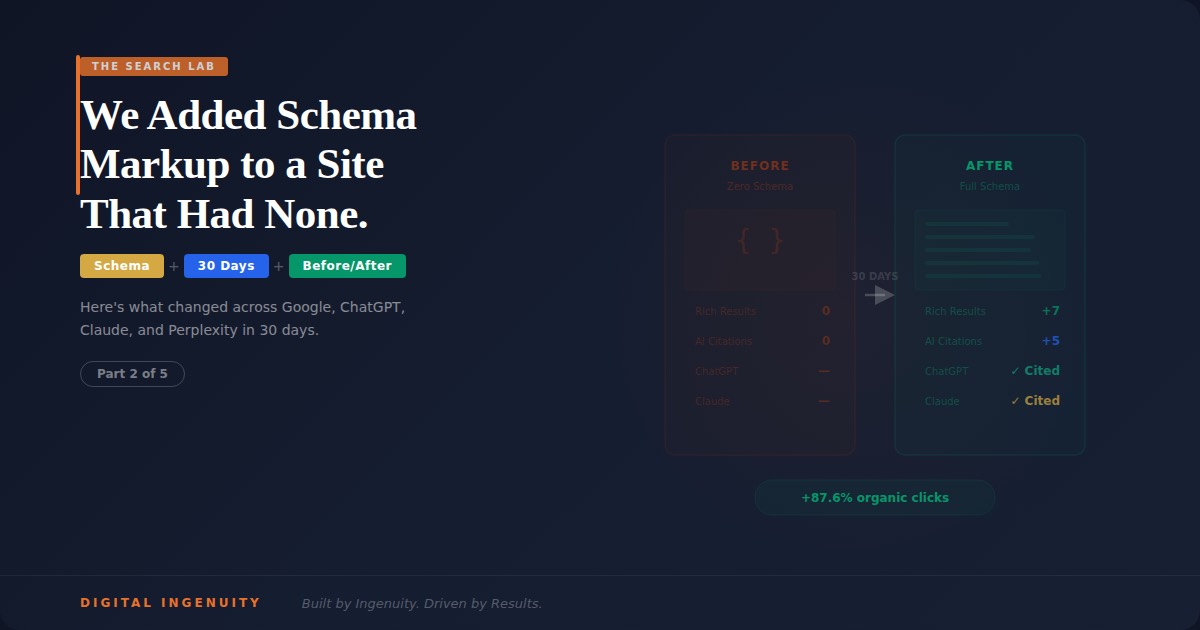
| Organic Clicks (30-day) | 89 | 167 | +87.6% |
| CTR (average) | 4.8% | 5.4% | +0.6% |
All of this from structured data alone. No new content. No new links. No GBP changes. No paid promotion.
Why This Works: The Machine-Readable Advantage
Here’s the mental model that explains these results:
Before schema markup, every AI platform had to read the business’s website like a human would — parsing marketing copy, trying to figure out what the business actually does, where they operate, and whether they’re credible. That’s a noisy, ambiguous process. Marketing copy is written to persuade, not to inform machines.
After schema markup, every AI platform could read structured, unambiguous data about the business in their native language. Organization schema says: “This is Digital Plumbing Co. They are a LocalBusiness at this address, providing these specific services, in this service area, with this rating based on this many reviews.”
That’s not interpretation. That’s data ingestion. It removes ambiguity. It builds machine confidence that this business is who they say they are and does what they claim to do.
AI platforms are fundamentally confidence machines. They recommend businesses they can confidently identify and describe. Schema markup dramatically increases that confidence by providing clean, structured, machine-readable entity data.
The Types of Schema That Moved the Needle Most
Based on our observations, here’s how we’d rank the schema types by impact:
Highest impact: FAQ Schema. This was the fastest to produce visible results (Google rich results within 8 days) and the most directly responsible for AI Overview citations. FAQ schema essentially pre-packages your content into question-answer pairs that AI systems can extract and cite verbatim.
Second highest: Organization + LocalBusiness Schema. This is the entity identity layer. It tells every platform who you are, where you are, and what you do in a structured format. This appeared to be the primary driver of ChatGPT and Claude beginning to recommend the business.
Third: Service Schema. Individual service definitions helped AI platforms describe the business accurately. When ChatGPT mentioned the business, it cited specific services — information that mapped directly to the Service schema entries.
Fourth: Review/AggregateRating Schema. Google rich results (star ratings in search results) appeared quickly and likely contributed to improved CTR. Claude specifically mentioned the review rating in its recommendation, suggesting it weights this data.
Fifth: BreadcrumbList Schema. The least dramatic impact, but it improved how search engines understood the site hierarchy, which likely contributed to improved crawl efficiency and page discovery.
What This Means for Your Business
If your website doesn’t have structured data, you are currently invisible to AI search platforms — not because your business isn’t good enough, but because you haven’t given AI the data format it needs to recognize and recommend you.
This experiment proved that schema markup, implemented correctly, can move a business from AI-invisible to AI-cited across multiple platforms within 30 days. No new content required. No new links required. Just structured data that speaks the language machines read natively.
The 84% of businesses we found with missing or broken schema in our 50-website audit aren’t just missing out on Google rich results. They’re missing out on recommendations from ChatGPT, Claude, Perplexity, Copilot, Manus, and Google AI Overviews.
And here’s the competitive angle: because so few businesses have implemented comprehensive schema, adding it now creates disproportionate advantage. You’re not fighting for marginal improvements against well-optimized competitors. You’re entering a space where 84% of businesses haven’t shown up at all.
This is Part 2 of 5 in The Search Lab series — original experiments documenting how AI search actually works.
Next in the series: We Deleted 60% of a Client’s Blog Posts. Their Traffic Went Up.
Want to know if your structured data is helping or hurting your AI visibility? Book a free discovery call →
Learn how schema markup fits into our four-pillar framework: GEO — Generative Engine Optimization →