Key takeaways
- Free SEO tools (Google Search Console, Google Analytics, Ubersuggest free tier, Answer the Public) are genuinely useful for traditional SEO fundamentals — keyword research, indexing status, basic performance tracking
- But every free tool was built to measure the world as it existed in 2019-2022: ten blue links, keyword rankings, organic traffic from Google. None of them measure the dimensions that matter most in 2026
- No free tool tracks whether ChatGPT, Claude, Perplexity, Copilot, or Manus recommends your business. No free tool monitors your featured snippet ownership across queries. No free tool checks whether Siri, Alexa, or Google Assistant mentions you in voice responses
- Paid tools (Ahrefs, Semrush, Moz) are significantly better for competitive analysis and backlink monitoring, but they also have blind spots on AI search — most are just now beginning to add AI visibility features
- The real cost of free tools isn’t the $0 price tag — it’s the false confidence they create. You monitor keyword rankings improving while your AI visibility stays at zero, and you never know what you’re missing
- The solution isn’t abandoning free tools — it’s layering them with monitoring that covers the full 2026 search landscape: Google organic + AI citations + featured snippets + voice results
The Tools That Built Modern SEO
Let’s give credit where it’s due. Free SEO tools democratized search optimization. Before Google Search Console, Ubersuggest, and Google Analytics, understanding your search performance required enterprise software costing thousands per month.
Google Search Console remains one of the most valuable SEO tools in existence — free or paid. It tells you exactly which queries drive impressions, which pages Google has indexed, where your Core Web Vitals stand, and what technical issues need attention. According to a 2024 Search Engine Journal survey, 94% of SEO professionals use Search Console as their primary diagnostic tool. That hasn’t changed, and it shouldn’t.
Google Analytics (now GA4) provides behavioral data — how visitors interact with your site, which pages convert, where people drop off. Ahrefs’ 2025 benchmark study found that businesses actively using analytics data to optimize their sites saw 2.3x more organic growth than those relying on intuition alone.
Answer the Public surfaces question-based queries that reveal how your customers actually think about your industry. Ubersuggest’s free tier provides basic keyword volume and difficulty data. Google Keyword Planner remains the standard for search volume estimates tied to actual Google data.
These tools are valuable. We use most of them ourselves. This isn’t a “free tools are worthless” argument.
This is a “free tools measure the wrong things if they’re the only things you measure” argument.
The 2019 Dashboard Problem
Every free SEO tool was designed to answer a specific question: how is my website performing on Google’s organic search results?
That was the right question in 2019. Google organic search was where customers found businesses. If you ranked well on Google, you were visible. If you didn’t, you weren’t. The entire SEO industry — tools, strategies, metrics — was built around this reality.
In 2026, that question is incomplete.
It misses AI-generated recommendations. When someone asks ChatGPT “recommend a plumber in Plano,” no SEO tool tells you whether your business was mentioned. Gartner predicted that traditional search traffic would decline 25% by 2026 due to AI search adoption. Whether that exact number holds, the directional trend is undeniable — a growing percentage of customer discovery happens outside of traditional search results.
It misses AI Overview absorption. Your Search Console might show you ranking position 1 for a keyword with hundreds of monthly searches, but your CTR is 0%. Why? Because Google’s AI Overview answered the query above all organic results. Semrush research published in late 2025 found that AI Overviews appeared in 47% of informational queries, and when they did, organic CTR for the top position dropped by an average of 34.5%. Free tools show you the ranking. They don’t show you the AI Overview eating your clicks.
It misses voice search entirely. When someone asks Siri “find me a good dentist nearby,” no analytics platform records that query. BrightLocal’s 2025 Voice Search Study found that 72% of smart speaker owners use voice search for local business queries at least weekly. That’s a massive discovery channel with zero visibility in any free SEO tool.
It misses cross-platform search. SparkToro’s 2025 research showed that 36% of all web searches now happen outside of Google — on Bing, DuckDuckGo, AI platforms, and social search. Free tools track Google. They don’t track the other 36%.
What Paid Tools Get Right (And Wrong)
What they get right:
Ahrefs has the most comprehensive backlink index in the industry. Understanding who links to you versus your competitors is intelligence no free tool replicates. According to Ahrefs’ own research, the average first-page Google result has backlinks from 3.8x more referring domains than results on page two. That kind of competitive insight requires a paid tool.
Moz’s Domain Authority metric, while imperfect, provides a useful relative benchmark. Semrush’s keyword tracking, site audit, and competitive gap analysis tools are best-in-class for traditional SEO. For $99-249/month, these tools earn their keep if search visibility matters to your revenue.
What they get wrong:
Paid tools are beginning to add AI search features, but they’re early. Semrush launched an “AI Overview Tracker” in late 2025, and Ahrefs has started including AI citation data in beta features. But these are bolt-on additions to platforms designed for traditional search.
None of them comprehensively track whether ChatGPT, Claude, Perplexity, Copilot, and Manus cite your business. None monitor voice search across Siri, Alexa, and Google Assistant. None measure entity authority across the full AI ecosystem.
The paid tools are catching up. But the AI search landscape is evolving faster than the tool ecosystem.
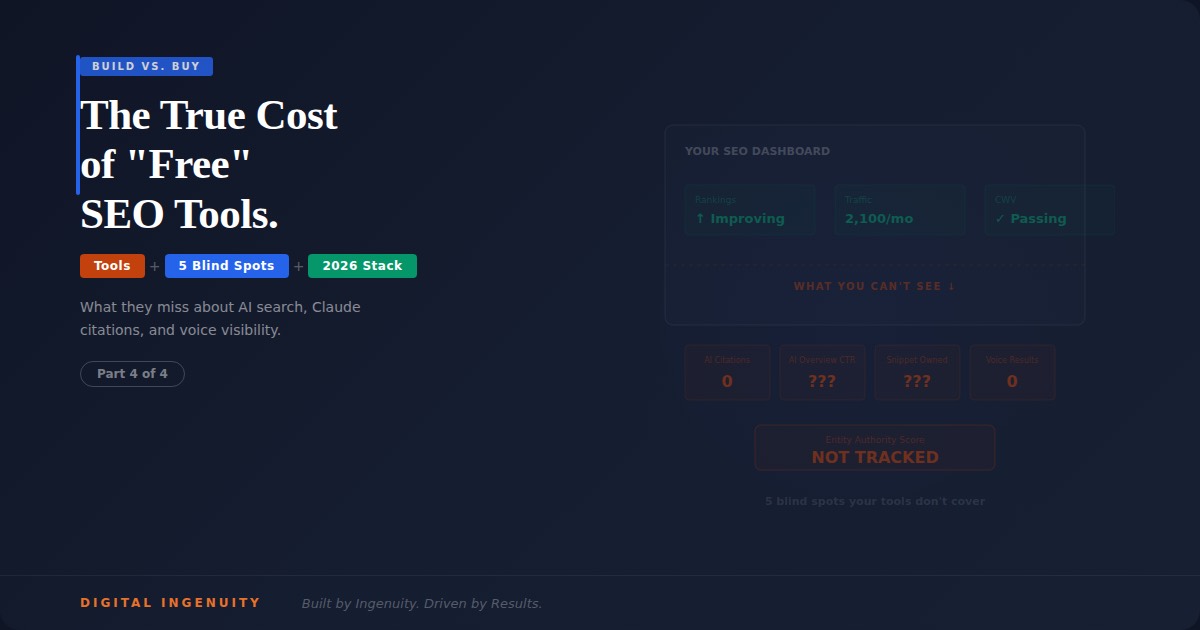
The Five Blind Spots
Blind Spot 1: AI Citation Monitoring
Does ChatGPT recommend your business? Does Claude? Perplexity? Copilot? Manus? How consistently? For which queries?
Our 90-day citation tracking study found that AI citations are volatile — the same query returned different cited sources 34% of the time week to week. A single snapshot tells you nothing. You need ongoing monitoring.
Blind Spot 2: AI Overview CTR Impact
Google Search Console shows impressions, clicks, and position. It doesn’t tell you whether an AI Overview appeared above your listing and absorbed the clicks. You can infer this (high impressions + position 1 + near-zero CTR is a strong signal), but no free tool explicitly identifies which keywords are being intercepted.
This distinction matters for strategy. Intercepted keywords need a GEO/AEO approach (get cited IN the overview). Normal-CTR keywords need traditional SEO refinement. Without this data, you’re applying the wrong strategy to the wrong keywords.
Blind Spot 3: Featured Snippet Ownership
Google Search Console doesn’t tell you which pages hold featured snippets or when you lose one. As we demonstrated in our AEO experiment, winning a snippet creates compound effects across AI Overviews, ChatGPT, and Claude. But you can’t optimize for what you can’t measure.
Blind Spot 4: Voice Search Visibility
When Siri recommends a business, that recommendation isn’t logged anywhere you can access. BrightLocal’s research found that 87% of voice queries return a single business recommendation. Either you’re the one business mentioned, or you’re invisible — and you have no way to know without actively testing.
Blind Spot 5: Entity Authority
How strongly do AI systems recognize your business as a trustworthy entity? This meta-metric drives everything — AI citations, voice recommendations, Knowledge Panel data, snippet confidence. It’s a composite of NAP consistency, structured data completeness, third-party mentions, review sentiment, content depth, and freshness. No single tool measures this.
The False Confidence Trap
Blind spots create false confidence. A business owner checks their free tools: keyword rankings improving, traffic steady, Core Web Vitals passing. Everything looks fine.
Meanwhile, ChatGPT has never mentioned their business. AI Overviews are absorbing 40% of their potential clicks. Siri recommends their competitor. Perplexity doesn’t know they exist. Their entity authority is weak.
All invisible — because their tools don’t measure it. They’re optimizing for 2019 search while 2026 search evolves around them.
What a 2026 Monitoring Stack Looks Like
Layer 1: Foundation (Free — keep using these)
- Google Search Console: Indexing, technical health, query performance
- Google Analytics (GA4): User behavior, conversions
- Google Business Profile Insights: Local search performance
Layer 2: Competitive Intelligence (Paid — pick one)
- Ahrefs OR Semrush: Backlinks, keyword tracking, competitive analysis, audits
- Budget: $99-249/month
Layer 3: AI and Voice Visibility (The gap)
- AI citation monitoring across ChatGPT, Claude, Perplexity, Copilot, Manus
- AI Overview detection and CTR impact analysis
- Featured snippet ownership tracking
- Voice search testing across Siri, Alexa, Google Assistant
- Entity authority scoring
Layer 3 is where most businesses have zero coverage. It’s also where the fastest growth in customer discovery is happening. This is what we built SearchLight™ to monitor — the full landscape that free and paid tools don’t yet cover.
The Honest Take
Free tools are a foundation, not a ceiling. If you’re a small business starting with SEO, Google Search Console and GBP Insights give you 80% of what you need for traditional optimization. Don’t let anyone sell you a $300/month tool suite when you’re still figuring out the basics.
But if you’re investing $999/month or more in SEO — or if search visibility drives meaningful revenue — monitoring only traditional metrics is like checking your speedometer but not your fuel gauge. The number looks fine until it doesn’t, and by then you’ve been running on empty for months.
The businesses that will dominate search in the next 3-5 years measure the full landscape: Google organic, AI citations, featured snippets, voice results, and entity authority. Not because they have bigger budgets — because they see the whole picture while competitors stare at a dashboard built for a version of search that no longer exists.
This is Part 4 of 4 in the Build vs. Buy series — challenging conventional marketing wisdom.
Start from the beginning: Why Your $50/mo Wix Site Is Costing You $5,000/mo in Lost Revenue
Want to see what your free tools are missing? Book a free discovery call →
Learn about SearchLight™ monitoring: The Four-Pillar Growth Engine →