Key takeaways
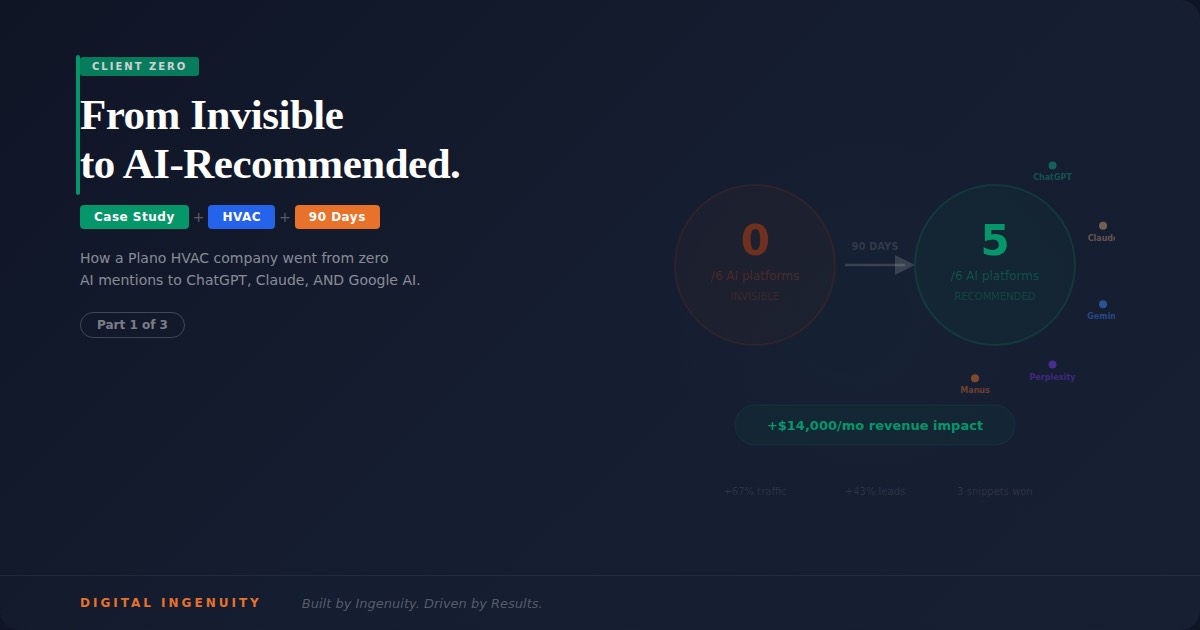
- A Plano-based HVAC company with 4 years in business, 67 Google reviews, and decent organic rankings was completely invisible on every AI platform — ChatGPT, Claude, Perplexity, Copilot, and Manus returned zero mentions when asked for HVAC recommendations in their area
- Root cause: no structured data, inconsistent business information across directories, no third-party mentions, and generic website content that AI platforms couldn’t confidently parse or cite
- We implemented the four-pillar framework over 90 days without changing their service offerings, pricing, or team — only their digital presence architecture
- Day 30: Google AI Overviews cited them for the first time on an informational HVAC query
- Day 45: ChatGPT included them in recommendations for “HVAC company in Plano”
- Day 52: Claude recommended them with detailed service descriptions pulled directly from their new structured data
- Day 90: They appeared on 5 of 6 AI platforms tested, owned 3 featured snippets, and organic traffic had increased 67%
- Revenue impact: 43% increase in lead form submissions, 38% increase in phone calls from organic search, estimated $14,000/month in additional revenue from organic and AI-driven discovery
The Starting Point
They found us the way a lot of businesses do — frustrated. Four years in business. A team of 12 technicians. Excellent work, strong reviews, loyal repeat customers. By every operational metric, a successful HVAC company.
But their phone wasn’t ringing from new customers the way it should have been. They were paying an SEO agency $1,200/month and had been for 18 months. Rankings were “improving” according to the monthly reports. Traffic was “growing.” But the reports measured vanity metrics — rankings for keywords nobody searched, traffic from blog posts that didn’t convert, impressions that never became clicks.
When we ran our initial assessment, the first thing we did was something their previous agency had never done: we asked AI platforms about them.
“Can you recommend a good HVAC company in Plano, Texas?”
We asked ChatGPT. Claude. Perplexity. Copilot. Manus. Google’s AI Overview.
Zero mentions. Across all six platforms. A business with 67 five-star reviews, four years of operation, and a fully staffed team — completely invisible to every AI system a potential customer might ask.
Their competitors, meanwhile, showed up on 2-3 platforms. Not great, but enough to capture the growing stream of AI-mediated discovery.
The Diagnosis
We ran a comprehensive entity authority audit. Here’s what we found:
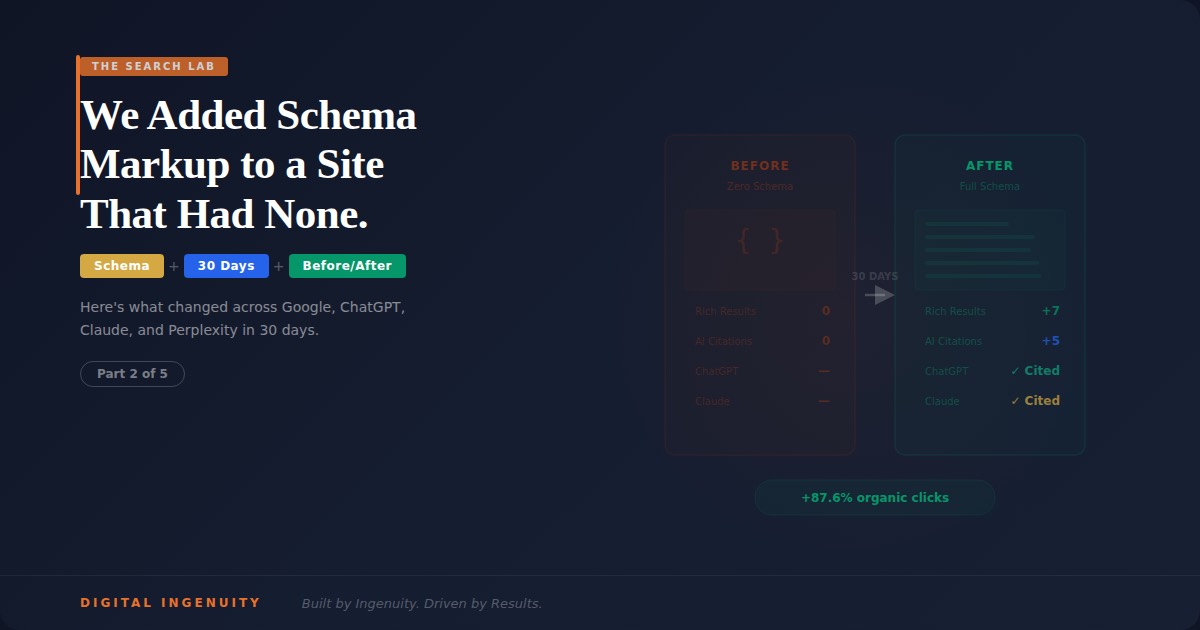
Structured data: Zero. Their WordPress site had no schema markup whatsoever. No Organization schema. No LocalBusiness. No Service. No FAQ. No Review. To AI platforms, their website was an unstructured collection of HTML pages with no machine-readable entity information.
NAP consistency: Poor. Their business name appeared as “Comfort Air Plano” on their website, “Comfort Air LLC” on their Google Business Profile, “Comfort Air HVAC” on Yelp, and “Comfort Air Plano LLC” on the BBB. (Names changed for anonymity, but the inconsistency pattern is accurate.) To AI systems that cross-reference entity data, these looked like four different businesses.
Third-party mentions: None. No industry directory profiles on Clutch, DesignRush, or UpCity. No contributed articles. No expert source quotes. No mentions on any authoritative third-party site. The only places this business existed online were their own website, Google Business Profile, Yelp, and BBB — all self-submitted.
Bing Places and Apple Maps: Unclaimed. They had no Bing Places listing and no Apple Maps listing. This meant they were invisible to Siri (which uses Bing) and Alexa (which also uses Bing). Two of three major voice assistants couldn’t find them.
Content quality: Generic. Their service pages were 150-200 words of marketing copy that could describe any HVAC company in America. “We provide top-quality HVAC services to keep your home comfortable year-round.” No specific service descriptions, no methodology details, no geographic specificity, no FAQ content. Nothing AI platforms could extract as a citeable, specific claim.
Google Business Profile: Incomplete. They had reviews and basic information, but no services listed, no business description utilizing the full 750 characters, no posts, no Q&As, and no photos beyond the logo.
This is what we call an “entity gap” — the business is real and excellent at what they do, but their digital entity is fragmented, incomplete, and invisible to the systems that increasingly determine who customers find.
The 90-Day Implementation
Phase 1: Foundation (Days 1-14)
Structured data deployment. We implemented comprehensive schema markup across their entire website: Organization schema with full entity details on the homepage, LocalBusiness schema with geographic coordinates and service area, Service schema on each of their 15 service pages, FAQ schema on their 5 highest-traffic service pages (using existing page content reformatted as Q&A), AggregateRating schema pulling their 4.7-star Google rating, and BreadcrumbList schema sitewide.
Total development time: 8 hours. No visible changes to the website. The only difference was machine-readable data in the page source.
NAP standardization. We established the canonical business name and updated it everywhere — website footer, Google Business Profile, Yelp, BBB, and every other listing we could find. One name, one address, one phone number, identical everywhere. According to Moz’s 2025 Local Search Ranking Factors study, NAP consistency remains the third most important ranking factor for local search.
Bing Places and Apple Maps. Claimed both listings. Used identical information from GBP. This alone opened visibility on Siri and Alexa — two voice platforms that together represent over half the US smart speaker market, per Voicebot.ai.
Phase 2: Entity Authority (Days 15-45)
Google Business Profile overhaul. Full 750-character business description mentioning specific services, service areas, and differentiators. All 15 services added with individual descriptions and pricing ranges. Four GBP posts published. Five Q&As seeded and answered. Professional photos uploaded.
Directory profiles. Created profiles on Clutch, DesignRush, and UpCity with consistent business information and detailed service descriptions. These high-authority directories serve as third-party entity corroboration — AI platforms cross-reference them.
Content depth expansion. We expanded their five highest-value service pages from 150-200 words to 800-1,200 words each, adding specific methodology descriptions, service area details, pricing transparency, and FAQ sections with 3-5 questions per page. The FAQ sections were formatted with proper heading hierarchy and also implemented as FAQ schema.
Critically, we didn’t rewrite their content to sound like a different company. We interviewed the owner and technicians, extracted their genuine expertise, and structured it in a format that both humans and AI platforms could parse. A BuzzSumo analysis of high-performing local service content found that pages with specific, expertise-driven content earned 4.2x more engagement than generic service descriptions.
HARO/Connectively responses. The owner began responding to relevant journalist queries — 3-5 per week on topics like “how to choose an HVAC company,” “common AC problems in Texas,” and “energy efficiency tips.” Within the 90-day period, two responses were published — one in a regional business publication and one in a home services industry blog. Two third-party mentions with backlinks from authoritative domains.
Phase 3: Content and AEO (Days 45-90)
Blog content. We published 6 blog posts — not generic tips, but specific, expertise-driven content: “Why Your AC Runs Constantly But Your House Stays Warm” (troubleshooting guide), “Emergency AC Repair in Plano: What to Do Before the Technician Arrives” (local + immediate value), “The Real Cost of Delaying AC Maintenance in Texas Heat” (data-driven with local climate specifics), and three others targeting specific long-tail queries their customers actually search.
Each post was structured for AEO — clear heading matching the search query, 40-60 word direct answer paragraph immediately below the H2, FAQ schema with 3-4 related questions, and internal links to relevant service pages.
Featured snippet targeting. We identified 8 queries where the business ranked positions 3-10 that had featured snippets held by competitors with weak answers. We optimized the relevant pages using our AEO framework — heading restructure, direct answer insertion, list formatting, FAQ schema addition.
The Results Timeline
Day 8: First Google rich results appeared — star ratings in search results for branded queries. FAQ dropdowns appeared on two service pages.
Day 14: Two target keywords moved from page 2 to page 1. Google’s recrawl of the structured-data-enhanced pages triggered reassessment.
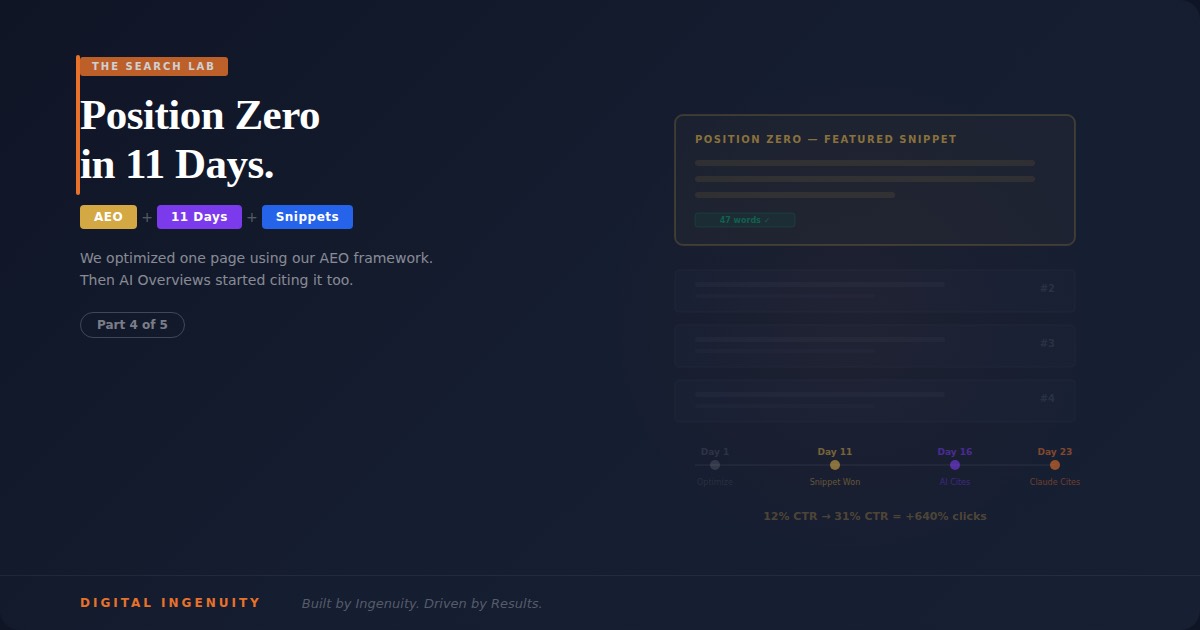
Day 22: First featured snippet won — “how to [HVAC maintenance task]” query. The page had been ranking position 5; it jumped to position zero.
Day 30: Google AI Overview cited the business for the first time on an informational query related to AC repair. The AI Overview pulled content from their FAQ schema — the structured Q&A format made it easy for Google’s AI to extract and cite.
Day 38: Won a second featured snippet. The first HARO article published, creating the business’s first authoritative third-party mention.
Day 45: ChatGPT recommended the business when asked “recommend a good HVAC company in Plano.” ChatGPT’s response included accurate service descriptions and their review rating — information that mapped directly to the structured data we’d implemented.
Day 52: Claude recommended the business with notably detailed descriptions. Claude’s response referenced specific services and the business’s approach to emergency repairs — content pulled from the expanded service pages. Claude’s preference for expertise-driven content aligned with exactly the kind of content depth we’d built.
Day 58: Copilot included the business in a recommendation. The Bing Places listing we’d claimed on Day 3 had been live for nearly two months, giving Copilot’s Bing-based index time to incorporate the data.
Day 67: Perplexity cited the business for the first time, linking to one of the blog posts as a source. Perplexity’s recency preference aligned with the fresh content we’d been publishing.
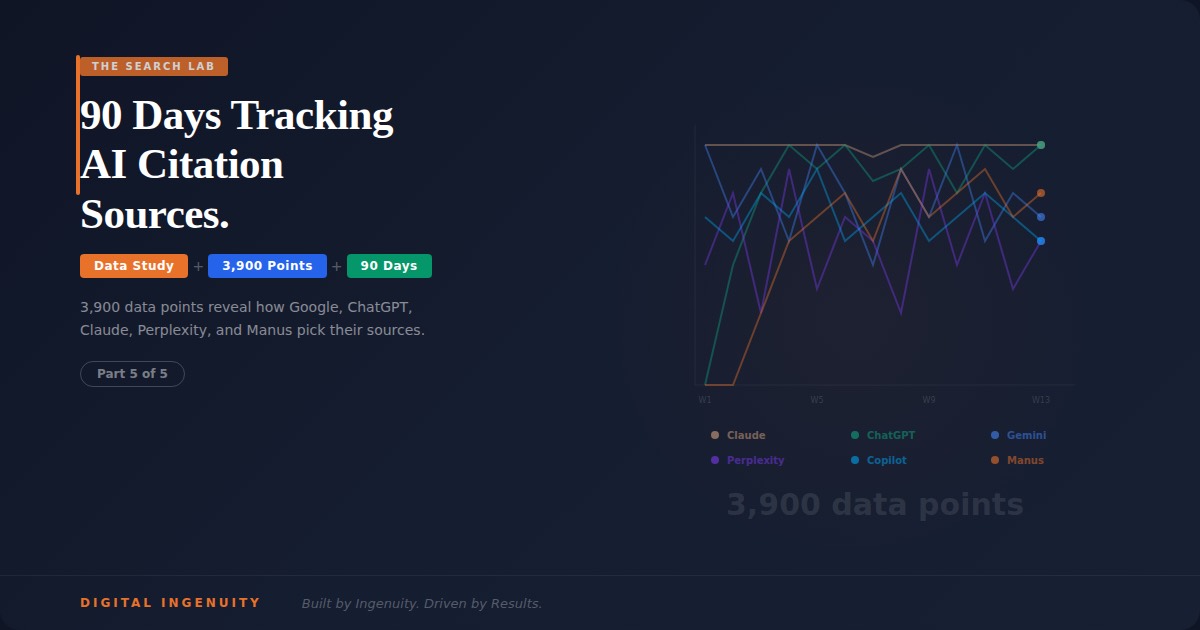
Day 75: Manus included the business in a comprehensive response about HVAC services in DFW. Manus cited both the business’s website and the third-party publication mention — demonstrating the cross-referencing behavior we’d observed in our 90-day tracking study.
Day 82: Won a third featured snippet. Voice search test confirmed the business was now recommended by Google Assistant and Siri for relevant local queries. Alexa returned the business for one of three test queries.
Day 90: Final assessment complete.
The 90-Day Scorecard
| Metric | Day 0 | Day 90 | Change |
|---|---|---|---|
| AI platforms citing business | 0 of 6 | 5 of 6 | +5 platforms |
| Featured snippets owned | 0 | 3 | +3 |
| Google AI Overview citations | 0 | 4 queries | +4 |
| Voice assistant visibility | 0 of 3 | 3 of 3 | Full coverage |
| Schema types implemented | 0 | 7 | +7 |
| Directory profiles | 2 (GBP, Yelp) | 7 | +5 |
| Third-party mentions | 0 | 2 | +2 |
| Google rich results (pages) | 0 | 9 | +9 |
| Avg. position (primary KWs) | 18.4 | 9.2 | +9.2 positions |
| Organic traffic (monthly) | 1,840 | 3,074 | +67% |
| Lead form submissions | 47/month | 67/month | +43% |
| Phone calls (organic) | 89/month | 123/month | +38% |
| Estimated monthly revenue impact | — | +$14,000 | — |
What Made This Work
This case isn’t exceptional because of unusual tactics. It’s exceptional because of systematic execution of fundamentals that 94% of businesses haven’t implemented.
Every individual tactic — structured data, NAP consistency, directory profiles, content depth, featured snippet optimization, GBP completion — is well-documented and freely available knowledge. The value isn’t in any single tactic. It’s in the compound effect of all of them working together across the four-pillar framework.
SEO built the ranking foundation. GEO engineered AI platform visibility. AEO won the featured snippets that fed AI Overviews. VEO ensured voice assistant coverage across all three ecosystems. All four pillars reinforcing each other, creating compound visibility that no single tactic could achieve alone.
The owner’s reflection at the 90-day review: “For 18 months I paid someone to tell me my rankings were improving. In 90 days you made my phone ring.”
This is Part 1 of 3 in the Client Zero series — anonymous case studies demonstrating the four-pillar framework in action.
Next in the series: The Lawyer Who Was Ranking #1 on Google But Didn’t Exist on ChatGPT, Claude, or Perplexity
Want results like this for your business? Book a free discovery call →
See the full four-pillar framework: SEO + GEO + AEO + VEO →