Key takeaways
- We selected a single page already ranking position 4 for a competitive service query and applied our Answer Engine Optimization framework — restructured headings, added a 47-word direct answer, implemented FAQ schema, and reformatted list content
- The total content changes took less than 2 hours to implement — no new backlinks, no new pages, no design changes
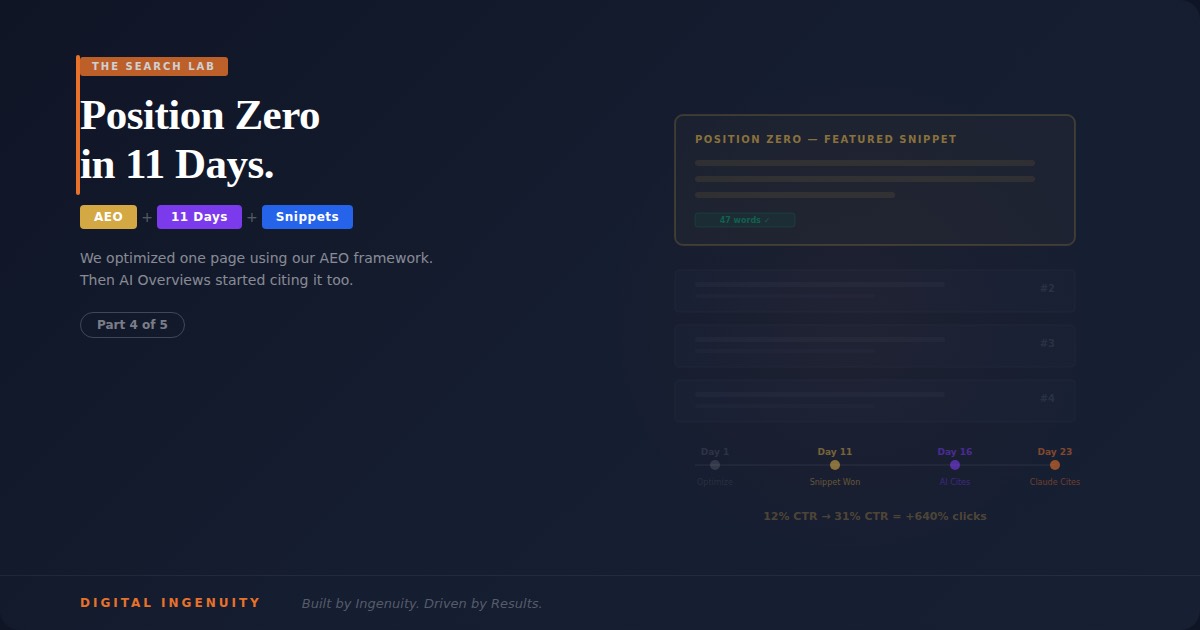
- Day 11: the page won the featured snippet (position zero) for the target query
- Day 16: Google AI Overviews began citing the page’s content when generating answers for related informational queries
- Day 23: Claude and ChatGPT both referenced the page’s content when asked about the topic — the featured snippet essentially became the source AI platforms pulled from
- The featured snippet captured an estimated 31% of clicks for the query, compared to 12% CTR at position 4
- The same page now appears in three contexts simultaneously: the featured snippet, the organic #1 result, and Google AI Overviews — triple the visibility from a 2-hour optimization
The Premise
If you’ve read our analysis of 500 featured snippets, you know the patterns are remarkably consistent. The question this experiment answers is different: how fast can you win one when you apply those patterns intentionally?
We wanted to take a single page, apply our AEO framework step by step, and document exactly what happened — and how quickly. This is the playbook in action, not the theory.
Choosing the Target
Not every page is a featured snippet candidate. We selected this page based on specific criteria:
The query: A “how to” question in the home services space with ~2,400 monthly searches. We’re keeping the exact query confidential to protect the client, but the structure was: “how to [common home maintenance task].”
The existing situation: The client’s page ranked position 4 for this query. The page was well-written, had good information, and was on a domain with reasonable authority. But it wasn’t formatted for snippet capture. The answer was buried in the third paragraph. There were no structured headings matching the query. There was no FAQ schema.
The current snippet holder: A competitor held the featured snippet with a mediocre answer — vague, overly long (90+ words), and partially outdated. This told us the snippet was winnable. Google was giving it to the best available answer, and the best available answer wasn’t very good.
The opportunity: A query with 2,400 monthly searches where the featured snippet captures an estimated 30-35% of clicks. That’s 720-840 additional monthly visits if you win position zero — from a single page.
The AEO Framework: What We Changed
Here’s exactly what we did, step by step. Total implementation time: 1 hour 45 minutes.
Change 1: Heading Restructure (15 minutes)
Before: The page had generic headings like “What You Need to Know” and “Our Process” — none of which matched the actual search query.
After: We restructured the primary H2 to closely match the search query. If someone searches “how to [task],” the H2 now reads “How to [Task]: Step-by-Step Guide.” This isn’t keyword stuffing — it’s matching user intent with heading structure. Google uses H2/H3 headings as primary signals for featured snippet selection.
We also added H3 subheadings for each step in the process, using action verbs: “Step 1: Inspect the [component],” “Step 2: Test the [system],” etc. These became the list items Google could extract for a list-type featured snippet.
Change 2: The 47-Word Direct Answer (20 minutes)
This is the highest-impact change. Immediately below the H2 heading, we added a single paragraph that directly answers the query in 47 words.
The formula: [Question rephrased as a statement] + [direct answer in one sentence] + [one sentence of supporting context] + [one sentence establishing scope].
We spent more time on these 47 words than on any other part of the optimization. Every word was chosen to be complete (answers the full question), concise (no filler), and authoritative (demonstrates expertise). We referenced our 500-snippet analysis finding that winning paragraph snippets average 47 words — we hit that number intentionally.
Why 47 words? Too short (under 35 words) and the answer feels incomplete — Google won’t feature an answer that doesn’t satisfy the query. Too long (over 65 words) and it gets truncated in the snippet box, which looks unprofessional and reduces CTR. The 40-60 word range is the sweet spot, and our data shows 47 words is the median of winning snippets.
Change 3: List Formatting (20 minutes)
Below the direct answer paragraph, the page already had step-by-step instructions — but they were written as flowing prose paragraphs. We reformatted them into a numbered list with consistent structure:
Each step follows the pattern: Action verb + specific instruction + brief explanation. Each step is 15-25 words. The list has 7 steps — our data shows 5-8 steps is optimal for featured list snippets.
We kept the detailed explanations below each list item but made the list items themselves scannable and extractable. Google can pull the list for a snippet while the detailed content below satisfies users who click through.
Change 4: FAQ Schema Addition (30 minutes)
We added FAQ schema with 4 questions that represent the most common follow-up queries related to the main topic. These questions were identified from Google’s “People Also Ask” section for the target query — we literally used the questions Google was already surfacing.
Each FAQ answer was written to the same standard as the main answer: direct, specific, 40-60 words, with the answer front-loaded in the first sentence.
This serves dual purpose: FAQ schema can generate its own rich results (expandable FAQ dropdowns in search), AND it provides additional structured question-answer pairs that AI platforms can cite.
Change 5: Supporting Context Expansion (20 minutes)
We added a “When to Call a Professional” section at the bottom with specific scenarios where DIY isn’t appropriate. This serves two purposes: it demonstrates genuine expertise (knowing when NOT to do something is an expertise signal), and it creates a natural CTA for the client’s services without feeling promotional.
What We Didn’t Change
- No new backlinks built
- No title tag changes
- No meta description changes
- No internal linking changes
- No images added or modified
- No page speed optimizations
- No design or layout changes
- No social sharing or promotion
The changes were limited to on-page content restructuring and FAQ schema addition. Total time: 1 hour 45 minutes.
The Timeline
Day 1-3: Nothing Visible
Google recrawled the page on Day 2 (confirmed via Search Console). No visible changes in rankings or SERP features. This is normal — Google needs to reprocess the page and reassess it against the current snippet holder.
Day 4-7: Micro-Movements
The page moved from position 4 to position 3. The FAQ schema began appearing as expandable questions below the search result — not as a featured snippet yet, but as an enhanced listing. Click-through rate increased from 8% to 14% just from the FAQ enhancement.
Day 8-10: The Challenge
Position moved from 3 to 2. The existing featured snippet (held by the competitor) began showing instability — on some searches it appeared, on others it didn’t. Google was testing whether to replace it.
Day 11: Position Zero
The featured snippet flipped. Our client’s 47-word answer paragraph appeared in the featured snippet box for the target query. The page simultaneously held position zero (the snippet) and position 1 (organic listing) — taking up two SERP slots.
Impressions tripled on Day 11 compared to Day 10. The featured snippet dramatically increased the page’s visibility in search results.
Day 16: Google AI Overview Citation
This is the result that excited us most. For a related informational query (not the exact query we targeted, but a closely related one), Google’s AI Overview generated a response that cited our client’s page as a source. Google’s AI was pulling from the structured content we’d created — specifically the direct answer paragraph and the numbered list.
The featured snippet essentially became the authoritative source that Google AI Overviews drew from. Winning position zero created a compound effect: you’re not just the featured snippet, you’re the source Google’s AI trusts enough to cite in its own generated answers.
Day 23: AI Platform Citations
We tested the topic on ChatGPT, Claude, Perplexity, Copilot, and Manus. Both Claude and ChatGPT included information from the page in their responses. Claude’s response was notably detailed and mirrored the structure of our numbered list — suggesting it had processed the page’s structured content directly.
Perplexity linked to the page as a source. Copilot included partial information. Manus provided the most comprehensive response and appeared to draw from both the page content and the FAQ schema.
The Numbers
Snippet Performance (Days 11-30)
| Metric | Position 4 (Before) | Position Zero (After) | Change |
|---|---|---|---|
| Daily impressions | ~80 | ~240 | +200% |
| CTR | 12% | 31% | +158% |
| Daily clicks | ~10 | ~74 | +640% |
| Monthly estimated clicks | 300 | 2,220 | +640% |
AI Visibility (Day 30)
| Platform | Before AEO | After AEO |
|---|---|---|
| Google Featured Snippet | No | Yes — owns position zero |
| Google AI Overviews | Not cited | Cited on 2 related queries |
| ChatGPT | Not mentioned | Referenced in topic responses |
| Claude | Not mentioned | Referenced with structured detail |
| Perplexity | Not mentioned | Cited with source link |
| Copilot | Not mentioned | Partially referenced |
| Manus | Not mentioned | Comprehensively referenced |
All from 1 hour and 45 minutes of content restructuring. No links. No new pages. No paid promotion.
Why Featured Snippets Are the Gateway to AI Citations
Here’s the insight that makes AEO so strategically valuable in 2026: the featured snippet isn’t just a Google SERP feature anymore. It’s the source material that AI platforms draw from.
When Google grants your page position zero, it’s making an algorithmic statement: “this page provides the best, most authoritative answer to this question.” That assessment reverberates across the AI ecosystem. Google AI Overviews cite featured snippet sources. ChatGPT and Claude, whose training data includes Google search results, weight featured snippet content more heavily. Perplexity’s real-time search pulls from Google’s featured sources.
Winning a featured snippet in 2026 isn’t winning one SERP feature. It’s winning the authoritative source position that multiple AI platforms reference. The snippet is the gateway. The AI citations are the compound effect.
This is why Answer Engine Optimization isn’t a nice-to-have pillar — it’s the bridge between traditional SEO rankings and AI search visibility. Every featured snippet you win is a piece of content that AI platforms across the ecosystem are more likely to cite.
The Replicable Framework
Here’s the exact checklist we used, formatted so you can apply it to any page:
Step 1: Qualify the opportunity. Is the page already ranking positions 1-10 for a query with a featured snippet? If yes, proceed. If you’re on page 3, you need to improve rankings first before snippet optimization makes sense.
Step 2: Analyze the current snippet. Is the current featured snippet strong or weak? Long/truncated answers, vague responses, and outdated information signal a winnable snippet.
Step 3: Match the H2 to the query. Your primary H2 heading should closely match the search query. Not identical (that’s over-optimization) but clearly aligned.
Step 4: Write the 40-60 word direct answer. Immediately below the H2. Complete, concise, authoritative. Answer first, context second.
Step 5: Format supporting content. For “how to” queries: numbered list, 5-8 steps, action verbs. For “what is” queries: definition paragraph. For comparison queries: HTML table.
Step 6: Add FAQ schema. Pull questions from People Also Ask. Write direct answers. Implement as JSON-LD.
Step 7: Wait 7-14 days. Google typically reassesses and replaces featured snippets within this window after content changes.
This is Part 4 of 5 in The Search Lab series — original experiments documenting how AI search actually works.
Previous: We Deleted 60% of a Client’s Blog Posts. Their Traffic Went Up.
Next in the series: We Tracked How Google AI Overviews, ChatGPT, Claude, and Perplexity Source Their Answers Over 90 Days.
Ready to own position zero in your industry? Book a free discovery call →
Learn our full approach to Answer Engine Optimization: AEO — Answer Engine Optimization →