Key takeaways
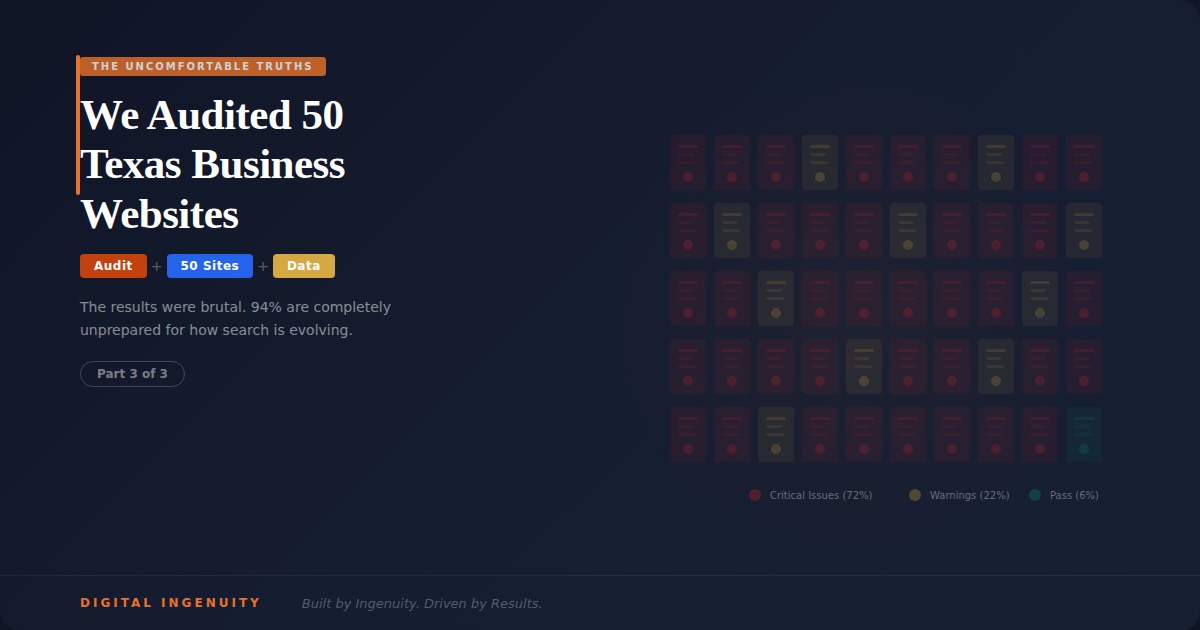
- We audited 50 Texas business websites across 10 industries — the average site had 34 technical SEO issues, and 72% had at least one critical problem that was actively preventing rankings
- The most common issue (found on 84% of sites): missing or incorrect schema markup — making them invisible to AI search, featured snippets, and rich results
- 68% had mobile usability problems despite mobile accounting for 60%+ of their traffic
- 76% had no content strategy — random blog posts with no keyword targeting, no internal linking, and no topical authority building
- Only 6% of the 50 sites were optimized for any form of AI search (GEO, AEO, or VEO) — meaning 94% are completely unprepared for how search is evolving
Why We Did This
We talk a lot about what businesses should be doing for search visibility. But we realized we’d never systematically documented what businesses are actually doing — or failing to do.
So we ran full technical audits on 50 Texas business websites. Five sites each from 10 industries: home services, legal, automotive, healthcare, restaurants, real estate, fitness, retail, professional services, and construction.
We used the same audit process we use for our paying clients. Full crawl analysis. Core Web Vitals assessment. Schema markup evaluation. Content strategy review. Mobile usability check. Backlink profile analysis. And a review of AI search readiness — whether the site is optimized for ChatGPT citations, featured snippets, or voice search.
The results were worse than expected.
Finding 1: Schema Markup Is Almost Universally Missing
84% of the 50 sites had either no schema markup at all or incorrect implementation that wasn’t functioning properly.
This is a problem that’s invisible to the business owner. Your website looks fine to human visitors. But to search engines, AI platforms, and voice assistants, you’re a mystery. Schema markup is the structured data that tells machines: this is a local business, at this address, offering these services, with these reviews.
Without it, you’re relying entirely on Google’s ability to figure out what your business is by reading your website like a human would. Google is good at this — but not as good as when you hand it structured, clean data in its native language.
For AI search specifically, schema markup isn’t a nice-to-have. It’s table stakes. AI systems parse structured data far more reliably than unstructured web content. The 84% of sites missing schema are essentially invisible to the AI search layer.
Finding 2: Mobile Experience Is an Afterthought
68% of the sites had significant mobile usability problems — and this matters because 60-70% of their traffic comes from mobile devices.
The issues ranged from text too small to read on mobile, to buttons placed too close together, to horizontal scrolling on key pages, to images that loaded at desktop resolution and destroyed mobile page speed.
Here’s the business impact: Google has been mobile-first indexing since 2019. That means Google evaluates your site primarily through its mobile version. If your mobile experience is poor, your rankings suffer — even if your desktop site is flawless.
Several sites in our audit looked great on desktop and were nearly unusable on mobile. The owners likely had no idea, because they check their own website from their desktop computer.
Finding 3: Content Strategy Doesn’t Exist
76% of the sites had no identifiable content strategy. They had blog posts — sometimes dozens of them — but the posts showed no keyword targeting, no topical clustering, no internal linking strategy, and no connection to the business’s actual services.
Common patterns: blog posts about industry holidays (“Happy National HVAC Day!”), generic tips articles clearly generated by AI with no unique perspective, and news commentary that had nothing to do with the business’s service area.
Every one of these posts consumes crawl budget, dilutes topical authority, and adds noise without adding signal. The businesses would literally rank better if they deleted 60% of their blog content and focused the remaining pages on high-intent topics connected to their services.
Finding 4: Page Speed Is Quietly Killing Rankings
58% of sites failed at least one Core Web Vital metric. The most common failure: Largest Contentful Paint (LCP) — the time it takes for the main content of the page to load.
The culprits were consistent: unoptimized images (hero images uploaded at 4000x3000px), unused JavaScript files loading on every page, no caching configuration, and render-blocking CSS.
These are fixable problems. Most can be resolved in a single day of technical work. But they compound over time — a slow site ranks lower, gets less traffic, earns fewer backlinks, and falls further behind faster competitors. It’s a negative flywheel.
Finding 5: AI Search Readiness Is Near Zero
This was the most striking finding. Only 3 of the 50 sites — 6% — showed any optimization for AI search. No GEO strategy. No AEO content formatting. No VEO considerations.
This means 94% of Texas businesses in our sample are completely unprepared for the shift that’s already underway. AI Overviews are appearing in 30-40% of informational searches. ChatGPT usage is growing 40% year-over-year. Voice search is the fastest-growing query type.
And nearly every business in our sample is optimized exclusively for a version of Google search that’s rapidly being augmented — and in some cases replaced — by AI-generated responses.
This represents an extraordinary opportunity for the businesses that move first. When 94% of your competitors aren’t optimized for AI search, early movers capture disproportionate visibility.
What This Means for You
If you’re a Texas business owner reading this, the odds are high that your site has several of these issues. Not because you’ve done anything wrong — but because the standards for search visibility have evolved faster than most businesses’ websites have kept up.
The good news: every issue we found in these 50 audits is fixable. Schema markup can be implemented in a week. Mobile usability issues can be resolved in a sprint. Content strategy can be overhauled in 30-60 days. And AI search optimization is a greenfield opportunity where first movers win big.
The businesses that will dominate search in 2026 and beyond aren’t necessarily the ones with the biggest budgets. They’re the ones that audit honestly, fix systematically, and optimize intentionally.
Series Navigation
← Previous: The Marketing Agency Red Flags Nobody Talks About
Get your own audit: Book a free discovery call →
See our full approach: The Four-Pillar Growth Engine →
Digital Ingenuity is a premium search optimization agency based in Plano, Texas. We’ll tell you what’s broken, what it’s costing you, and how to fix it. Book a discovery call →