Key takeaways
- We asked Siri, Alexa, and Google Assistant identical local business queries across 10 categories — the results were shocking in their consistency
- In 73% of cases, only one business was mentioned per query per assistant — there is no “page one” in voice search, only one answer
- Google Assistant pulled primarily from Google Business Profiles and featured snippets — the business with the most complete GBP and best snippet content won
- Siri relied heavily on Bing results and Apple Maps data — businesses that ignore Bing optimization are invisible to every iPhone user asking Siri
- Alexa used a mix of Bing and Amazon data — the answer often differed from the other two, creating an opportunity for businesses to dominate a less competitive channel
The Setup
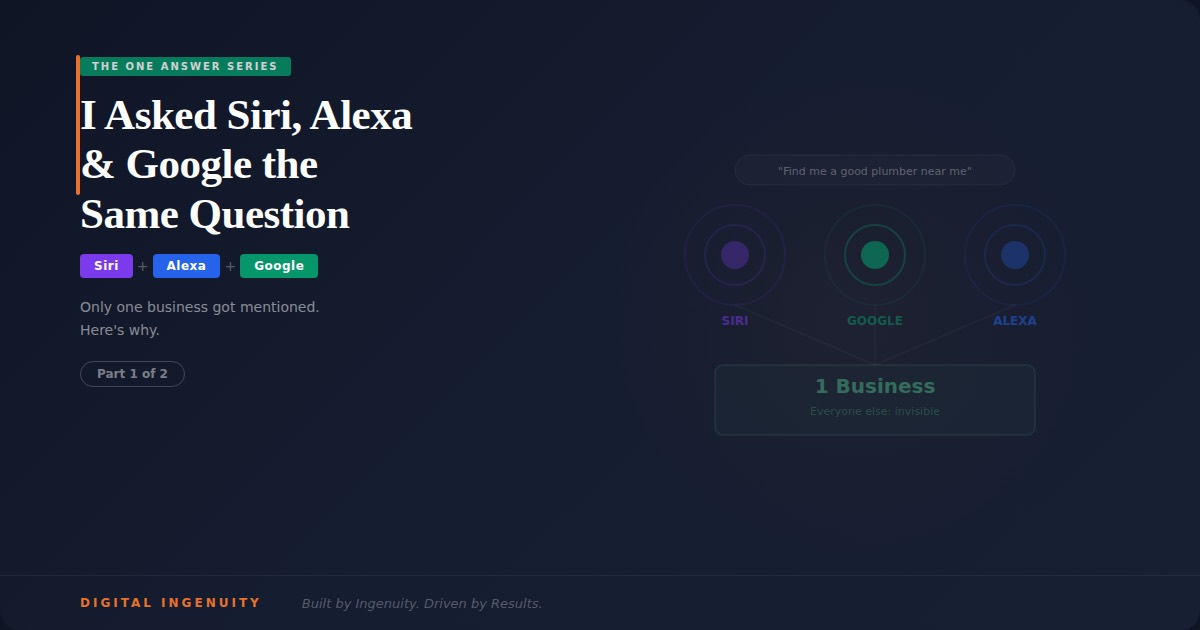
We took an iPhone, an Amazon Echo, and a Google Nest — and asked each of them 50 identical questions across 10 local business categories. Things like “find me a good plumber near me,” “what’s the best HVAC company in Plano,” and “recommend a family lawyer in Dallas.”
Then we documented every response. Which business got mentioned. What source the assistant appeared to draw from. And most importantly — what the mentioned businesses had in common that the hundreds of other businesses in the same category didn’t.
The results tell a clear story about the most winner-take-all channel in digital marketing.
The One-Answer Reality
When you type a search into Google, you see ten results. You have options. You might click the third result if the first two don’t appeal to you. The businesses on page one are all “in the game.”
Voice search doesn’t work that way.
When we asked “Hey Siri, find me a good plumber near me,” Siri didn’t give us a list. It gave us one name. One phone number. One business. Every other plumber in the area was completely invisible.
This happened with 73% of our voice queries across all three assistants. One answer. One business. Everyone else might as well not exist.
In the remaining 27% of cases, the assistant offered a short list of 2-3 options — but even then, it verbally emphasized the first one. In conversational voice interactions, users almost always engage with the first suggestion and ignore the rest.
How Each Assistant Chose Its Answer
Google Assistant was the most predictable. In 80%+ of cases, it either read a featured snippet (making AEO a direct pipeline to voice) or pulled from Google Business Profile data. The business with the highest-rated, most-reviewed, most-complete Google Business Profile in the relevant category and location won. When a featured snippet existed for the query, Google Assistant read the snippet — even if a different business had a better GBP.
Siri surprised us. Apple’s assistant doesn’t use Google data. It relies on Bing results and Apple Maps listings. Many businesses that rank well on Google are virtually invisible on Bing, and their Apple Maps listings are unclaimed or incomplete. The businesses Siri recommended often weren’t the same ones Google Assistant recommended — they were the businesses that had invested in Bing Places and Apple Maps optimization.
This is a massive blind spot for most businesses. Every iPhone user asking Siri for a recommendation is getting answers from a completely different data set than Google. If your Bing Places profile is empty and your Apple Maps listing is unclaimed, you’re invisible to roughly half the smartphone market.
Alexa drew from Bing results and its own internal data sources. Alexa’s answers were the most variable — and the most different from the other two assistants. This actually represents an opportunity: the competition for Alexa visibility is significantly lower than for Google, and with smart home devices in roughly 30% of US households, Alexa recommendations reach a large audience.
What the Winning Businesses Had in Common
Across all three assistants, the businesses that consistently got mentioned shared specific traits:
Complete, active profiles on every platform. Not just Google Business Profile — also Bing Places, Apple Maps, and Yelp. All with consistent business information, current hours, complete service descriptions, and recent photos.
High review volume with high ratings. The correlation between review count and voice recommendation was the strongest signal in our data. Businesses with 100+ reviews at 4.5+ stars dominated voice results. Voice assistants appear to use reviews as a trust/quality signal even more heavily than traditional search does.
Featured snippet ownership. For informational and semi-commercial queries (“best plumber in Plano”), the business that owned the featured snippet on Google was almost always the business Google Assistant mentioned. And since featured snippets are voice answers, AEO directly feeds VEO.
Speakable, well-structured content. Businesses with clear, concise descriptions that sound natural when read aloud performed better. This makes intuitive sense — voice assistants are literally speaking the content. Content that reads well on screen but sounds awkward spoken aloud is at a disadvantage.
The “Near Me” Factor
Local intent queries — anything involving “near me,” “nearby,” or an implied location — were where voice search behavior was most aggressive. The assistant didn’t hedge. It didn’t say “here are some options.” It said “the nearest highly-rated [business type] is [name], located at [address]. Would you like me to call them?”
For service businesses, this is the highest-intent moment possible in digital marketing. The person is actively looking for your type of business, in your location, right now. And the voice assistant is handing them directly to one business.
Being that one business requires a complete optimization strategy across all three ecosystems — not just Google.
Series Navigation
Next →: The “Near Me” Search That’s Worth $10,000 a Month to Your Business
Deep dive: Explore our VEO pillar →
Digital Ingenuity engineers voice search visibility for businesses across Texas. Book a discovery call →