Key takeaways
- We analyzed 50+ AI responses across ChatGPT, Perplexity, and Google AI Overviews to identify the specific signals that earn citations
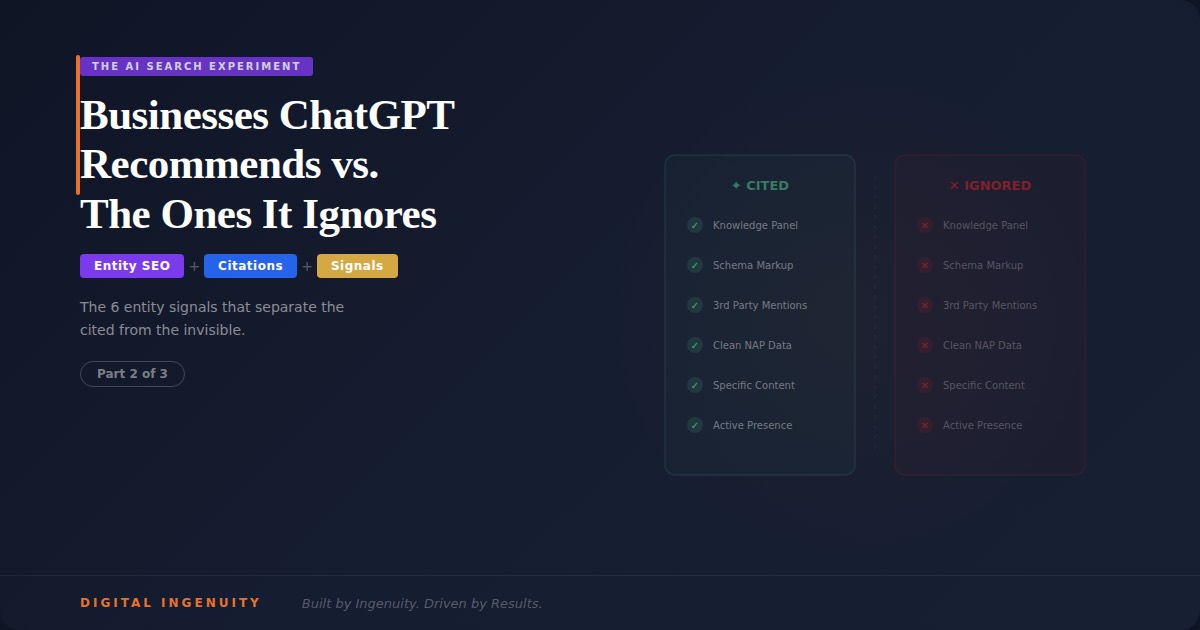
- The 6 entity signals that matter most: verified knowledge panels, schema markup, third-party mentions, consistent NAP data, authoritative content, and specificity of claims
- Businesses with generic “we deliver results” messaging were consistently ignored — AI rewards specificity and verifiable claims
- Having a strong traditional SEO presence helps but isn’t sufficient — businesses ranking #1 on Google still got ignored by AI when they lacked entity authority
- The fix isn’t complicated: structured data, consistent information, authoritative off-site presence, and content that makes specific, citeable claims
Going Deeper Than “Just Be Authoritative”
In the first part of this series, we ran an experiment asking AI platforms to recommend businesses and documented the general patterns. But “have strong entity signals” is about as useful as “just be good at SEO.” It’s directionally correct but practically useless.
So we went deeper. We analyzed over 50 AI-generated responses across multiple industries and markets, cataloging exactly which businesses got mentioned and auditing their digital presence against businesses in the same category that didn’t.
The result is a concrete list of six signals that separate the cited from the invisible.
Signal 1: Verified Google Knowledge Panel
Every business ChatGPT consistently recommended had a verified Google Knowledge Panel — the information box that appears on the right side of Google search results when you search a business name.
This matters because Knowledge Panels represent Google’s own confidence that a business entity exists, is legitimate, and has verified information. AI systems — especially those trained on web data — treat Knowledge Panel data as high-confidence entity information.
If you Google your business name and don’t see a Knowledge Panel, that’s a problem for AI visibility. The fix involves claiming your Google Business Profile, ensuring consistent information across authoritative data sources, and building enough entity signals that Google creates a panel for you.
Signal 2: Comprehensive Schema Markup
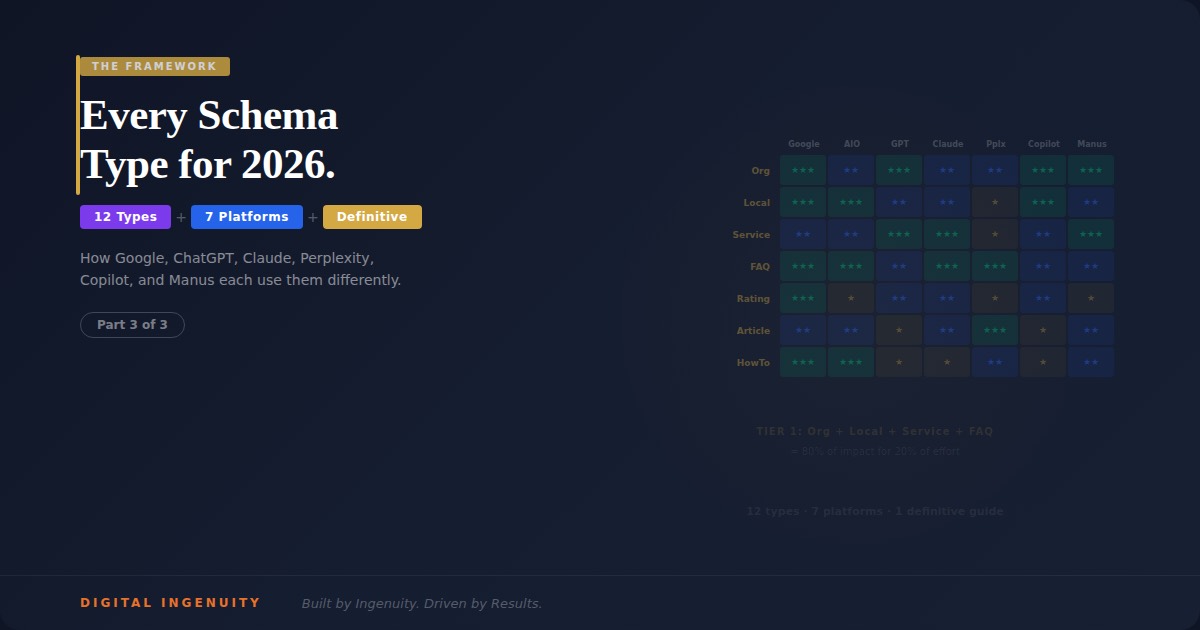
This was the most technically specific signal we identified. Businesses with Organization schema, LocalBusiness schema, and service-specific structured data on their websites were cited at dramatically higher rates than businesses without it.
Schema markup is invisible to human visitors but speaks directly to AI systems. It says: “Here is our business name. Here is our address. Here are our services. Here is our service area. Here are our reviews.” In a language machines parse perfectly.
We found businesses ranking on page one for traditional search but completely missing from AI responses — and the only significant gap in their digital presence compared to cited competitors was structured data. When the information on your website is only readable by humans, AI systems can’t confidently extract and cite it.
Signal 3: Third-Party Mentions on Authoritative Sites
This is the off-site equivalent of link building, but with a critical difference: AI systems don’t just care that a link exists. They care about the context of the mention.
Being listed in a “Top 10 Marketing Agencies in Dallas” article on a recognized publication carries significant weight. Being quoted as an expert source in an industry article carries even more. Having case studies or client results featured on other authoritative sites is the gold standard.
The businesses AI ignored typically had a digital presence that extended no further than their own website and their Google Business Profile. They existed in their own bubble. The businesses that got cited had footprints across multiple authoritative sources — all saying consistent things about who they are and what they do.
Signal 4: Consistent NAP Data Across the Web
NAP — Name, Address, Phone number — consistency is a foundational local SEO principle. But it has outsized importance for AI systems because these systems use NAP data as an entity verification signal.
When your business name is “Digital Ingenuity” on your website, “Digital Ingenuity LLC” on Yelp, and “Digital Ingenuity Marketing” on the BBB, you’ve created ambiguity about your entity identity. AI systems can’t confidently determine if these are the same business or three different ones — so they cite none of them.
We found multiple businesses that had strong websites and good content but inconsistent entity information across the web. In traditional SEO, this might cost you a few spots in local pack rankings. In AI search, it can make you completely invisible.
Signal 5: Authoritative, Specific Content
This is where most businesses fail — and it’s the easiest signal to control.
The businesses ChatGPT recommended had website content that made specific, substantive claims about their expertise. Not “we deliver best-in-class solutions” but “we specialize in SEO for home service businesses across the Dallas-Fort Worth metroplex, focusing on local pack rankings, Google Business Profile optimization, and review acquisition strategies.”
AI systems are trained to identify expertise. Vague, generic marketing copy reads as low-information content. Specific, detailed descriptions of methodology, service areas, industries served, and results achieved reads as authoritative knowledge worth citing.
The businesses that got ignored had websites that could belong to literally any company in their industry. The content was interchangeable. And AI systems treated it as exactly that — generic, undifferentiated, not worth citing when a more specific alternative existed.
Signal 6: Freshness and Active Presence
AI platforms don’t just evaluate whether information exists — they evaluate whether it’s current. Businesses with recently published content, active Google Business Profile posts, and fresh reviews were cited more consistently than businesses whose last blog post was from 2023.
This makes intuitive sense. Would you recommend a restaurant that hasn’t posted in two years? AI systems apply similar logic. An active digital presence signals that the business is operational, engaged, and maintaining its expertise.
The Practical Takeaway
None of these six signals require a massive budget or years of work. They require intentionality. They require treating your digital presence as an entity system rather than a collection of disconnected assets.
Structured data can be implemented in a week. NAP consistency can be audited and corrected in a month. Content can be rewritten to make specific, citeable claims about your expertise. Third-party mentions require a longer-term PR and content strategy, but the first placements can happen within 60-90 days.
The businesses winning in AI search aren’t doing anything magical. They’re doing the fundamentals with a level of intentionality and consistency that most businesses never achieve.
Series Navigation
← Previous: I Asked ChatGPT to Recommend a Marketing Agency
Next →: Google AI Overviews Are Eating Your Traffic. Here’s the Data.
Deep dive: Explore our GEO pillar →
Digital Ingenuity engineers AI search visibility for businesses across Texas. Book a discovery call →