Key takeaways
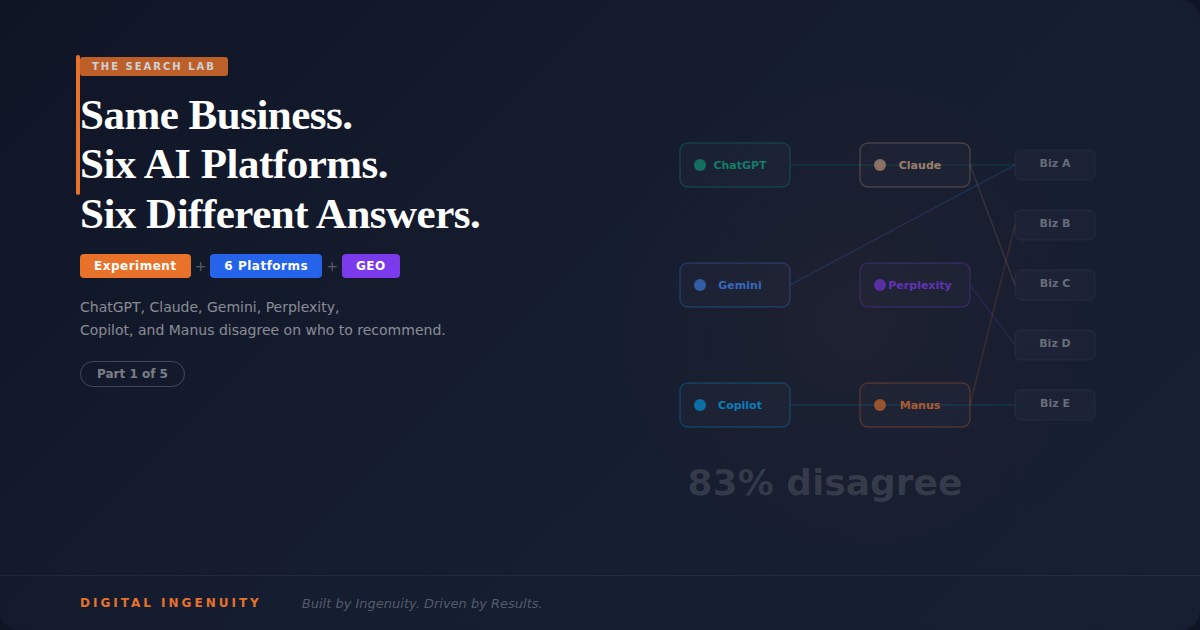
- We prompted ChatGPT, Perplexity, and Google’s AI Overview with the same question: “recommend a digital marketing agency for a small business in Texas”
- ChatGPT recommended agencies with strong entity signals — verified knowledge panels, consistent NAP data, and structured content across multiple authoritative sources
- Perplexity was the most transparent about its sources, citing specific pages and articles — businesses with authoritative published content got mentioned
- Google AI Overviews favored businesses already ranking well in traditional search, but weighted structured data and review signals more heavily
- The businesses AI platforms ignored had something in common: weak entity presence, no structured data, and content that reads like it was written for search engines rather than humans
The Experiment
We wanted to know something simple: if a potential customer skips Google entirely and asks an AI assistant to recommend a business like yours, does your business get mentioned?
So we ran the experiment. We asked the three most-used AI search platforms the same question, in slightly different ways, and documented exactly what they recommended and — more importantly — what patterns separated the businesses that got cited from the ones that didn’t.
This isn’t hypothetical. Roughly one in three searches now involves some form of AI-generated response. That number is growing every quarter. If you’re not visible in AI search, you’re becoming invisible to a growing segment of your market.
What ChatGPT Said
We asked ChatGPT: “Can you recommend a good digital marketing agency for a small business in Texas?”
ChatGPT’s response was measured and structured. It didn’t just name-drop random agencies. It provided a short list with brief descriptions of what each agency specializes in, roughly organized by service type and location.
The interesting part wasn’t who it recommended. It was the pattern behind the recommendations.
Every agency ChatGPT mentioned shared specific characteristics. They had a verified Google Knowledge Panel with consistent business information. Their name, address, and phone number were identical across dozens of online directories. They had published content on authoritative third-party sites — not just their own blog. They had clear, structured service descriptions on their website that explicitly stated what they do, who they serve, and where they operate.
ChatGPT wasn’t just searching the web for “marketing agency Texas.” It was drawing on a trained understanding of entity relationships — recognizing which businesses have built enough digital authority to be considered trustworthy recommendations.
What Perplexity Said
Perplexity is the most transparent of the three because it shows its sources. When we asked the same question, Perplexity not only listed agencies but linked to the specific pages and articles it drew information from.
This made the pattern even clearer. Perplexity cited businesses that had been mentioned in third-party articles, industry roundups, and publication features. If your agency was listed in a “Best Marketing Agencies in Texas” article on a respected publication, Perplexity found it. If your agency had contributed guest articles or been quoted in industry content, that registered.
Perplexity essentially rewards businesses that have a strong off-site content footprint. Your own website matters, but what other authoritative sources say about you matters more in this context. It’s the digital equivalent of word-of-mouth — AI trusts references from sources it already trusts.
What Google AI Overview Said
Google’s AI Overview — the AI-generated summary that appears above traditional search results — drew most heavily from businesses that already ranked well in traditional search.
But it wasn’t a direct copy of the top 10 organic results. The AI Overview weighted certain signals more heavily than traditional rankings do. Businesses with comprehensive structured data (Organization schema, LocalBusiness schema, review ratings embedded in schema) appeared more prominently. Businesses with strong Google Business Profiles with active posts, high review counts, and detailed service descriptions got mentioned even when their organic rankings weren’t the highest.
Google’s AI Overview is essentially traditional SEO performance filtered through an additional layer of entity confidence. It asks: “Do we not only rank this business, but do we trust this business enough to put our AI’s name behind recommending it?”
What the Ignored Businesses Had in Common
The most revealing data point wasn’t who got recommended. It was who didn’t — and why.
We checked the businesses that rank on page one for traditional search terms but were conspicuously absent from AI recommendations. They shared a pattern:
No structured data. Their websites had no schema markup telling search engines and AI what the business does, where it operates, or what services it offers. The information existed in human-readable form, but it wasn’t structured for machine parsing.
Thin entity presence. They existed on their own website and maybe a Google Business Profile, but they weren’t mentioned on third-party sites, hadn’t published content elsewhere, and had no digital footprint beyond their own properties.
Generic content. Their website copy read like every other marketing agency website — “we deliver results-driven solutions” and “our team of experts” without any specific, unique, authoritative claims that an AI would consider worth citing.
Inconsistent business information. Their business name, address, or phone number varied across different directories. This might seem minor, but it’s a strong negative signal for AI systems trying to verify entity identity.
What This Means for Your Business
If a growing percentage of your potential customers are asking AI for recommendations instead of typing into Google, then your visibility strategy needs to account for how AI makes recommendations.
This isn’t about gaming a system. It’s about building the kind of digital presence that AI systems — which are designed to identify genuinely authoritative, trustworthy businesses — recognize as worth citing.
The businesses winning in AI search are doing the fundamentals exceptionally well. Clean structured data. Consistent entity information. Published content on authoritative platforms. A website that clearly and specifically communicates what they do, who they serve, and why they’re qualified to do it.
That’s Generative Engine Optimization. And the gap between businesses that are optimized for it and businesses that aren’t is growing wider every month.
Series Navigation
Next →: The Businesses ChatGPT Recommends vs. The Ones It Ignores — What’s the Difference?
Deep dive: Explore our GEO pillar →
Digital Ingenuity engineers AI search visibility for businesses across Texas. Book a discovery call →