Key takeaways
- Agency size tells you capacity, not whether the SEO work on your site will be good.
- Google’s hiring guidance focuses on transparency, fit, references, and following its guidelines. Firm size isn’t on the list.
- Ask who, by name, will do the work, and whether any of it is outsourced.
- Whoever you hire, your business should stay the verified owner of Search Console and the admin of Analytics.
- Bigger teams make sense for specific needs, such as international sites, very large sites, or multi-discipline projects. Hire for the need.
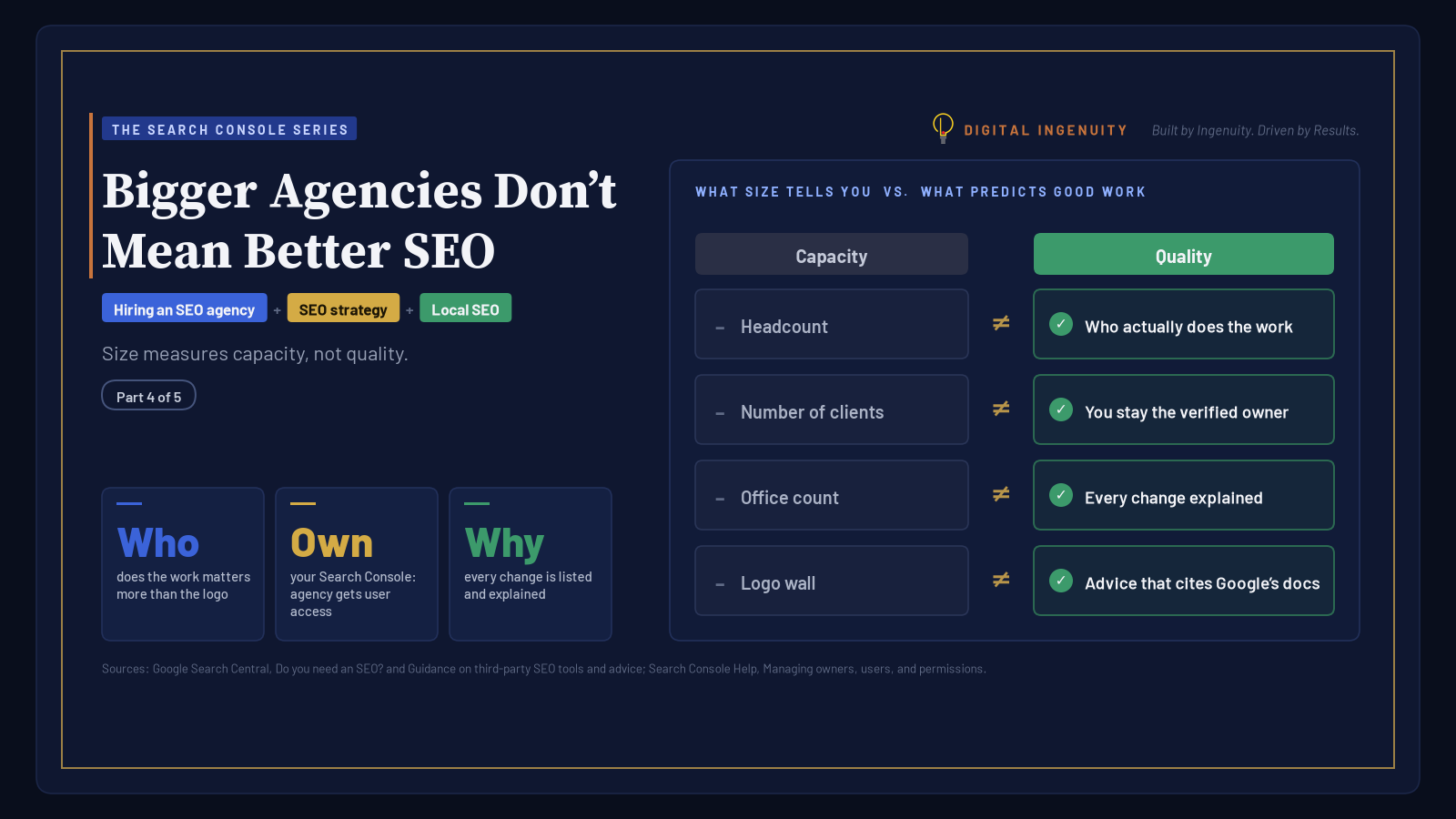
When a business starts shopping for SEO help, the biggest proposal in the pile usually feels like the safest one. More people, more offices, more logos on the “trusted by” slide. But bigger agencies don’t mean better SEO. Size tells you how much work a firm can take on. It doesn’t tell you whether the work on your site will be any good.
This isn’t an argument against large agencies. Some needs really do call for a big team, and we’ll cover those. It’s an argument for judging every option, large or small, by the things that actually predict good work. Conveniently, Google has already written most of that list.
Key points
- Agency size is a measure of capacity, not quality.
- Google’s own hiring advice focuses on transparency, fit, references, and following its guidelines. Firm size doesn’t appear.
- The person working on your account matters more than the logo on the proposal.
- An expensive tool stack doesn’t give anyone Google’s data. Search Console does, and it’s free.
- Hire for the need: some needs call for a big team, and some businesses don’t need an agency at all.
Why buyers use size as a shortcut
Quality in SEO is hard to see before you buy. You can’t test-drive a strategy, and the results take months. So buyers fall back on things they can see: headcount, office locations, awards, and recognizable client names.
Those signals answer real questions. Can this firm handle the volume? Will it still be around next year? Does it have the processes a large organization expects? Those are fair things to care about. But none of them answers the question you’re actually paying to have answered: will the specific people on my account make good decisions about my specific site?
That’s where the shortcut breaks down. A large firm and a two-person consultancy can both do excellent work, and both can do poor work. The difference shows up in how they answer a handful of specific questions.
What Google says to look for
Google’s Search Central guide, ”Do you need an SEO?”, is one of the most useful documents a buyer can read, and it’s written for business owners, not SEOs. It starts by listing the services a good SEO can provide:
- A review of your site’s content or structure
- Technical advice on website development, such as hosting, redirects, error pages, and JavaScript
- Content development
- Management of online business development campaigns
- Keyword research
- SEO training
- Expertise in specific markets and geographies
- Optimizing for generative AI
Notice what’s on that list and what isn’t. Every item is a skill. None of them requires a large firm, and several (market expertise, training, content that reflects your business) often work best with a small team that knows you well.
Google then lists interview questions. Paraphrased:
- Can you show examples of previous work and success stories?
- Do you follow Google Search Essentials?
- What results do you expect, and in what timeframe? How do you measure success?
- What’s your experience in my industry? In my country or city? With international sites?
- How long have you been in business, and how will we communicate?
- Will you share every change you make to my site, with the reasoning behind it?
Two more pieces of advice from the same page are easy to skip and shouldn’t be. First: “See if the SEO is interested in you and your business. If they’re not interested, find someone who is.” A good SEO asks what makes you different, who your competitors are, and how customers find you. Second: check references, and ask past clients whether the work was useful, the team was easy to work with, and the results were positive.
Google also says to be careful with any company that’s secretive or won’t clearly explain what it intends to do, and reminds you that “you are responsible for the actions of any companies you hire.” That responsibility doesn’t shrink when the firm gets bigger.
The person doing the work matters more than the logo
Proposals are written by firms. Work is done by people. The most useful question you can ask in any pitch is simple: who, by name, will work on our account, and what will each of them do?
Follow it with:
- “Are the people in this meeting the people we’ll work with after we sign?”
- “How many other accounts does that person handle?”
- “Is any of the work outsourced or white-labeled? If so, to whom?”
- “Who do we call when something breaks, and how fast will they respond?”
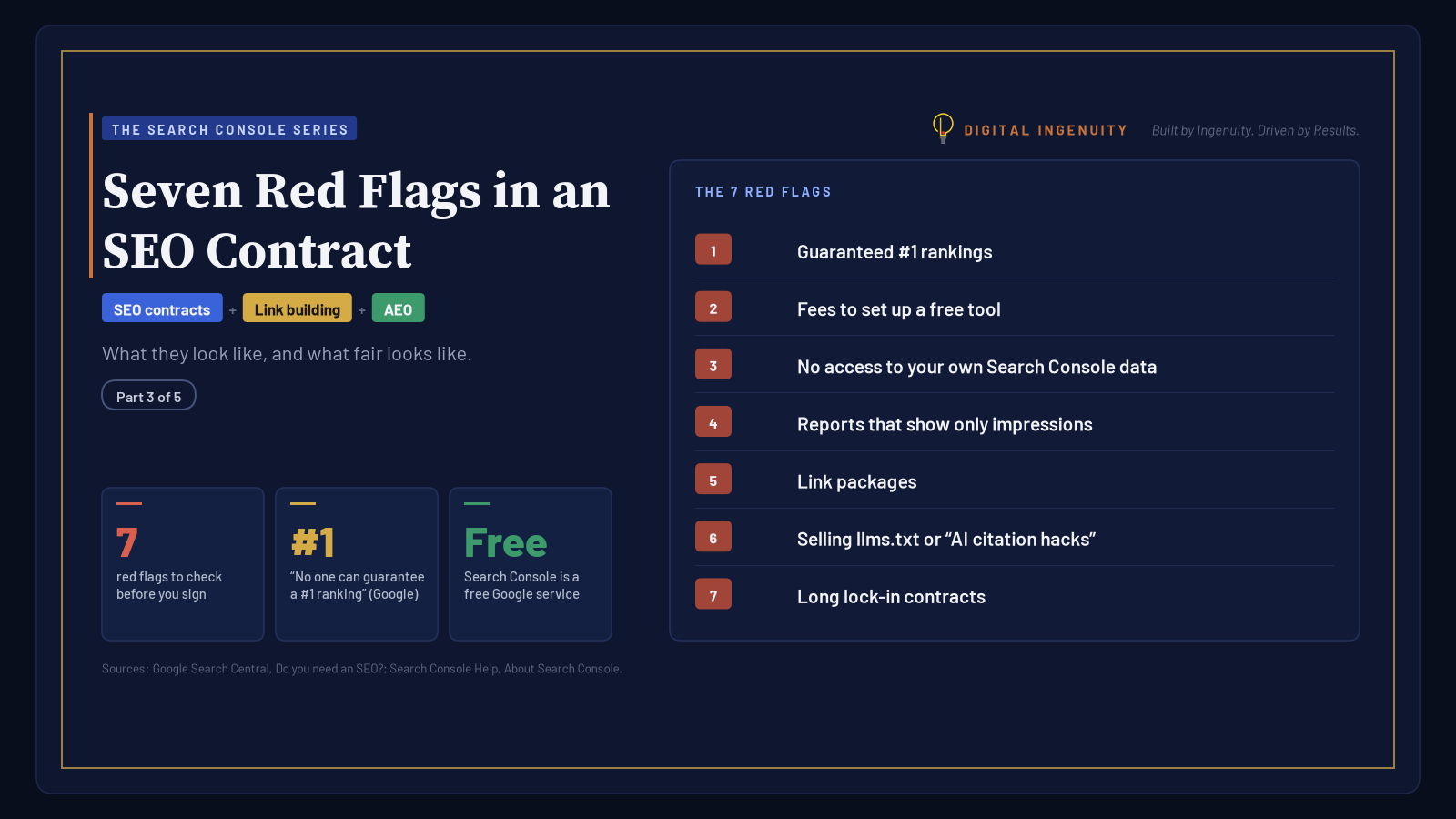
Neither large nor small firms have a monopoly on good answers. A big agency may put a senior strategist on your account and back them with specialists. A small agency may have the founder doing the work personally. Either can also hand you to someone junior once the contract is signed. The questions above tell you which situation you’re in. Our post on red flags in an SEO contract covers how to get those answers into writing.
Ownership and transparency don’t scale with headcount
Some rules apply at every size, and you shouldn’t relax them because a firm looks established:
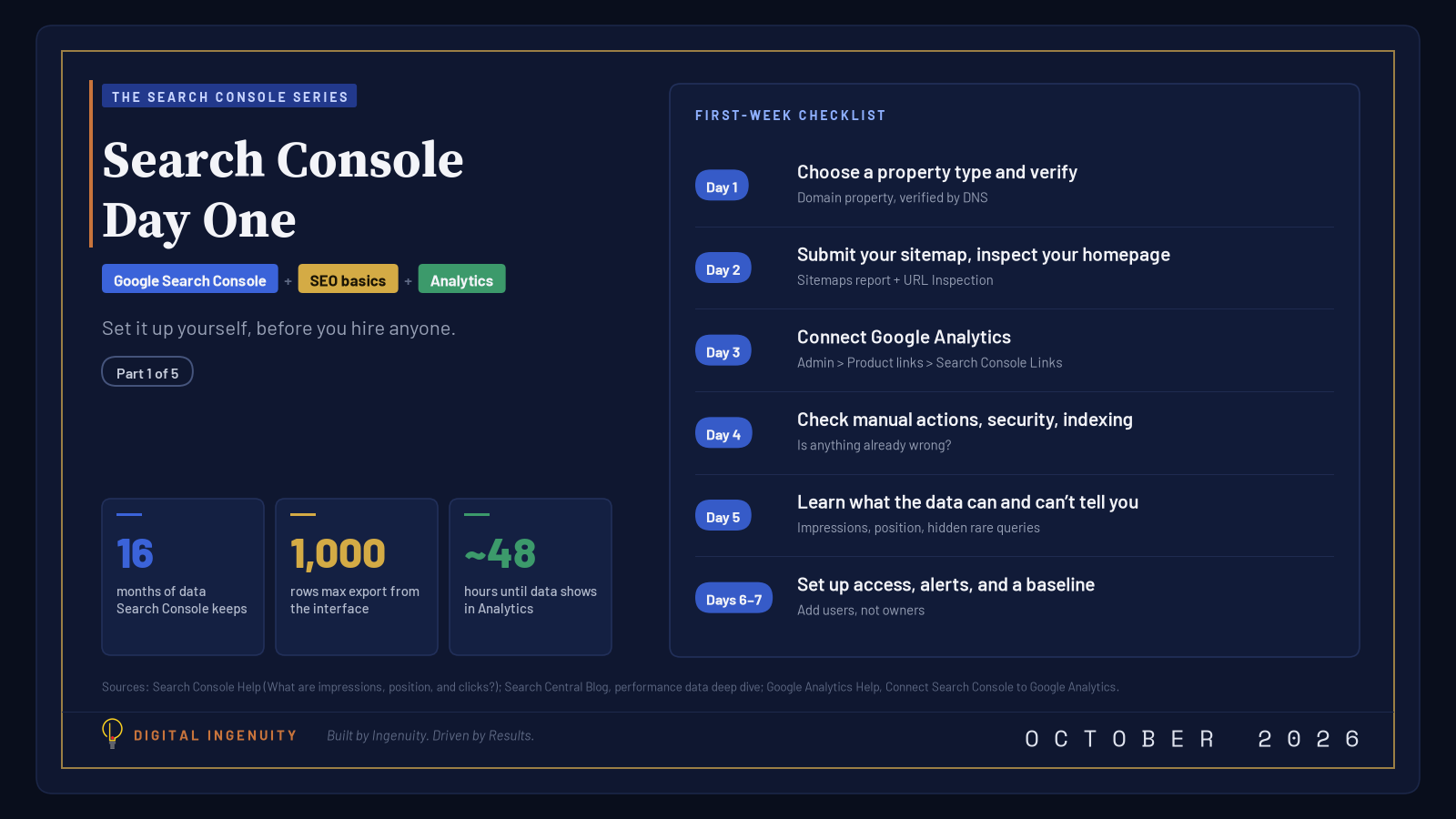
- Your business stays the verified owner of Google Search Console and the admin of Google Analytics. The agency gets user access. Google’s hiring guide even suggests granting only read access to Search Console during an audit. If you haven’t set Search Console up yet, our Search Console Day One checklist walks through it.
- Every change gets disclosed and explained. Google lists this as an interview question for a reason. A monthly report should say what was changed, where, and why.
- Advice should cite its sources. Google’s guidance on third-party SEO advice says good advice either labels itself as opinion based on data or experience, or backs its claims with official Google documentation. Its hiring guide adds a newer question: if a firm offers “AEO” or “GEO” services, does that advice line up with Google’s own guidance on optimizing for generative AI?
A bigger firm may have more polished reporting. That’s not the same as more transparent reporting. Ask to see a sample monthly report from a real (anonymized) account before you sign.
A bigger tool stack isn’t better data
Large agencies often lead with their technology: rank trackers, crawlers, AI visibility dashboards, and proprietary scores. These tools can be genuinely useful for spotting patterns and saving time.
But Google is direct about their limits. Its guidance says it doesn’t evaluate or endorse third-party SEO tools, that those tools “don’t have access to our internal ranking data,” and that they “can’t guarantee performance.” It also warns you to be wary of any tool that claims to be “acceptable” or “approved” by Google. And it recommends one tool above the rest: “we strongly encourage using our first-party tool, Google Search Console.”
So when you compare proposals, the question isn’t how many tools each firm licenses. It’s whether they work from your own Search Console and Analytics data, and whether they can explain what a third-party score actually measures. If a report is full of proprietary metrics and light on the numbers Google gives you directly, that’s worth noticing. We walk through which Search Console numbers to trust in Impressions Up, Clicks Flat.
Local knowledge is a skill, not a size
For businesses that sell to a specific area, “expertise in specific markets and geographies” is near the top of what matters. Google’s interview list asks directly about experience in your country and city.
Local search has its own rules. Google’s Business Profile help says local results are based mainly on relevance, distance, and prominence (the page’s summary calls the last one popularity), and that there’s no way to request or pay for a better local ranking. Prominence means how well known a business is, and Google says it draws on information like how many websites link to you and how many reviews you have. Earning those signals takes someone who understands your market: which neighborhoods you actually serve, which local organizations and publications matter, and how customers in your area search.
That knowledge doesn’t come from headcount. A national firm can have it if the people on your account have done the work in your market. A local firm should have it by default, and should be able to prove it. In Dallas-Fort Worth, for example, a business in Fort Worth and one in Frisco can face very different competitors for the same service. Ask any candidate to explain the local results for your top service, in your city, with the search results open. That’s the core of our local SEO work, and it’s a fair test for anyone.
When a bigger team does make sense
Size is the right answer when the need itself is large or specialized. A few examples:
- International or multilingual sites, where you need language, market, and technical expertise at once. Google lists international experience as its own interview question.
- Very large sites that need data engineering. Google built Search Console’s bulk data export to BigQuery for large websites with very high page or query counts, and notes that small and medium sites already get all their data through the interface, the Looker Studio connector, or the API. We cover that setup in Search Console for Enterprise.
- Organizations with many properties, brands, or locations, where governance, access control, and consistent processes matter as much as tactics.
- Projects that need several disciplines at the same time, such as a site migration with engineering, content, analytics, and SEO all moving together. Google notes that a redesign or new launch is a great time to bring in an SEO, and the earlier the better.
If your need looks like one of these, a bigger team may be the right call. Just keep applying the same questions about people, ownership, and disclosure. For a closer look at where scale helps and where it breaks, see our post on enterprise SEO services vs. point solutions.
When you may not need an agency at all
Google says it plainly: “If you run a small local business, you can probably do much of the work yourself.” It recommends starting with its SEO Starter Guide. And its newer guide to generative AI search notes that plenty of content does well in Google Search, including its AI experiences, without any overt SEO.
That’s not an argument against hiring help. It’s an argument for knowing what you’re buying. We weigh the trade-offs of doing it yourself in DIY SEO vs. agency SEO, so we won’t repeat them here. The short version: learning the basics makes you a better buyer whichever way you go, because you’ll recognize when a recommendation doesn’t hold up.
A fair comparison scorecard
When you have two or three proposals in front of you, compare them on these lines instead of size:
| Question | What a strong answer looks like |
|---|---|
| Who does the work? | Named people, their roles, and how much of their time you get |
| Is the work outsourced? | A clear yes or no, and to whom |
| Who owns the accounts? | Your business is the verified owner; the agency is a user |
| How are changes reported? | Every change listed, with the reason and how it’ll be measured |
| What results, and when? | A realistic timeframe tied to specific pages and queries, not guarantees |
| What’s the AI search plan? | Grounded in Google’s generative AI guidance, with sources |
| Do they know your market? | They can explain your local or industry results with examples |
| What do references say? | Past clients describe useful work, easy communication, and real results |
The firm that scores best might be large, small, or somewhere in between. That’s the point.
Comparing proposals and want a second opinion? Contact us for more information.
Sources
- Do you need an SEO? (Google Search Central)
- Guidance on third-party SEO tools and advice (Google Search Central)
- Optimizing for generative AI search (Google Search Central)
- SEO Starter Guide (Google Search Central)
- Tips to improve your local ranking on Google (Google Business Profile Help)
- Bulk data export of Search Console performance data (Search Central Blog)
- Managing owners, users, and permissions (Search Console Help)