
Key takeaways
- Traditional SEO alone isn’t enough anymore. Zero-click searches account for nearly 60% of all Google queries, and AI Overviews have cut organic click-through rates by up to 58%.
- SEO is still the foundation. It powers crawlability, domain authority, and rankings — and local searches are largely immune to AI disruption (only 8% trigger AI Overviews).
- GEO (Generative Engine Optimization) gets your brand cited in AI-generated answers on ChatGPT, Perplexity, and Google AI Mode — where 93% of sessions are zero-click but traffic converts at 4.4x the rate of traditional organic.
- AEO (Answer Engine Optimization) positions your content as the answer in featured snippets, People Also Ask, and AI Overviews through structured content, schema markup, and FAQ formatting.
- VEO (Voice Engine Optimization) captures voice search traffic where assistants pick one answer — not ten. Voice is 3x more likely to be local, making it critical for service businesses.
- The four pillars compound. One well-engineered piece of content can rank in Google, get cited by AI engines, win featured snippets, and be read aloud by voice assistants simultaneously.
- Bottom line: Businesses that optimize across all four surfaces will dominate. Those stuck on one pillar are leaving visibility — and revenue — on the table.
The Search Landscape Has Fundamentally Changed
If your marketing strategy still revolves entirely around ranking in Google’s traditional blue links, you’re optimizing for a search experience that’s shrinking.
The numbers tell the story. Google’s AI Overviews now appear in roughly 15–21% of all search queries, and that number has more than doubled since early 2025. When those AI-generated summaries show up, click-through rates on organic results drop by as much as 35–58%, depending on the study. Meanwhile, ChatGPT has crossed 800 million weekly active users. Perplexity, Google’s AI Mode, and voice assistants like Alexa and Siri are all pulling users away from the traditional “type a keyword, scan ten links, click one” behavior that SEO was built around.
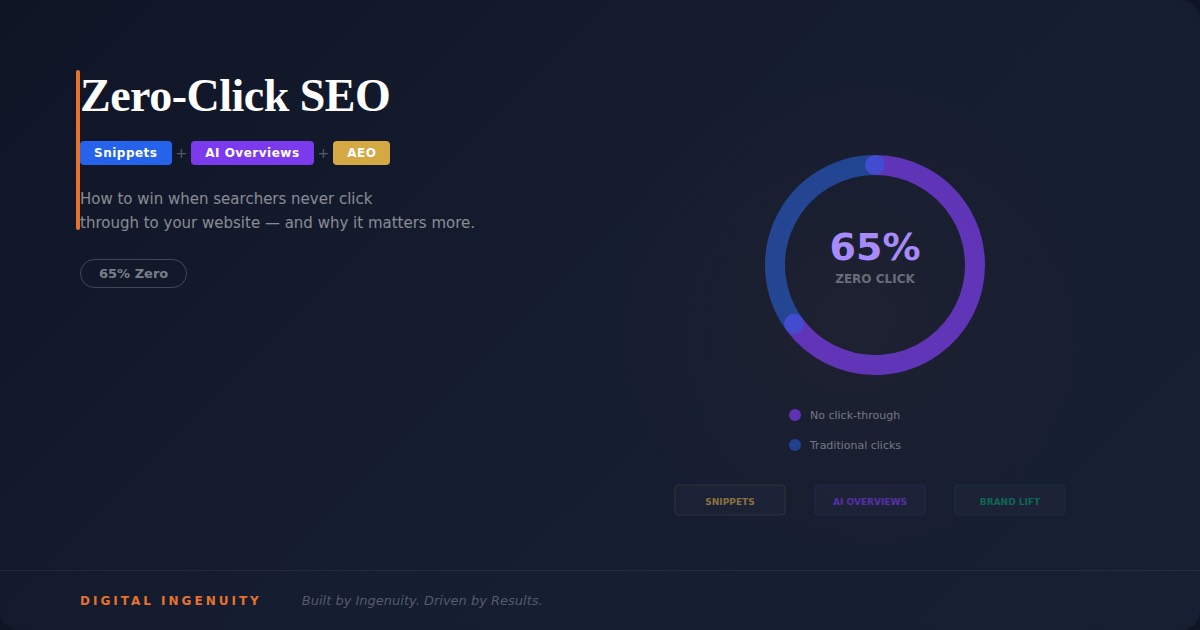
Zero-click searches — where users get their answer without ever visiting a website — now account for nearly 60% of all Google searches in the U.S. On mobile, that number jumps to 75%. In Google’s AI Mode specifically, 93% of sessions end without a single website click.
What does this mean for your business? Traditional SEO is no longer enough. Not even close.
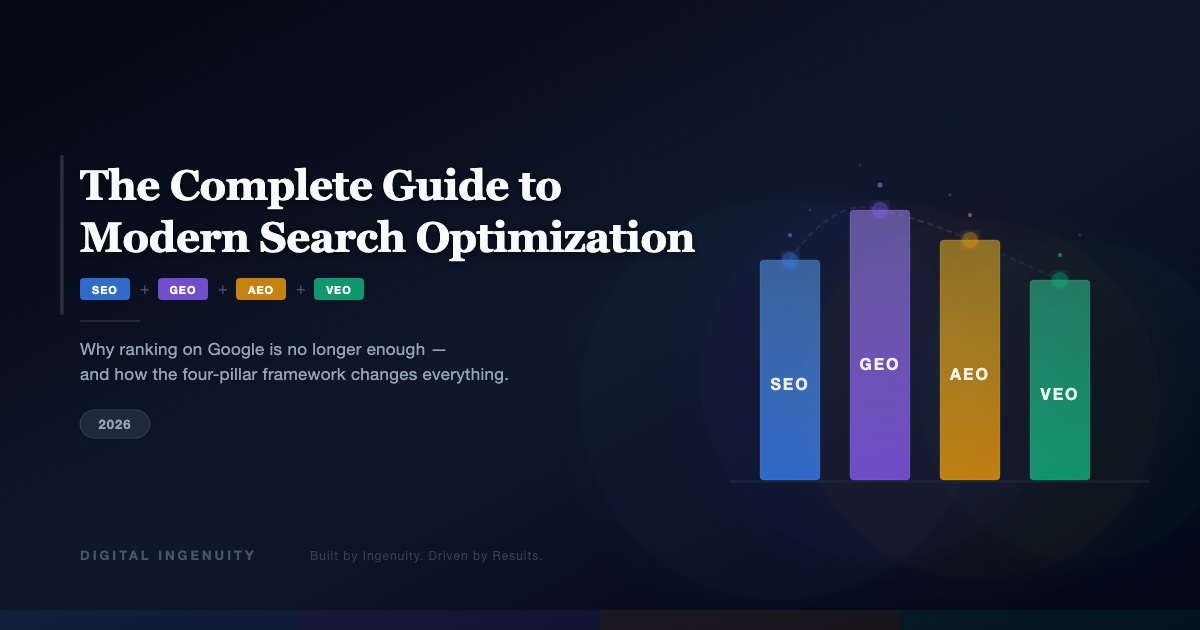
That doesn’t mean SEO is dead — far from it. SEO remains the foundation. But in 2026, you need a system that covers every surface where people discover, research, and make buying decisions. That means optimizing for four distinct but interconnected engines: SEO, GEO, AEO, and VEO.
At Digital Ingenuity, we call this the Four-Pillar Framework — and it’s the backbone of every growth system we engineer for our clients.
Let’s break down each pillar, what it does, how it works, and most importantly, how they work together as a unified system.
Pillar 1: SEO — Search Engine Optimization
What It Is
SEO is the practice of optimizing your website and content to rank higher in traditional search engine results on platforms like Google, Bing, and Yahoo. It’s the discipline that started it all — and despite the hype around AI search, it remains the most critical pillar of the four.
Why? Because SEO is the foundation that makes the other three pillars possible. Without strong technical SEO, authoritative content, and a healthy backlink profile, your chances of showing up in AI Overviews, generative engine citations, or voice search results drop dramatically.
Why It Still Matters in 2026
Some marketers have started treating SEO as a legacy channel. That’s a mistake.
Google still processes over 9 billion searches per day. Even with AI Overviews expanding, the vast majority of those searches still produce traditional organic results. For local businesses especially — plumbers, dentists, law firms, restaurants — service-based keywords like “plumber near me” or “family lawyer in Frisco” rarely trigger AI Overviews. Only about 8% of local searches generate an AI summary.
SEO drives compounding returns. Unlike paid ads that stop generating traffic the moment you stop spending, well-optimized content continues to drive organic traffic for months or years. A single well-written, well-optimized page can become a permanent lead generation asset.
SEO feeds every other pillar. The technical health of your site, the authority of your domain, and the structure of your content all influence whether AI engines cite you, whether voice assistants read your content aloud, and whether generative platforms trust you enough to include you in their answers.
The Core Components of Modern SEO
Technical SEO ensures search engines can crawl, render, and index your site efficiently. This includes site speed, mobile responsiveness, proper URL structures, XML sitemaps, canonical tags, and clean code. If your site is built on a JavaScript framework (like many modern web apps), server-side rendering or pre-rendering is critical — without it, search engines may not see your content at all.
On-Page SEO focuses on optimizing individual pages for specific keywords and search intent. This means strategic title tags, meta descriptions, header hierarchy (H1 through H3), internal linking, and content that genuinely answers the searcher’s question — not just keyword stuffing.
Off-Page SEO builds your site’s authority through backlinks from reputable sources, brand mentions across the web, and an active presence on platforms that search engines trust — industry directories, review sites, and professional associations.
Content Strategy ties it all together. In 2026, thin content doesn’t rank. Google’s algorithms evaluate whether your content demonstrates genuine expertise, experience, authority, and trustworthiness — what Google calls E-E-A-T. Content written by someone who clearly understands the subject, backed by real data, and structured for both humans and machines is what wins.
Local SEO: The Secret Weapon for Service Businesses
For businesses with a physical location or a defined service area, local SEO is arguably the highest-ROI component of the entire framework.
Google Business Profile optimization, local citation building, review management, and geo-targeted content all feed into the local map pack — those three business listings that appear at the top of location-based searches.
Local searches are also the most resistant to AI disruption. When someone searches “best HVAC company in Plano,” they need to call someone, check reviews, and schedule an appointment. AI can’t do that for them — which means local SEO will continue driving real leads long after AI Overviews dominate informational queries.
Pillar 2: GEO — Generative Engine Optimization
What It Is
GEO is the practice of optimizing your content and digital presence to be cited, referenced, and surfaced by AI-powered generative search engines — including ChatGPT, Google’s AI Mode, Perplexity, Gemini, and Microsoft Copilot.
Unlike traditional SEO, where the goal is to rank on a page of results that the user clicks through, GEO is about getting your brand included in the AI-generated answer itself. When someone asks ChatGPT “What’s the best marketing agency in Dallas?” or uses Google’s AI Mode to research digital marketing services, GEO determines whether your business shows up in that conversation — or gets left out entirely.
Why GEO Matters Now
The shift toward AI-powered search isn’t coming — it’s already here.
ChatGPT now has over 800 million weekly active users. Google’s AI Mode has surpassed 100 million monthly active users in the U.S. alone. Generative AI usage for content discovery has grown 156% year-over-year. And nearly 40% of Americans now use at least one AI chatbot every month.
Here’s the critical insight most businesses are missing: AI-generated search traffic is remarkably high-value. Research from Entail AI suggests that visitors arriving through AI search convert at up to 4.4 times the rate of traditional organic search. This makes sense — by the time someone gets a recommendation from an AI engine, they’ve already been pre-qualified. The AI has essentially done the comparison shopping for them.
But here’s the catch: AI search is predominantly zero-click. Roughly 93% of Google AI Mode sessions end without a website visit. That means if your brand isn’t mentioned in the answer, you don’t exist in that user’s journey. There’s no page 2 to scroll to. There’s no “next result” to check. You’re either in the answer or you’re invisible.
How to Optimize for Generative Engines
Build deep topical authority. AI engines don’t just evaluate individual pages — they assess your entire domain’s credibility on a subject. If your site has one blog post about marketing but thirty about unrelated topics, an AI engine won’t cite you as a marketing authority. Deep, consistent content around your core expertise signals to AI systems that you’re a credible source worth referencing.
Earn mentions across the web. This is where GEO overlaps with digital PR. AI engines reference brands that appear consistently across multiple trusted sources. Research shows that domains with profiles on platforms like Trustpilot, G2, Yelp, and industry-specific review sites are three times more likely to be cited by ChatGPT compared to those without such presence. Getting mentioned on industry sites, being quoted in articles, and maintaining active profiles on major platforms all feed the AI engines’ trust signals.
Prioritize structured, factual content. Generative engines favor content that’s easy to parse and verify. That means clear headings, structured data (schema markup), factual claims backed by data, and content organized in a way that AI can extract clean answers from. Studies show that Q&A-formatted content performs best for AI citation, while dense, unstructured paragraphs perform worst.
Keep content fresh. AI engines have a strong recency bias. Research from Seer Interactive found that 85% of AI Overview citations were published within the last two years, with 44% from 2025 alone. Perplexity cites even more recent content — 50% of its citations come from articles published in the current year. If your content is stale, AI engines will skip you for someone more current.
Monitor your AI visibility. Unlike traditional SEO where you can track rankings in Google Search Console, monitoring your presence in AI-generated answers is still an emerging discipline. Tools are starting to emerge, but the most practical approach right now is regularly querying AI platforms with the same questions your prospects would ask and checking whether your brand appears. If it doesn’t, you know where the gaps are.
Pillar 3: AEO — Answer Engine Optimization
What It Is
AEO is the practice of structuring and optimizing your content to be selected as the direct answer in zero-click search results — including Google’s featured snippets, “People Also Ask” boxes, AI Overviews, knowledge panels, and voice assistant responses.
While GEO focuses on getting cited within AI-generated summaries across multiple platforms, AEO is specifically about being chosen as the answer — the single result that Google highlights at the top of the page, or the one response that Siri reads out loud.
Think of it this way: GEO is about being part of the conversation. AEO is about being the definitive answer.
Why AEO Matters Now
The rise of zero-click search has made AEO essential. When nearly 60% of Google searches end without a click, the only way to capture attention is to be the answer that’s displayed directly in the search results.
Google’s AI Overviews appear for virtually all informational queries — studies show 99% of AI Overviews are triggered by informational search intent. And the queries most likely to trigger these AI-generated answers are longer, more conversational searches — exactly the kind of questions your potential customers are asking.
Searches with seven or more words trigger an AI Overview 46% of the time. These long-tail, question-based queries represent the highest-intent traffic on the web — people asking specific questions because they’re actively trying to solve a problem or make a decision.
AEO ensures your content is the one that gets selected to answer those questions.
How to Optimize for Answer Engines
Structure content around real questions. Start by identifying the specific questions your target customers ask at every stage of their buying journey. Tools like AnswerThePublic, AlsoAsked, and even Google’s own “People Also Ask” section are goldmines for discovering these questions. Then, create content that addresses each question directly — with the question as a heading and a clear, concise answer immediately following.
Format for featured snippets. Google’s featured snippets favor specific content formats depending on the query type. “What is” questions typically pull paragraph-style answers (aim for 40–60 words of crisp, factual explanation). “How to” queries favor numbered step lists. Comparison queries pull tables. Structure your content to match the format Google prefers for each type of question.
Implement schema markup aggressively. Schema markup is code that helps search engines understand the context of your content. For AEO, the most important schema types are FAQPage (for frequently asked questions), HowTo (for instructional content), LocalBusiness (for location information), and Product or Service schemas (for commercial pages). Schema doesn’t guarantee a featured snippet, but it dramatically increases your odds — especially for voice search results and AI Overviews.
Write concise, authoritative answers. AEO rewards clarity. When answering a question, lead with the answer in the first sentence, then expand with supporting detail. Don’t bury the answer three paragraphs deep. Search engines (and AI models) are looking for content that delivers value immediately — not content that forces readers to wade through filler.
Build FAQ sections into every key page. FAQ sections serve double duty. They provide structured, question-and-answer content that search engines love for featured snippets and AI Overviews, and they address the real objections and concerns that prospects have before they pick up the phone. Every service page, industry page, and location page on your site should have a relevant FAQ section.
Pillar 4: VEO — Voice Engine Optimization
What It Is
VEO is the practice of optimizing your content and online presence to be discovered and delivered through voice search — including Google Assistant, Apple’s Siri, Amazon Alexa, and Microsoft Cortana.
Voice search is fundamentally different from typed search. When someone types a query, they use shorthand: “best dentist Plano TX.” When they speak, they ask a full question: “Hey Google, who’s the best dentist near me that’s open on Saturdays?” VEO accounts for this difference by optimizing content around conversational language, natural phrasing, and the unique behavior of voice assistants.
Why VEO Matters Now
Voice search is no longer a novelty — it’s a mainstream behavior.
The voice commerce market is projected to reach nearly $150 billion by 2030. Voice search is three times more likely to be used for local queries than text search. And the critical difference between voice and text is this: when someone types a query, Google shows them ten options. When someone asks a voice assistant, they get one answer — maybe two. There’s no scrolling, no comparing results. The assistant picks a single source and reads it aloud.
This means VEO has the smallest margin of error of any pillar. You’re either the answer, or you’re nothing.
For local businesses, VEO is especially powerful. People use voice search on the go — in the car, walking down the street, multitasking at home. These are high-intent moments. “Where’s the closest tire shop?” “What time does the pharmacy close?” “Find me a plumber near me with good reviews.” These voice queries represent customers who are ready to act immediately.
How to Optimize for Voice Search
Target conversational long-tail keywords. Voice queries are longer and more natural than typed searches. Instead of optimizing only for “SEO services Plano,” also optimize for “Who provides the best SEO services in Plano, Texas?” Think about how your customers actually talk — then write content that matches that language.
Aim for Position Zero. Voice assistants pull their answers primarily from featured snippets (Position Zero) and knowledge panels. Everything you do for AEO directly supports your VEO efforts. Concise answers in the 40–60 word range are ideal — long enough to be comprehensive, short enough to be read aloud naturally.
Optimize your Google Business Profile thoroughly. For local voice searches, Google leans heavily on your Business Profile. That means your name, address, phone number, hours, services, and categories need to be complete, accurate, and consistent across every platform. Reviews matter here too — voice assistants often factor in rating and review count when selecting which business to recommend.
Ensure mobile and speed performance. Voice searches are overwhelmingly conducted on mobile devices. If your site loads slowly or isn’t mobile-optimized, you’re disqualifying yourself from voice results. Google’s Core Web Vitals — Largest Contentful Paint (LCP), Interaction to Next Paint (INP), and Cumulative Layout Shift (CLS) — all factor into whether your content gets selected for voice delivery.
Create natural-language FAQ content. FAQ pages written in conversational language are VEO gold. Each question should mirror how a real person would ask it verbally, and each answer should be concise enough to be read aloud in a few seconds. This content does triple duty — it supports your AEO featured snippet strategy, your GEO citation strategy, and your VEO voice search strategy simultaneously.
How the Four Pillars Work Together
Here’s what most agencies miss: SEO, GEO, AEO, and VEO aren’t four separate strategies requiring four separate budgets. They’re interconnected layers of a single system, and the work you do on one pillar strengthens every other pillar simultaneously.
The Compounding Effect
When you write a comprehensive, well-structured blog post with proper schema markup and FAQ sections:
- SEO benefits from the keyword targeting, internal links, and domain authority signals
- GEO benefits from the structured, authoritative content that AI engines can cite
- AEO benefits from the FAQ format and concise answer structure that featured snippets pull from
- VEO benefits from the conversational language and Position Zero targeting that voice assistants rely on
One piece of content, engineered correctly, works across all four surfaces. That’s not four times the work — it’s one body of work with four times the reach.
The Foundation Hierarchy
Think of the four pillars as a stack:
SEO sits at the base. Without technical health, crawlability, and domain authority, nothing else works. AI engines are far more likely to cite domains with strong SEO fundamentals. Research shows that sites with high domain authority and substantial referring domains are 3.5 times more likely to be cited by ChatGPT.
AEO builds on SEO. Once your pages rank and your content is structured properly, AEO techniques position that content to be pulled into featured snippets, “People Also Ask” results, and AI Overviews.
GEO extends your reach beyond Google. With strong SEO and AEO in place, GEO ensures your content gets cited across ChatGPT, Perplexity, Gemini, and other AI platforms — expanding your visibility to entirely new search surfaces.
VEO captures the voice layer. Everything you’ve built for SEO, AEO, and GEO feeds VEO. Voice assistants pull from the same featured snippets, knowledge graphs, and authority signals — they just deliver them through a spoken interface.
The Practical Example
Let’s say you’re a home services company in the Dallas-Fort Worth area. Here’s how the four pillars work together on a single service page:
SEO: Your “AC Repair in Frisco, TX” page is optimized with the right title tag, meta description, header structure, internal links, and local citations. Google can crawl it, index it, and rank it for relevant searches.
AEO: The page includes an FAQ section: “How much does AC repair cost in Frisco?” with a concise, formatted answer that Google pulls into a featured snippet. “People Also Ask” now shows your answer.
GEO: Because your site has strong domain authority, consistent brand mentions across the web, and well-structured content, ChatGPT and Perplexity reference your company when users ask about AC repair services in the Frisco area.
VEO: When someone in their car says “Hey Google, I need an AC repair company near me,” Google pulls your featured snippet answer and reads your company name, phone number, and rating. They call you directly.
One page. Four surfaces. One customer.
Why Most Businesses Are Still Stuck on One Pillar
Despite the data, the overwhelming majority of businesses — and frankly, most marketing agencies — are still treating SEO as the entire strategy.
There are a few reasons for this:
The tools haven’t caught up. Google Search Console still doesn’t provide data on AI Overview performance. There’s no “GEO Console” or “AEO Dashboard” that shows you how often your content gets cited in AI-generated answers. The measurement infrastructure is still being built, which means many agencies default to what they can measure — traditional rankings.
The terminology is confusing. SEO, GEO, AEO, VEO, AIO, LLMO — the industry is drowning in acronyms, and there’s no universally agreed-upon taxonomy yet. This confusion causes paralysis. Businesses don’t invest in what they don’t understand.
Most agencies aren’t built for it. The typical agency model is built around one-dimensional SEO: keyword research, content writing, link building, rank tracking. Executing a four-pillar strategy requires a fundamentally different approach — one that treats search visibility as an engineered system, not a collection of individual tactics.
This is exactly why Digital Ingenuity built the Four-Pillar Framework into the core of every engagement. We don’t bolt on GEO or AEO as upsells. They’re integrated into the system from day one because that’s how modern search actually works.
Getting Started: A Practical Action Plan
If you’re looking at your current marketing and realizing it only covers traditional SEO (or worse, nothing at all), here’s where to start:
Phase 1: Audit Your Foundation (SEO)
Run a comprehensive technical audit of your website. Check site speed, mobile performance, crawlability, indexing status, and Core Web Vitals. Fix any broken links, duplicate content, or rendering issues. Ensure your Google Business Profile is fully optimized with accurate information, photos, and active review management.
Phase 2: Structure for Answers (AEO)
Review your top-performing pages. Add FAQ sections with real customer questions. Implement schema markup (FAQPage, LocalBusiness, HowTo) across every relevant page. Restructure existing content so the answer to each question appears clearly and concisely — don’t bury it.
Phase 3: Build for AI Citation (GEO)
Audit your brand’s presence across the web. Are you mentioned on industry sites, review platforms, directories, and authoritative sources? Build a content strategy focused on deep topical authority — not a scattershot approach. Update stale content so AI engines see you as a current, credible source.
Phase 4: Capture Voice (VEO)
Review your highest-traffic pages through a voice lens. Are your answers concise enough to be read aloud? Is your content conversational? Is your Google Business Profile detailed enough for voice assistants to confidently recommend you? Optimize for the conversational, question-based queries that voice users actually speak.
Phase 5: Monitor and Iterate
This isn’t a set-it-and-forget-it strategy. Search is evolving faster than it ever has. What works today may shift in six months as AI engines update their models and Google rolls out new features. Build a regular cadence of monitoring your traditional rankings, testing AI engine responses, tracking featured snippet performance, and refining your approach.
The Bottom Line
The businesses that will win in 2026 and beyond aren’t the ones spending the most on ads or publishing the most blog posts. They’re the ones that engineered their presence across every surface where their customers are searching — traditional search, AI engines, answer boxes, and voice assistants.
SEO is the foundation. GEO extends your reach into AI. AEO makes you the answer. VEO captures the voice.
Four pillars. One system. Complete search visibility.
Ready to see how your business stacks up? Book a free discovery call with Digital Ingenuity and we’ll audit your current search presence across all four pillars — then show you exactly where the gaps are and how to close them.
Digital Ingenuity is a full-service digital marketing agency headquartered in Plano, Texas, specializing in engineered growth systems for businesses across the Dallas-Fort Worth metroplex and nationwide. Our Four-Pillar Framework — SEO + GEO + AEO + VEO — is built into every engagement we deliver.