Key takeaways
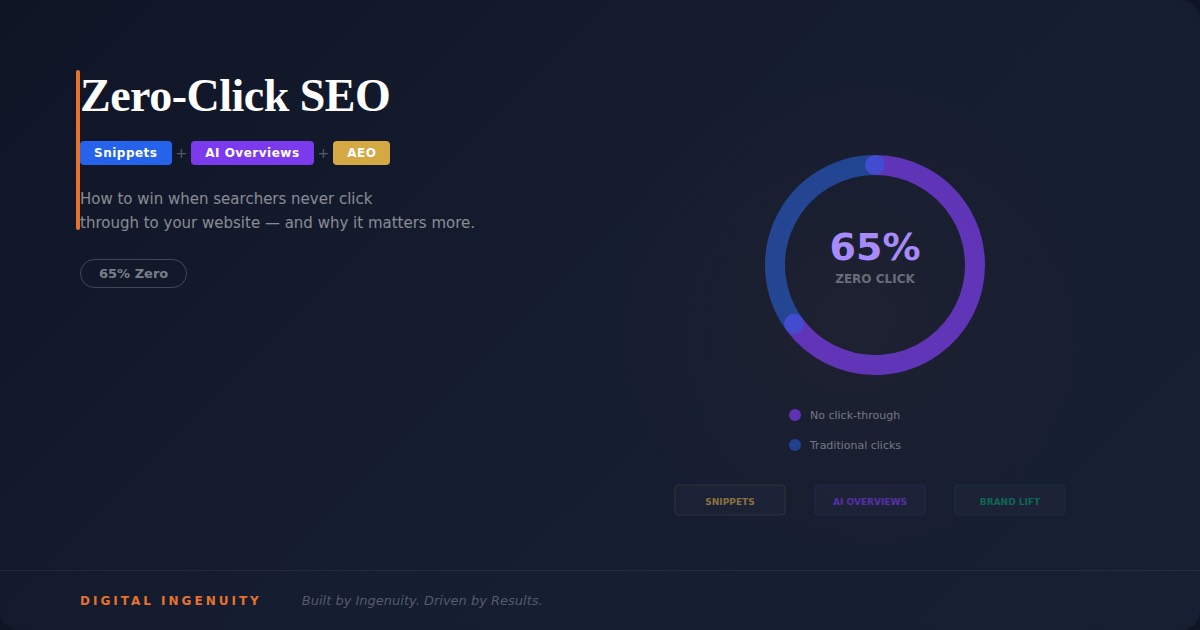
- Over 60% of Google searches now end without a click to any website — the answer appears directly in search results through featured snippets, AI Overviews, knowledge panels, and People Also Ask boxes
- Zero-click results are not the enemy: businesses that appear in these positions capture more brand visibility, trust, and downstream conversions than businesses buried in organic results below
- Answer Engine Optimization (AEO) is the discipline of engineering your content to become the featured answer Google displays — and it’s a skill most businesses haven’t developed
- The same content that wins featured snippets also gets cited by AI search platforms and read aloud by voice assistants, creating compound visibility across multiple surfaces
- Winning zero-click positions requires a specific content structure: direct answers, supporting context, schema markup, and topical authority
The Search Results Page Has Changed Forever
If you’ve searched for anything on Google recently, you’ve noticed something: Google answers your question before you click anything. Type “how much does a new roof cost in Texas” and Google displays an AI Overview with pricing ranges, factors that affect cost, and regional considerations — all synthesized from multiple sources. Type “best restaurants in Frisco TX” and a local pack with maps, ratings, and reviews appears. Type “what is GEO in marketing” and a featured snippet provides a definition pulled from the most authoritative source Google can find.
This is the zero-click reality. The majority of Google searches now result in the user getting their answer without clicking through to any website. The information appears directly in the search results page through featured snippets, AI Overviews, knowledge panels, People Also Ask boxes, local packs, and other SERP features.
For businesses, this creates a strategic question that demands an honest answer: If more than half of your potential customers are getting answers without clicking, should you keep optimizing for clicks — or should you optimize to be the answer?
The answer is both. And the discipline that captures zero-click visibility is called Answer Engine Optimization (AEO).
The Anatomy of Zero-Click Results
Understanding which SERP features capture zero-click traffic — and how to earn positions in each — is the foundation of AEO strategy.
Featured Snippets
Featured snippets are the most prominent zero-click feature. They appear in a highlighted box at the top of organic results, displaying a direct answer extracted from a web page. Featured snippets come in three primary formats: paragraph snippets (a concise text answer), list snippets (numbered or bulleted steps), and table snippets (structured data in rows and columns).
Earning featured snippets requires specific content engineering. The content must directly answer the question — typically within the first 40 to 60 words of the relevant section. The answer must be structured clearly: question as a heading, direct answer immediately below, then supporting context. The page overall must have sufficient topical authority (strong domain, comprehensive content, relevant backlinks) to be considered trustworthy enough for snippet extraction.
Google AI Overviews
AI Overviews are Google’s newest and most transformative zero-click feature. Rather than extracting a snippet from a single source, AI Overviews synthesize information from multiple sources into a comprehensive answer generated by Google’s AI. They appear on an increasing share of queries, especially informational and comparison queries.
Optimizing for AI Overviews overlaps significantly with GEO because Google’s AI uses similar retrieval and synthesis processes as standalone AI platforms. Content that’s comprehensive, well-structured, factually specific, and marked up with proper schema is more likely to be sourced by AI Overviews.
People Also Ask
The People Also Ask (PAA) feature displays related questions that expand to show answers pulled from web pages. PAA boxes appear on a significant share of Google searches and represent a massive visibility opportunity because each expanded answer includes a link to the source page.
Winning PAA positions requires understanding the question clusters around your target topics. When you target “HVAC repair Dallas,” the PAA questions might include “How much does HVAC repair cost in Dallas?” “When should I replace my HVAC system?” “What is the most reliable HVAC brand?” Creating content that answers these related questions — and structuring it with FAQ schema — positions you to capture multiple PAA positions from a single piece of content.
Knowledge Panels
Knowledge panels appear on the right side of search results for entities Google has confirmed — businesses, people, organizations, places. For local businesses, the Google Business Profile effectively serves as a knowledge panel, displaying business information, reviews, photos, and hours directly in search results.
Optimizing your knowledge panel presence means maintaining a complete, accurate, and actively managed Google Business Profile. Every field should be filled, photos should be professional and recent, reviews should be fresh, and Google Posts should be published regularly. This is foundational local SEO that directly impacts zero-click visibility.
Why Zero-Click Is Actually Good for Business
The common reaction to zero-click statistics is panic: “If people aren’t clicking, how do I get leads?” This reaction misunderstands how zero-click visibility actually converts.
First, appearing as the featured answer builds enormous brand authority and trust. When Google selects your content as the answer — above ten organic results, above paid ads — it signals to the searcher that you are the authority on this topic. Even if they don’t click that specific result, they remember your brand. When they’re ready to buy, your brand has a trust advantage.
Second, featured snippet positions drive higher click-through rates than standard organic positions, not lower. Studies consistently show that featured snippets earn more clicks than the first organic result, even though some users get their answer without clicking. The net effect is positive — you capture both the zero-click brand impression and a higher share of the clicks that do occur.
Third, zero-click optimization creates compound visibility across multiple channels. The content that wins featured snippets is the same content that AI Overviews source, that ChatGPT cites, that Perplexity references, and that voice assistants read aloud. One piece of well-optimized content can capture visibility across five or six surfaces simultaneously.
The AEO Content Framework
Winning zero-click positions isn’t about writing more content. It’s about structuring content specifically for answer extraction. Here’s the framework that consistently earns featured snippets and AI Overview sourcing.
The Question-Answer-Context Structure
Every section targeting a zero-click position should follow this pattern. Start with the question as a heading (H2 or H3). Immediately below, provide a direct, concise answer in one to two sentences. Then expand with supporting context, examples, data, and nuance in two to four additional paragraphs.
This structure works because Google’s snippet extraction algorithm looks for concise answers positioned immediately after the question. The supporting context demonstrates topical depth and authority, which influences whether Google trusts your answer enough to feature it.
FAQ Sections With Schema
Every page on your website should include an FAQ section with three to five questions relevant to the page’s topic. Each FAQ should follow the question-answer-context structure. And every FAQ section should have FAQPage schema markup, which tells Google these are questions and answers in machine-readable format.
FAQ schema doesn’t guarantee featured snippet positions, but it dramatically increases the likelihood of appearing in People Also Ask results and being sourced by AI Overviews. For local businesses in Dallas, Houston, Austin, and across Texas, FAQ sections targeting local variations of common questions (“How much does X cost in [city]?”) are particularly effective.
Comparison and List Content
Some of the most valuable zero-click positions are comparison features — tables, lists, and structured comparisons that Google displays for queries comparing options. “Best X in [city],” “X vs Y,” and “top 10 X for Y” queries frequently trigger these formats.
Creating content with clear comparison tables, ranked lists, and structured pros and cons gives Google ready-made content to display. When a Frisco resident searches “best HVAC companies in Frisco,” a well-structured comparison guide on your site is exactly what Google’s featured snippet algorithm looks for.
Data-Rich Content
Featured snippets disproportionately feature content with specific data: pricing ranges, statistics, timelines, and measurable outcomes. Generic content (“we provide excellent service”) never earns snippets. Specific content (“the average HVAC repair in North Texas costs $150 to $600 depending on the issue, with compressor replacement averaging $1,200 to $2,500”) does.
This applies across every industry. Home services content with specific pricing, legal marketing with case timelines and typical outcomes, automotive content with service costs and intervals — specificity wins zero-click positions.
Voice Search: The Ultimate Zero-Click Channel
Voice search is zero-click by definition. When a user asks Google Assistant, Siri, or Alexa a question, the assistant reads one answer aloud. There’s no results page, no list of options — just a single answer from a single source.
This makes VEO (Voice Engine Optimization) the ultimate zero-click strategy. The content that wins featured snippets is the same content voice assistants read aloud. But VEO adds an additional layer: optimizing for conversational, spoken queries rather than typed keywords.
People speak differently than they type. A typed search might be “HVAC cost Dallas.” A voice query is “How much does it cost to fix my air conditioning in Dallas?” Optimizing for these natural language patterns — longer, more conversational, question-format queries — improves both featured snippet positions and voice search results.
Measuring Zero-Click Success
Traditional SEO metrics (organic clicks, traffic, rankings) don’t fully capture zero-click value. You need additional metrics to measure AEO effectiveness.
Featured snippet positions and People Also Ask appearances can be tracked through tools that monitor SERP features for your target keywords. AI Overview sourcing — whether your content is cited in Google’s AI-generated answers — requires monitoring that most SEO tools don’t yet provide. SearchLight™ tracks visibility across all these surfaces, including AI Overviews, ChatGPT citations, and voice assistant responses.
Brand search volume is an indirect but powerful indicator of zero-click success. When more people search for your brand name after encountering your business in featured snippets and AI answers, it validates that zero-click visibility is driving awareness and trust.
The Four-Pillar Integration
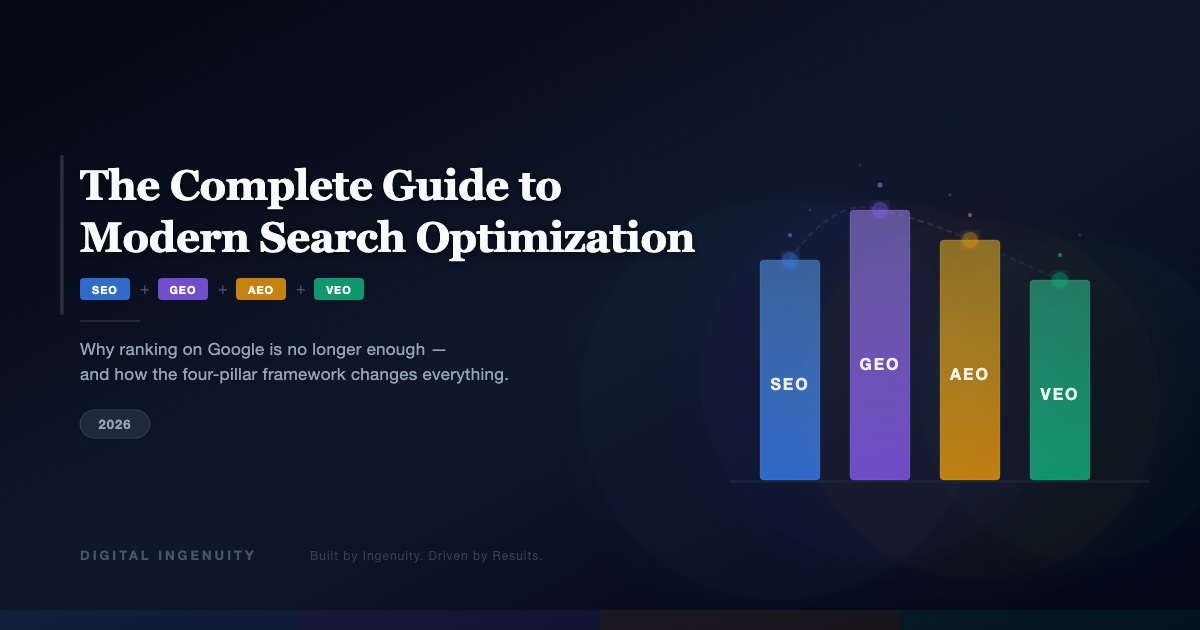
AEO doesn’t operate in isolation. It’s most effective when integrated with the other three pillars of the four-pillar framework.
Strong SEO earns the page authority and indexing that makes featured snippet positions possible. GEO extends zero-click visibility from Google’s SERP features to standalone AI platforms like ChatGPT and Perplexity. VEO optimizes the same content for voice delivery, capturing the growing share of zero-click queries that happen through smart speakers and phone assistants.
Together, these four pillars create a compounding system where every zero-click position reinforces the others. A featured snippet earns Google’s trust, which makes AI Overviews more likely to cite you, which signals authority to ChatGPT and Perplexity, which voice assistants then read aloud. One investment, multiple surfaces, compounding returns.