Key takeaways
- Google’s crawl budget is finite, and wasting it on thin pages, duplicate content, or broken architecture means your most important pages may never get indexed.
- Experience, Expertise, Authoritativeness, and Trustworthiness aren’t just guidelines — they’re the lens through which Google evaluates whether your content deserves to rank.
- AI systems need to be able to extract clear, specific claims from your content.
- When AI systems encounter conflicting information about your business across different sources, they’re less likely to cite you with confidence.
- Stale websites with content from three years ago are significantly less likely to be cited than brands actively publishing quality material.
The Search Landscape Has Fundamentally Changed
If you’re running a business in 2026 and your entire digital strategy is still built around ranking on Google’s traditional search results page, you’re optimizing for a world that’s already shrinking.
That’s not hyperbole. It’s math.
Google still processes hundreds of billions of searches every month. That hasn’t changed. What has changed is where the answers are being delivered. AI Overviews now appear on a significant portion of all Google searches. ChatGPT processes billions of messages monthly with a user base that continues to grow at a staggering rate. Perplexity, Gemini, and a growing roster of AI-powered search tools are pulling users away from the traditional search results page entirely.
The result is a fragmented discovery landscape where your potential customers are finding businesses through at least five different platforms — and the majority of those platforms don’t operate on the same rules as traditional SEO.
This isn’t a future prediction. This is happening right now, and the businesses that understand it are already pulling ahead.
What Most Agencies Get Wrong About “AI SEO”
Here’s the part that frustrates us.
Walk into most digital marketing agencies today and ask them about AI search optimization, and you’ll get one of two responses. Either they’ll tell you it doesn’t matter yet (it does), or they’ll rebrand their existing SEO services with “AI-powered” language and change nothing about their actual methodology.
Both of those approaches fail businesses.
The reality is that optimizing for AI-driven search requires fundamentally different thinking than optimizing for traditional search. It’s not about stuffing more keywords into more pages. It’s not about publishing 50 blog posts a month and hoping volume compensates for strategy. And it’s certainly not about slapping an “AI” label on the same tactics agencies have been running since 2015.
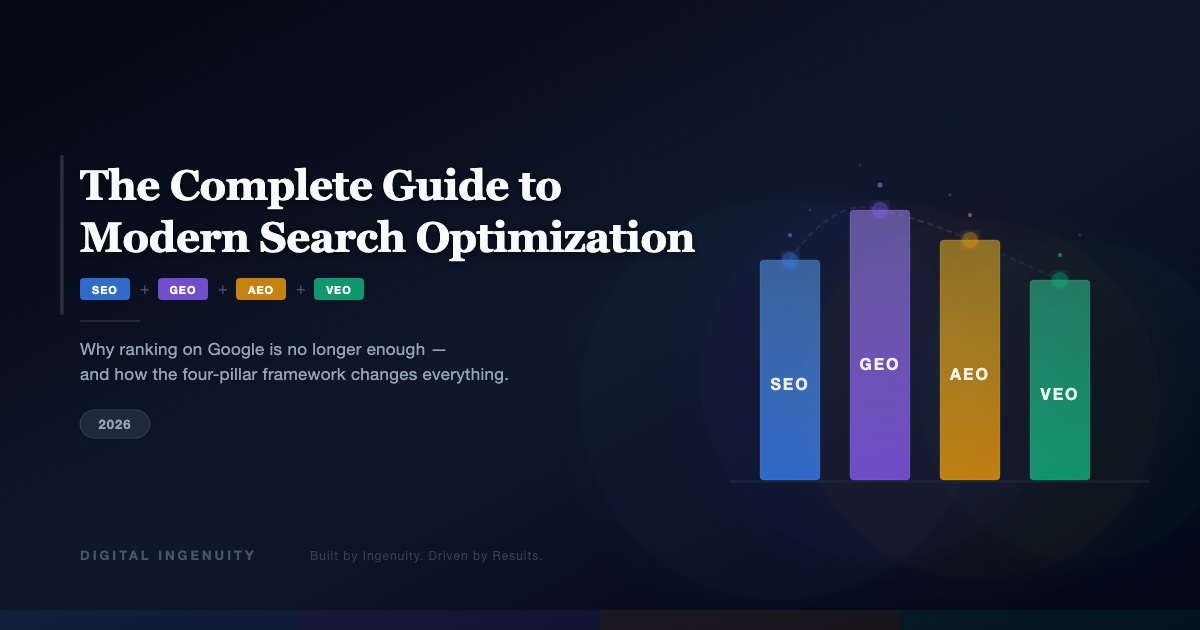
What’s actually required is a systems-level approach — one that treats each search surface as a distinct channel with its own rules, its own ranking signals, and its own optimization requirements, while ensuring all four channels reinforce each other. This systems-level thinking extends to every part of your digital presence, from your website build and brand identity to your paid media strategy and marketing operating system.
That’s exactly why we built the four-pillar framework.
Pillar One: SEO — The Foundation That Never Left
Let’s start with the pillar everyone knows. Search Engine Optimization is the practice of improving your website’s visibility in organic search results on platforms like Google and Bing. It’s been the backbone of digital marketing for over two decades, and despite what some headlines suggest, it isn’t going anywhere.
Here’s why: every other pillar in this framework depends on the foundation that strong SEO provides. Generative engines pull from well-indexed, authoritative web content. Answer engines extract information from pages that are semantically structured. Voice assistants read from featured snippets and knowledge panels that only exist because of solid technical and on-page SEO.
Remove the SEO foundation, and the other three pillars have nothing to stand on.
What Modern SEO Actually Requires in 2026
The SEO that works today looks nothing like the SEO that worked five years ago. The fundamentals remain — crawlability, indexation, site speed, mobile optimization, quality content — but the execution has evolved dramatically.
- Technical excellence is non-negotiable. Google’s crawl budget is finite, and wasting it on thin pages, duplicate content, or broken architecture means your most important pages may never get indexed. We’ve seen this firsthand — sites with 200+ pages where fewer than 50 are actually indexed because the technical foundation was built carelessly. Every page that Google crawls but doesn’t index is crawl budget that could have been spent on a page that actually drives revenue.
- Content quality has replaced content volume. The era of publishing mediocre blog posts at scale and winning through sheer volume is over. Google’s algorithms have become sophisticated enough to evaluate content depth, expertise signals, and whether a page genuinely serves user intent or simply exists to capture a keyword. Thirty-five exceptional pages will outperform 170 thin ones every single time.
- E-E-A-T signals matter more than ever. Experience, Expertise, Authoritativeness, and Trustworthiness aren’t just guidelines — they’re the lens through which Google evaluates whether your content deserves to rank. For service-based businesses, this means demonstrating real-world experience, showcasing expertise through depth of knowledge, building authority through external validation, and establishing trust through consistency and transparency.
- Structured data is your silent advantage. Schema markup — including FAQ, LocalBusiness, HowTo, Service, and Organization schemas — gives search engines explicit context about your content. It’s the difference between Google guessing what your page is about and Google knowing exactly what it is, what entity it represents, and how it should be classified.
Local SEO remains critical for service businesses. Google Business Profile optimization, citation consistency across directories, localized content, and review management still drive the majority of leads for businesses serving specific geographic markets. If you’re a service provider and you’re not dominating the local map pack in your area, you’re leaving money on the table every single day.
The SEO Metrics That Actually Matter
Stop obsessing over vanity metrics. The numbers that correlate with revenue are impressions trending upward over time, click-through rates improving as you refine titles and meta descriptions, average position moving into the top three for your target queries, and most importantly, the quality and volume of leads generated from organic traffic.
A page ranking position one with zero clicks has a meta description problem. A page generating impressions but no rankings above position 30 has a content authority problem. These distinctions matter because they dictate completely different optimization strategies — and smart businesses pair their organic efforts with strategic paid media to accelerate results while the organic compounding builds.
Pillar Two: GEO — Showing Up in AI-Generated Answers
Generative Engine Optimization is the practice of positioning your brand and content so that AI platforms — ChatGPT, Google Gemini, Perplexity, Claude, and others — cite, recommend, or mention you when users ask questions.
This is the pillar that most businesses haven’t even started thinking about, which is exactly why it represents the largest opportunity for those willing to act now.
Why GEO Matters Right Now
Consider how your customers are already behaving. When a business owner wants to know which digital marketing strategies are most effective for their industry, a growing number of them aren’t typing that question into Google. They’re asking ChatGPT. They’re prompting Perplexity. They’re using Google’s AI Mode to get synthesized answers without clicking through to any website.
When that happens, one of two things occurs: either your brand is part of the answer, or it isn’t. There is no “page two” of AI-generated results. There is no “we’ll rank eventually.” You’re either in the conversation or you’re invisible.
Research has shown that brands producing consistent, authoritative content can achieve dramatically faster visibility gains in generative engines compared to those publishing sporadically. The compounding effect is real — early movers in GEO are building advantages that will become increasingly difficult for latecomers to overcome.
How Generative Engines Decide What to Cite
Understanding how AI platforms select sources is critical for any GEO strategy. These systems don’t operate on the same ranking algorithms as Google. Instead, they use Retrieval-Augmented Generation (RAG) architectures that index, embed, and retrieve content based on a different set of signals.
- Topical authority across the web. Generative engines favor brands that appear consistently across multiple authoritative sources — not just on their own website. If your brand is mentioned in industry publications, cited in reputable directories, discussed on credible forums, and referenced across social platforms, AI systems develop a stronger “understanding” of who you are and what you’re known for.
- Content that’s semantically structured. AI systems need to be able to extract clear, specific claims from your content. Vague, marketing-heavy language that sounds good to humans but says nothing specific is essentially invisible to generative engines. They’re looking for factual, well-organized information that can be synthesized into coherent answers.
- Entity consistency. Your brand needs to be represented the same way everywhere — same name, same descriptions, same core claims. When AI systems encounter conflicting information about your business across different sources, they’re less likely to cite you with confidence. This is especially critical for multi-location businesses where inconsistent NAP data across dozens of listings can dilute authority signals.
- Freshness and frequency. Generative engines reward brands that produce recent, relevant content on an ongoing basis. Stale websites with content from three years ago are significantly less likely to be cited than brands actively publishing quality material. This is one reason we maintain an active blog and invest in community programs like Foundation Lab — every piece of authentic, valuable content strengthens the entity signals AI systems rely on.
Practical GEO Strategies You Can Implement
The most effective GEO strategies combine several disciplines that many agencies treat as separate silos: content marketing, digital PR, review management, and social media presence. When these channels work together with a unified entity strategy, the compound effect on AI visibility is substantial.
Start by ensuring your website contains comprehensive, specific content about your services, your methodology, and your results. Then extend that presence outward — guest contributions on industry publications, active participation in relevant online communities, consistent social media activity, and a healthy profile of genuine customer reviews across multiple platforms.
The goal isn’t to game AI systems. The goal is to make your brand so well-represented across the web that AI platforms can’t answer questions in your space without encountering you.
Pillar Three: AEO — Engineering Your Content for Zero-Click Search
Answer Engine Optimization focuses on structuring your content so that AI-powered search platforms — Google AI Overviews, Bing Copilot, and others — can extract, summarize, and surface it directly in search results without requiring users to click through to your website.
If that sounds counterintuitive (“Why would I want to give away my content without a click?”), understand this: in a zero-click environment, being the cited source is the new number one ranking. Users see your brand name, associate it with authority, and when they’re ready to take action, they come directly to you.
The Zero-Click Reality
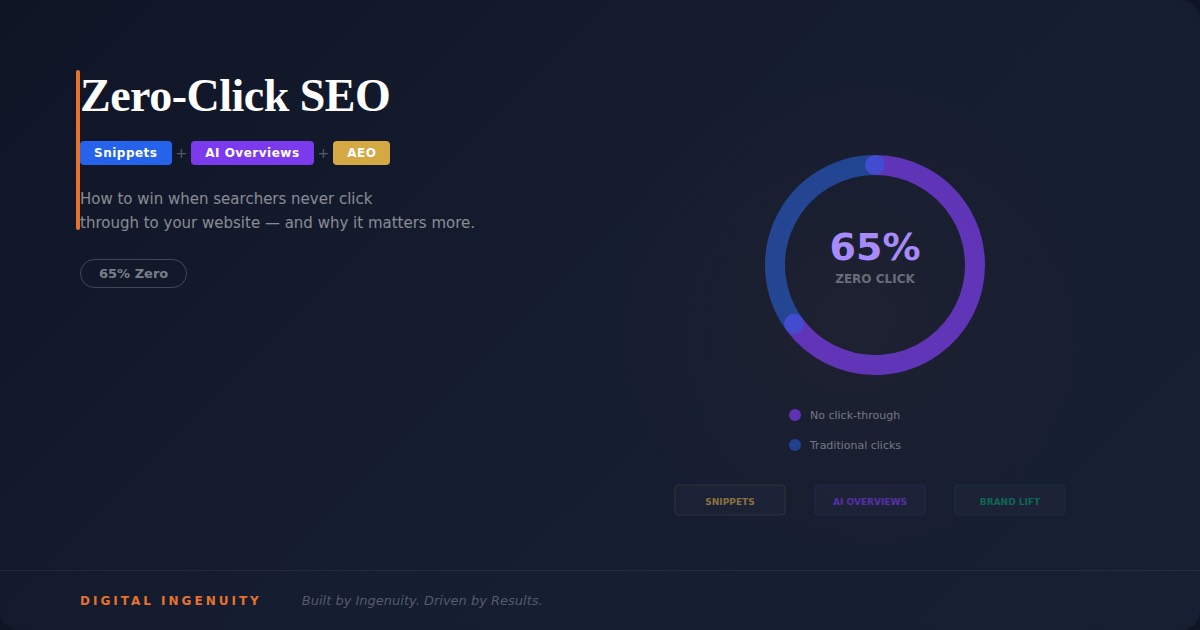
A growing percentage of all searches now result in zero clicks. The user gets their answer directly from the search results page — through featured snippets, knowledge panels, People Also Ask boxes, or AI Overviews — and never visits a website.
You can either resist this trend and watch your visibility evaporate, or you can engineer your content to be the answer that gets displayed. AEO is how you choose the second option.
The Structural Requirements of AEO-Optimized Content
Content that gets selected for AI-generated answers shares several consistent characteristics that differentiate it from traditional SEO content.
- Immediate, direct answers. AEO-optimized content doesn’t bury the answer at the bottom of a 2,000-word article. It leads with the answer — clearly, concisely, and definitively — then provides supporting context, evidence, and depth below. Think of it as the inverted pyramid structure that journalists have used for decades, applied to search optimization.
- Question-based architecture. Structure your content around the actual questions your audience is asking. Not the keywords they’re typing — the questions they’re speaking, thinking, and prompting. Use heading tags (H2, H3) that mirror these questions precisely, and follow each heading with a direct, extractable answer in the first one or two sentences.
- Semantic clarity. Every claim on your page should be specific, verifiable, and unambiguous. Generalized statements like “we provide excellent service” give AI systems nothing to extract. Specific statements like “our average client sees a 40% increase in organic traffic within six months” give them something concrete to cite.
- Comprehensive FAQ architecture. Dedicated FAQ sections — implemented with proper FAQ schema markup — are one of the most effective AEO tactics available. Each question-answer pair becomes a discrete unit that AI systems can extract independently. The more precisely your FAQ mirrors the questions real users are asking, the more likely your content is to be surfaced.
- Supporting evidence. AI-generated answers tend to favor content that includes statistics, data points, citations, and specific examples. This tracks directly with E-E-A-T principles — content that demonstrates expertise through evidence is inherently more extractable and trustworthy than content built on assertions alone.
AEO and Featured Snippets
Featured snippets remain one of the most valuable real estate positions in search, and they’re directly connected to AEO. When Google selects your content for a featured snippet, it becomes the default source for related AI Overview answers, voice assistant responses, and People Also Ask features.
Winning featured snippets requires precise content formatting: paragraph snippets for definition queries (keep the answer to 40-60 words), list snippets for process or ranking queries, and table snippets for comparison queries. Each format has specific structural requirements that signal to search engines exactly how to display your content.
Pillar Four: VEO — Winning the Voice Search Battle
Voice Engine Optimization is the practice of optimizing your content to become the primary answer in voice-based searches conducted through Google Assistant, Siri, Alexa, Cortana, and other voice-enabled devices.
Here’s what makes VEO categorically different from every other form of search optimization: there is no page of results. When someone asks their voice assistant a question, they get one answer. Just one. Either that answer is you, or you don’t exist in that interaction.
The Scale of the Voice Opportunity
Voice search is no longer a novelty. Smart speakers are installed in millions of homes. Every smartphone has a voice assistant built in. Cars, appliances, and wearable devices all support voice commands. The voice commerce market is projected to reach nearly $150 billion by 2030, and a substantial percentage of all searches are expected to be voice-conducted in the coming years.
For local service businesses, the implications are especially significant. Voice searches have strong local intent — “Where is the best SEO agency near me?” or “Who does digital marketing in Frisco?” — and they demand immediate, specific answers. Whether you’re a home services company, a law firm, a gym or fitness studio, or a private school, if your business isn’t optimized for these queries, you’re conceding every voice-initiated lead to whoever is.
The Three Foundations of VEO
Effective voice optimization rests on three foundational principles that work together to position your content as the answer voice assistants choose.
- Conversational long-tail language. Voice queries don’t sound like typed keywords. Nobody says “SEO agency Dallas” out loud. They say “Who’s the best SEO agency in Dallas?” or “What does a digital marketing agency do?” Your content needs to match these natural, conversational patterns. This means identifying the actual spoken questions your audience uses and structuring your content to answer them in natural language.
- Position zero targeting. Featured snippets — often called “position zero” — are where most voice assistant answers come from. Voice devices read featured snippet content aloud as the authoritative answer to the user’s question. Optimizing for featured snippets through precise content formatting (concise 40-60 word answers, structured lists, clear definitions) directly increases your voice search visibility.
- Schema markup implementation. Structured data tells voice assistants exactly what your content means and how it should be categorized. FAQ schema marks question-answer pairs for easy extraction. LocalBusiness schema provides location, hours, and service details that voice assistants surface for local queries. Speakable schema specifically identifies content that’s suitable for text-to-speech playback.
Why VEO Is a Winner-Take-All Game
Traditional SEO at least offers the consolation of page one visibility — even if you’re position seven, you’re still visible. VEO offers no such consolation. Voice assistants select a single answer, and that answer typically comes from the featured snippet, the knowledge panel, or the most authoritative structured source for that query.
This winner-take-all dynamic means that the gap between the business that wins the voice query and the business that doesn’t isn’t a difference of a few positions. It’s the difference between existing and not existing for that interaction. For local businesses competing in tight markets, that’s not a theoretical concern — it’s a direct revenue impact.
Why the Four Pillars Must Work Together
Here’s what most businesses — and most agencies — miss: these four pillars aren’t four separate strategies. They’re one system.
The content you create for SEO becomes the raw material that generative engines reference for GEO. The structured answers you engineer for AEO are the same answers voice assistants select for VEO. The topical authority you build through GEO strengthens your SEO rankings. The featured snippets you win through AEO fuel your voice search visibility through VEO.
When these pillars operate in isolation, each one delivers incremental improvement. When they operate as an integrated system, the compound effect is transformative. Every optimization you make in one pillar amplifies the results of the other three.
This is the fundamental insight behind what we call the Digital Ingenuity System — the understanding that modern search optimization isn’t about choosing between SEO and AI optimization. It’s about engineering a unified system where all four surfaces reinforce each other continuously.
The Compounding Advantage
Businesses that adopt a four-pillar approach early gain a compounding advantage that accelerates over time. Each piece of content serves multiple purposes across multiple search surfaces. Each authority signal strengthens visibility in every channel simultaneously. And because most competitors are still operating with a single-pillar (traditional SEO only) mindset, early adopters capture disproportionate visibility across the channels that are growing fastest.
This compounding effect is why we consistently see the same pattern: businesses that commit to the four-pillar framework see modest improvements in months one through three, noticeable acceleration in months four through six, and significant competitive separation by month twelve. The businesses that wait, thinking they’ll “catch up later,” discover that the gap only widens. (If you’re an agency seeing these same trends and want to offer this framework to your own clients, explore our partnership models.)
How to Know If Your Current Strategy Is Falling Behind
If any of the following describe your current situation, your visibility is more vulnerable than you think:
- You have no idea if your brand appears in AI-generated answers. Most businesses have never even checked whether ChatGPT, Perplexity, or Gemini mention them when users ask relevant questions. If you haven’t looked, the answer is almost certainly no — and every day you don’t address this, a competitor might be filling that space.
- Your content is written for keywords, not for questions. Pages optimized around two-word keyword phrases but never actually answering the questions real users ask are increasingly irrelevant in a search landscape dominated by conversational queries and AI-powered answers.
- You have no structured data on your website. Without schema markup, AI systems and voice assistants have to guess what your content means. They won’t guess. They’ll just use a competitor’s content that is properly structured.
- Your website has indexing problems. If Google can’t even index your pages properly, no amount of GEO, AEO, or VEO strategy will matter. Technical SEO problems are the silent killer of visibility, and many businesses don’t discover them until they’ve already lost months of potential traffic.
- You’re still measuring success by keyword rankings alone. Traditional rankings are one metric in a multi-surface search ecosystem. If you’re not also tracking AI citation visibility, featured snippet capture rate, voice search presence, and entity consistency across the web, you’re flying blind.
The Implementation Roadmap
For businesses ready to move from a single-pillar strategy to a full four-pillar system, here’s the practical sequence we recommend.
Phase One: Audit and Foundation (Weeks 1-4)
Start with a comprehensive technical SEO audit. Fix crawlability issues, resolve indexing problems, optimize site speed, and ensure mobile performance is strong. Simultaneously, audit your existing content against current search intent — identify pages that are thin, outdated, or misaligned with what users are actually looking for.
Implement foundational schema markup across your site: Organization, LocalBusiness, Service, FAQ, and BreadcrumbList schemas at minimum. Set up Google Search Console monitoring to track indexing status, impression trends, and click-through rates.
Phase Two: Content Engineering (Weeks 5-12)
Rebuild your content strategy around the four-pillar framework. Every new piece of content should be engineered to serve multiple purposes: rank in traditional search (SEO), be extractable by AI systems (AEO), be citable by generative engines (GEO), and be speakable by voice assistants (VEO).
This means structuring content with clear question-answer architecture, leading with direct answers, supporting claims with specific evidence, and implementing comprehensive FAQ sections with proper schema. Each page should target a specific topic cluster and thoroughly address every question a user might ask about that topic.
Phase Three: Authority Building (Weeks 8-20)
Expand your brand presence beyond your website. Pursue mentions in industry publications, maintain active social media profiles, encourage and respond to genuine customer reviews, and ensure your business information is consistent across every directory and platform where your brand appears.
Simultaneously, make sure your on-site systems are capturing every lead your new visibility generates. Tools like AI-powered conversations that engage prospects 24/7 and automated email and SMS nurturing ensure that increased visibility translates directly into revenue — not just impressions.
This phase runs parallel to content engineering because authority building takes time to compound. The earlier you start, the sooner generative engines begin recognizing your brand as a source worth citing.
Phase Four: Optimization and Scaling (Ongoing)
Monitor performance across all four surfaces. Track traditional SEO metrics alongside AI visibility indicators. Identify which content is winning featured snippets and double down on that format. Test different approaches to AI citation capture. Continuously refine your structured data implementation as search engines introduce new schema types and opportunities.
The four-pillar framework isn’t a project with an end date. It’s an ongoing system that gets more powerful the longer it runs.
The Bottom Line
The search landscape in 2026 is bigger, more fragmented, and more opportunity-rich than it has ever been. Businesses that recognize this shift and engineer their digital presence to capture visibility across every search surface — traditional results, AI-generated answers, zero-click features, and voice responses — will own their markets.
Businesses that don’t will watch their visibility erode in slow motion, losing ground to competitors who understood the moment and acted on it.
The four pillars aren’t optional. They’re not a premium add-on. They’re the minimum viable strategy for any business that takes digital visibility seriously in 2026 and beyond.
The question isn’t whether your business needs a four-pillar search optimization strategy. The question is how much longer you can afford to wait before building one.
If you want to dig deeper into the terminology behind modern search, explore our SEO & FAQ Glossary. To see how the four-pillar framework has performed for real businesses, check out our case studies. And when you’re ready to talk about what this looks like for your specific situation, contact us or book a discovery call.
Digital Ingenuity is a full-service digital marketing agency headquartered in Plano, Texas, specializing in engineered growth systems built on the four-pillar framework: SEO + GEO + AEO + VEO. Serving businesses across the Dallas-Fort Worth metroplex and nationwide, we engineer visibility systems that compound over time. To learn how the system works for your business, visit digitalingenuity.io or call (214) 444-3385.