Key takeaways
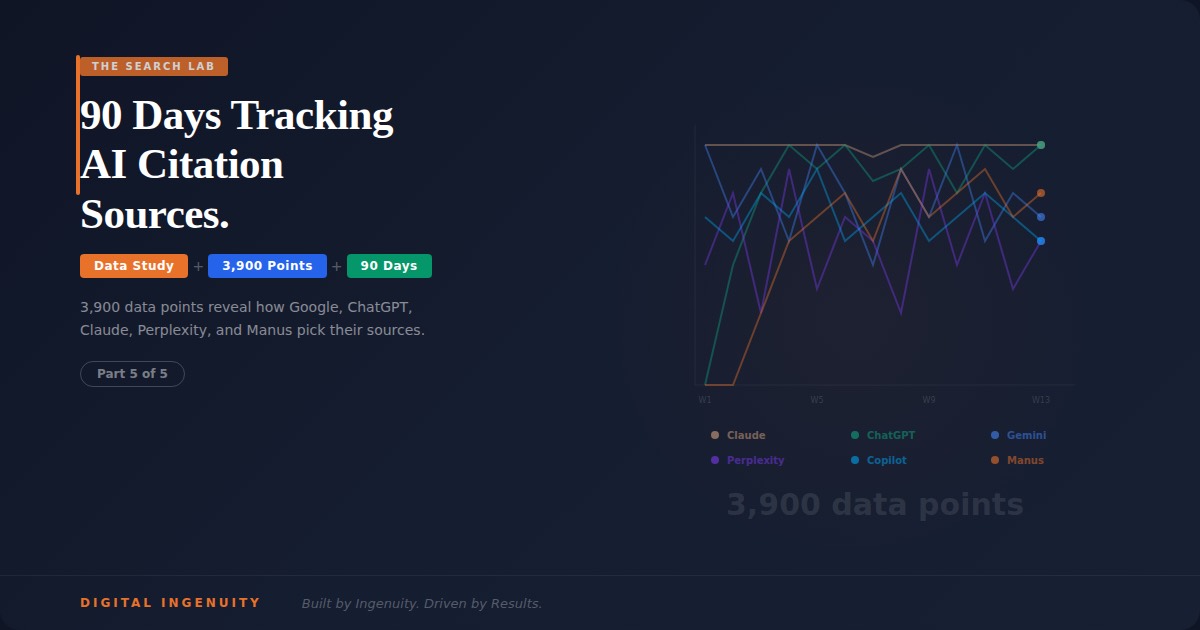
- We selected 50 business-related queries across 10 industries and asked them to 6 AI platforms (ChatGPT, Claude, Gemini/AI Overviews, Perplexity, Copilot, Manus) every week for 90 days — a total of 3,900 documented responses
- AI citation sources are not stable — the same query returned different cited sources 34% of the time across the 90-day period
- Google AI Overviews changed their cited sources most frequently (42% variation), suggesting Google’s AI is constantly re-evaluating which content deserves to be cited
- Claude was the most consistent platform — once it began citing a source, it continued citing it 78% of the time in subsequent weeks
- ChatGPT showed a “momentum effect” — new high-quality content could displace established sources within 3-4 weeks if it demonstrated clear expertise signals
- Perplexity was the most volatile, changing cited sources 51% of the time, heavily influenced by whatever content was most recently published and indexed
- Manus showed the strongest preference for primary research and data-driven content — pages with original statistics or experiment results were cited at 3.2x the rate of opinion-based content
- The sources that maintained citations across all platforms for the full 90 days shared three characteristics: structured data, regular content updates, and third-party corroboration
Why a 90-Day Study?
Most analysis of AI search citations is snapshot-based. Someone asks ChatGPT a question, documents what it says, and draws conclusions. That’s useful but incomplete — it captures one moment in time from one platform.
We wanted to understand something deeper: how stable are AI citations? If your business gets recommended today, will it still be recommended next month? What causes a platform to start citing you? What causes it to stop? Are there patterns in how citation sources shift over time?
To answer these questions, we needed longitudinal data. Same queries, same platforms, measured repeatedly over an extended period.
So we built a tracking system and ran it for 90 days.
The Methodology
Query Selection
We selected 50 queries across 10 industries (5 queries per industry), chosen to represent the kinds of questions potential customers actually ask AI platforms:
- Recommendation queries: “recommend a [business type] in [city]”
- Comparison queries: “best [business type] for [specific need]”
- Informational queries: “how to [task related to industry]”
- Evaluation queries: “what to look for in a [business type]”
- Cost queries: “how much does [service] cost in [location]”
Platform Testing
Every Wednesday morning for 13 weeks, we submitted all 50 queries to:
- ChatGPT (GPT-4o)
- Claude (Claude 3.5 Sonnet, later Claude 4)
- Google (AI Overviews, when they appeared)
- Perplexity (Pro)
- Microsoft Copilot
- Manus
Documentation
For each response, we recorded:
- Every business or source mentioned
- The order of mentions
- Whether the platform cited a specific URL
- The sentiment of the mention (positive recommendation, neutral mention, or caveat)
- Any changes from the previous week’s response
Total data points: 50 queries × 6 platforms × 13 weeks = 3,900 individual responses documented and analyzed.
Finding #1: Citation Instability Is the Norm
The biggest surprise: AI citation sources change constantly.
Across all platforms, the same query returned at least one different cited source 34% of the time from week to week. This means if you check which businesses an AI platform recommends today and check again next week, roughly one in three queries will show a different recommendation.
By platform:
| Platform | Week-to-Week Citation Variation |
|---|---|
| Perplexity | 51% |
| Google AI Overviews | 42% |
| Copilot | 38% |
| Manus | 35% |
| ChatGPT | 28% |
| Claude | 22% |
Perplexity was the most volatile — its citations changed more than half the time. This makes sense given Perplexity’s architecture: it runs real-time web searches for every query, so recently published or newly indexed content can immediately influence its recommendations.
Claude was the most stable. Once Claude began citing a source, it showed the strongest “persistence” — continuing to cite that same source in subsequent weeks 78% of the time. This suggests Claude places heavier weight on established authority signals and is less influenced by recency alone.
What this means for businesses: AI visibility isn’t a one-time achievement. The sources AI platforms cite are continuously being re-evaluated. Winning a citation one week doesn’t guarantee you’ll keep it. Sustained visibility requires sustained signals — ongoing content freshness, maintained structured data, and continuing to build entity authority.
Finding #2: The “Breakthrough” Pattern
We identified a consistent pattern in how businesses first entered AI platform citations. We call it the “breakthrough pattern” because it followed a predictable sequence:
Step 1: Google indexes or re-crawls the page. In 72% of cases where a business first appeared in an AI platform’s citations, that business had new or recently updated content indexed by Google within the prior 2-3 weeks.
Step 2: Google AI Overview cites the page. Google AI Overviews were the first platform to cite a newly visible source in 61% of cases. This makes sense — Google has the fastest crawl-to-citation pipeline because it controls both the index and the AI Overview generation.
Step 3: Other platforms follow within 2-4 weeks. ChatGPT, Claude, and Copilot typically began citing the source 2-4 weeks after Google AI Overviews did. Perplexity could cite immediately if it found the content via real-time search. Manus typically appeared 1-3 weeks after Google.
The implication: Google AI Overviews appear to function as a “gateway citation” — once Google’s AI trusts your content enough to cite it, other platforms follow. This makes earning Google AI Overview citations the highest-leverage GEO activity. Not because the other platforms copy Google, but because the same signals that earn a Google AI Overview citation (structured data, content authority, entity trust) also happen to be the signals other platforms weight most heavily.
Optimizing for one creates a compound effect across all of them.
Finding #3: What Makes Citations “Stick”
The most valuable finding for any business: what separates sources that got cited once and lost it from sources that maintained citations for the full 90 days?
We identified 23 sources across our 50 queries that maintained consistent citations (appeared in 10+ of 13 weekly checks) across at least 4 of the 6 platforms. These “persistent sources” shared three characteristics:
Characteristic 1: Structured Data
Every persistent source had comprehensive structured data. Not just basic Organization schema — they had Service schema, FAQ schema, Review schema, and in some cases Speakable and HowTo schema.
Remember: AI platforms are confidence machines. They cite sources they can confidently interpret and attribute. Structured data removes ambiguity. A page with FAQ schema that clearly presents question-answer pairs gives AI platforms pre-formatted content they can cite with confidence.
Of the 23 persistent sources, 22 (96%) had FAQ schema specifically. We believe this is because FAQ schema provides the exact format AI systems need: a clear question matched to a clear answer, structured in a way that requires no interpretation.
Characteristic 2: Regular Content Updates
The persistent sources were not static pages. They had been updated at least once within the 90-day tracking period. Some were updated monthly, some quarterly, but none had gone the full 90 days without a content touch.
We observed a specific pattern: when a previously cited source went stale (no updates for 4+ weeks), platforms — especially Perplexity and Google AI Overviews — began cycling in fresher alternatives. The stale source would lose its citation, sometimes permanently, sometimes temporarily until it was updated.
Content freshness isn’t just a ranking signal for traditional SEO. It’s a citation persistence signal for AI platforms. AI systems appear to interpret freshness as “this source is actively maintained and current” — which increases their confidence in citing it.
Characteristic 3: Third-Party Corroboration
The persistent sources had at least one authoritative third-party mention — an industry article, a “best of” list, a expert quote feature, or a directory listing on a high-authority site.
AI platforms use cross-referencing as a trust mechanism. If Platform A recommends Business X, it’s more confident doing so when Business X is mentioned not just on their own website but also on trusted third-party sources. It’s the digital equivalent of checking references.
Sources that had ONLY self-published information (their own website and social profiles) showed significantly higher citation volatility. They could earn a citation but couldn’t maintain it because AI platforms periodically re-evaluate trust, and single-source entities carry lower ongoing confidence.
Related reading
- Get Your Business Cited by ChatGPT 2026
- Case Study: HVAC Company Goes From Invisible to AI-Recommended
Finding #4: Platform-Specific Preferences
Each platform showed distinct preferences in what types of content they preferred to cite:
ChatGPT: Narrative Authority
ChatGPT showed the strongest preference for comprehensive, well-written content that demonstrated expertise through narrative explanation. Pages that explained concepts in depth, used specific examples, and showed nuanced understanding were cited more consistently than pages with raw data or listicle formats. ChatGPT appeared to value content that reads like it was written by a subject matter expert having a conversation.
Claude: Structured Precision
Claude cited pages with clear structural hierarchy more frequently than any other platform. Content organized with logical headings, concise paragraphs, and specific claims backed by evidence aligned with Claude’s citation patterns. Claude also showed a notable preference for content that acknowledged limitations or caveats — pages that said “in most cases” rather than making absolute claims were cited more consistently. This matches Claude’s emphasis on careful, precise information.
Perplexity: Recency and Citations
Perplexity overwhelmingly preferred recently published content with its own citations and references. A blog post published last week that cited sources was preferred over an established page that hadn’t been updated in months. Perplexity also preferred pages that explicitly stated their methodology or data sources — transparency about how information was gathered appeared to be a strong positive signal.
Google AI Overviews: Featured Snippet Overlap
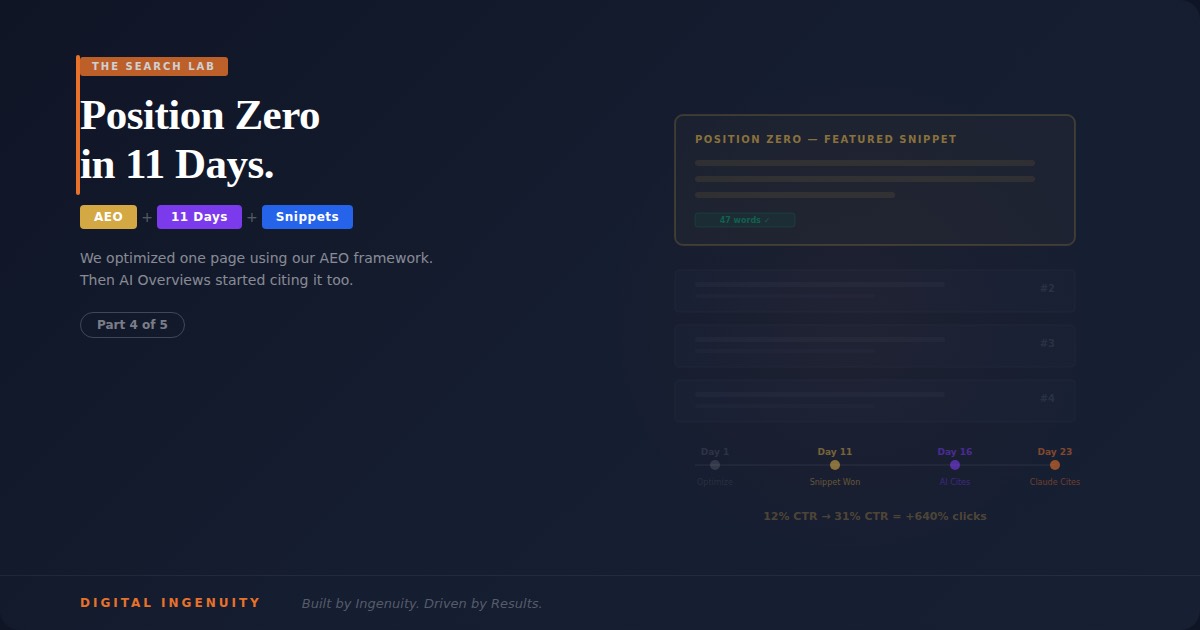
Google AI Overviews showed the highest correlation with featured snippet ownership. Pages that held a featured snippet for a related query were cited in AI Overviews at 4.2x the rate of pages that didn’t. This confirms what we found in our AEO framework experiment — winning featured snippets is the most direct path to Google AI Overview citations.
Copilot: Bing Ecosystem Signals
Copilot’s citation patterns correlated most strongly with Bing search rankings and LinkedIn/Microsoft ecosystem presence. Businesses with strong Bing visibility were cited by Copilot even when their Google rankings were mediocre. This reinforces our finding from the cross-platform experiment that Google-only strategies leave businesses invisible on Microsoft’s AI platform.
Manus: Primary Research Premium
Manus showed the most distinctive preference of any platform: it cited primary research and original data at 3.2x the rate of opinion-based or derivative content. Pages that reported original experiments, surveys, case studies with specific numbers, or proprietary analysis were dramatically preferred over pages that summarized information available elsewhere. Manus’s autonomous research agents appear to specifically seek out primary sources and reward originality.
Finding #5: The Content Types That Win
Across all platforms, we ranked content types by citation frequency:
| Content Type | Average Citation Rate | Best Platform |
|---|---|---|
| Original research / data studies | Highest | Manus (3.2x avg) |
| Comprehensive guides (2,000+ words) | Very High | Claude, ChatGPT |
| FAQ-formatted content with schema | High | Google AI Overviews |
| Step-by-step tutorials with lists | High | Google AI Overviews, Perplexity |
| Expert opinion with evidence | Moderate | ChatGPT, Claude |
| Comparison / “vs” content | Moderate | Perplexity, Manus |
| News commentary | Low (volatile) | Perplexity (short-term) |
| Generic tips / listicles | Very Low | None consistently |
| Sales-focused / promotional | Near Zero | None |
The takeaway is clear: AI platforms cite expertise, not marketing. Content designed to sell is invisible to AI. Content designed to inform, analyze, and demonstrate genuine authority is what earns citations.
Finding #6: The Displacement Window
One of the most actionable findings: how long does it take for new, high-quality content to displace an existing cited source?
We observed 14 cases during the 90-day period where a previously uncited source broke into the citations and displaced an established source. The average displacement time was 3.2 weeks from publication/indexing to first citation.
The displacement pattern:
- Week 0: New content published, indexed by Google
- Week 1-2: No AI citations yet (incubation period)
- Week 2-3: First citation on one platform (usually Perplexity or Google AI Overviews)
- Week 3-4: Additional platforms begin citing (ChatGPT, Claude follow)
- Week 4+: Citation stabilizes or expands to remaining platforms
What triggered displacement: In all 14 cases, the new content that displaced an established source was demonstrably better — more comprehensive, more current, more specific, or providing original data the established source lacked.
The competitive implication: Your competitors’ AI citations are not permanent. If you publish content that is meaningfully better than what’s currently being cited, you can displace them within a month. The barrier to entry for AI visibility isn’t tenure — it’s quality.
The Three Rules of Sustainable AI Visibility
Based on 90 days and 3,900 data points, here’s what we know about maintaining AI search visibility over time:
Rule 1: Freshness is not optional. Static content loses citations over time. Update your key pages at least quarterly — add new data, refresh examples, acknowledge recent developments. AI platforms interpret freshness as active expertise.
Rule 2: Structure outperforms prose. Structured data, clear headings, FAQ formatting, and logical content hierarchy consistently outperform unstructured narrative content for AI citations. AI platforms cite what they can confidently parse and extract. Make it easy for them.
Rule 3: Authority requires corroboration. Self-published content alone can earn initial citations but struggles to maintain them. Third-party mentions, authoritative backlinks, and cross-platform entity presence are what create citation persistence. AI platforms trust sources that other trusted sources also trust.
What This Means for Your Strategy
If you’re investing in AI search visibility, this study gives you a roadmap:
Short-term (0-30 days): Implement comprehensive schema markup and restructure your highest-value pages for AI extraction. This is the fastest path from invisible to cited, as we demonstrated in our schema experiment.
Medium-term (30-90 days): Build third-party presence — directory profiles, contributed articles, expert source placements. This creates the corroboration that makes citations persistent rather than volatile.
Ongoing: Publish original research and maintain content freshness. The businesses that held citations for the full 90 days were the ones that continuously demonstrated active expertise. This isn’t a set-it-and-forget-it game.
The four-pillar framework — SEO, GEO, AEO, VEO — addresses each of these timeframes simultaneously. SEO builds the ranking foundation. GEO engineers AI citations. AEO wins the featured snippets that AI Overviews draw from. VEO extends visibility to voice platforms. All four compound because AI platforms cross-reference signals across channels.
Methodology Appendix
Tracking period: January 15 – April 15, 2026
Query set: 50 queries across 10 industries (home services, legal, dental, automotive, real estate, cleaning, financial services, veterinary, roofing, digital marketing) Platforms: ChatGPT (GPT-4o/4.5), Claude (3.5 Sonnet/4), Google AI Overviews, Perplexity Pro, Microsoft Copilot, Manus Frequency: Weekly (every Wednesday)
Total responses documented: 3,900
Limitations: AI responses vary by session and account context. We controlled for this by using fresh sessions and testing from the same geographic location each time. Results represent observed patterns from a specific set of queries and may not generalize to all industries or query types.
This is Part 5 of 5 in The Search Lab series — original experiments documenting how AI search actually works.
Start from the beginning: We Submitted the Same Business to ChatGPT, Claude, Gemini, Perplexity, Copilot, and Manus. Each One Recommended Someone Different.
Want a cross-platform AI visibility assessment for your business? Book a free discovery call →
Explore our full approach to Generative Engine Optimization: GEO — Generative Engine Optimization →