Key takeaways
- Google features answers that are complete, concise, and immediately useful — the “Wikipedia test” is the simplest filter: would this answer feel at home in an encyclopedia?
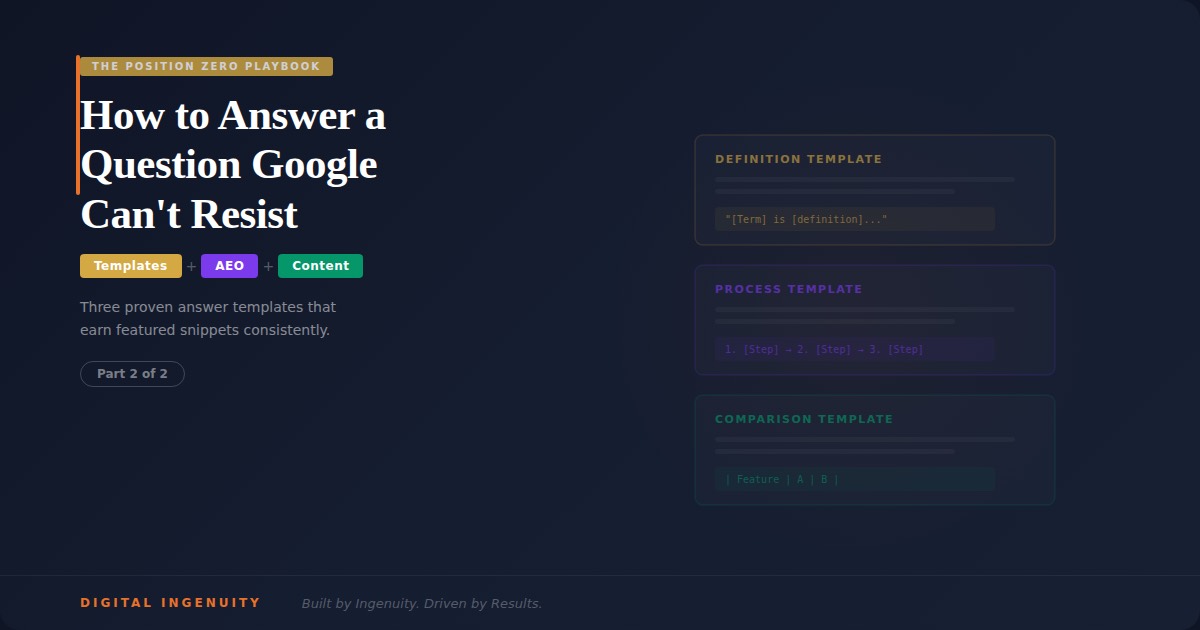
- Three proven answer templates: the Definition Answer (for “what is” queries), the Process Answer (for “how to” queries), and the Comparison Answer (for “vs” and “best” queries)
- The secret ingredient is specificity — “SEO takes 3-6 months” wins over “SEO results vary” every time
- FAQ schema markup doubles down on the strategy — it gives Google a second pathway to feature your answers
- The best snippet content doesn’t feel optimized — it feels like an expert answering a colleague’s question directly
The Psychology of What Gets Featured
Google’s featured snippet algorithm is trying to do something deceptively simple: find the best answer to a question and display it prominently.
“Best” in this context means three things simultaneously. The answer is complete — it addresses the full intent of the query without requiring additional context. It’s concise — it delivers the answer in the minimum number of words needed. And it’s authoritative — it comes from a page that demonstrates expertise on the topic.
Understanding this psychology changes how you write. You’re not writing for a search engine. You’re writing as an expert answering a colleague’s question. Would you give them a vague, hedging non-answer? No. You’d give them a direct, specific, useful response and then explain the nuance.
That’s what gets featured.
Template 1: The Definition Answer
For queries that start with: “What is,” “What are,” “Define”
Structure:
[H2: What Is {Topic}?]

{Topic} is {one-sentence definition that captures the core concept}.
{Second sentence expanding on the practical implication or application}.
{Third sentence that differentiates from common misconceptions, if relevant}.
Example — “What is generative engine optimization?”
“Generative engine optimization (GEO) is the practice of engineering your digital presence so that AI platforms like ChatGPT, Perplexity, and Google AI Overviews cite your business in their responses. Unlike traditional SEO which focuses on ranking in search results, GEO focuses on being referenced as a trusted source by AI systems. This requires specific entity signals, structured data, and content architecture that AI models can confidently draw from.”
That’s 62 words. Slightly above the 40-60 sweet spot from our snippet analysis, but within the effective range. It defines the term, differentiates it from something related, and provides actionable specificity.
Template 2: The Process Answer
For queries that start with: “How to,” “How do I,” “Steps to”
Structure:
[H2: How to {Achieve Outcome}]

To {achieve outcome}, follow these steps:
1. {Action verb + specific task}
2. {Action verb + specific task}
3. {Action verb + specific task}
...

[Follow each numbered step with a paragraph of expanded detail]
Key principles: Start each step with an action verb. Keep each list item under 15 words. Aim for 5-8 steps total. Google prefers numbered lists that feel complete, not lists of 20+ items that feel like a brain dump.
Template 3: The Comparison Answer
For queries that include: “vs,” “difference between,” “best,” “compared to”
Structure:
[H2: {Option A} vs. {Option B}: What's the Difference?]

{One-sentence summary of the fundamental difference}.

| Feature | {Option A} | {Option B} |
| Focus   | ...        | ...        |
| Cost    | ...        | ...        |
| Best For| ...        | ...        |

[Follow with expanded paragraphs on each option]
Tables are underused in snippet strategy. Only 13% of snippets in our data set were tables, but they had the highest retention rate — Google rarely drops a table snippet once it features one. For comparison queries, a clean HTML table with 3-5 rows comparing key attributes is extremely effective.
The Specificity Principle
Across all three templates, one principle dominates: specificity wins.
“SEO typically takes 3-6 months to produce meaningful results, with technical fixes showing impact within 30-60 days and content-driven improvements compounding after month 4.” — This gets featured.
“SEO results can vary depending on many factors including your industry, competition, and current website condition.” — This doesn’t.
Both statements are technically true. But the first one makes a specific, useful claim. The second one says nothing actionable. Google’s snippet algorithm consistently prefers the specific answer because it’s more useful to the searcher.
This means taking positions. Making claims. Being willing to say “this costs $999/month” instead of “pricing varies.” Being willing to say “this takes 90 days” instead of “timelines depend on your situation.” The nuance and caveats belong in the supporting paragraphs — not in the answer itself.
Related reading
Doubling Down with FAQ Schema
Once you’ve structured your content with clear questions and direct answers, FAQ schema markup gives Google a second pathway to feature your content. FAQ schema explicitly tells Google: “This page contains these questions and these answers.”
Pages with FAQ schema can appear as expanded FAQ results in search results, which are visually prominent and capture significant click-through rates. They also provide clean, structured question-answer pairs that AI Overviews and voice assistants can extract from directly.
Every service page, every pillar blog post, and every comprehensive guide on your site should have FAQ schema with 3-5 relevant questions and direct answers.
The Content That Doesn’t Feel Optimized
Here’s the paradox of great AEO content: it shouldn’t feel optimized. It should feel like an expert answering questions with confidence and specificity.
Read any featured snippet aloud. It sounds like a knowledgeable person giving a direct answer. Not like a marketer trying to rank for a keyword. Not like an AI trying to sound authoritative. Just a clear, useful, human answer to a real question.
That’s the target. Write like you’re answering a client’s question over coffee. Be direct. Be specific. Be helpful. Then structure it properly and let the formatting do the rest.
Series Navigation
← Previous: We Tracked 500 Featured Snippets. Here’s What They All Have in Common.
Explore the full AEO pillar: Answer Engine Optimization →
Digital Ingenuity is a premium search optimization agency based in Plano, Texas. Book a discovery call →