Key takeaways
- We analyzed 500 featured snippets across 12 industries — the patterns are remarkably consistent regardless of topic
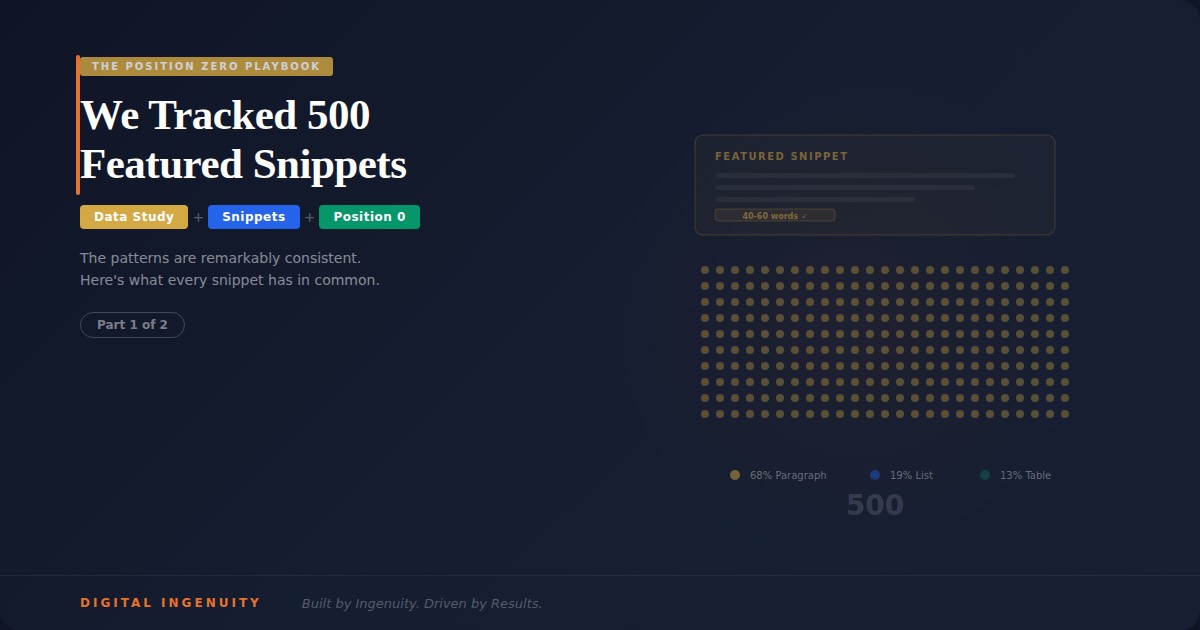
- 68% of featured snippets are paragraph format (40-60 words answering the query directly), 19% are lists, and 13% are tables
- The winning pages answered the query within the first 200 words of content, not buried deep in the article
- 87% of snippet-winning pages had proper heading structure (H2 matching the query, answer immediately below)
- Pages ranking positions 1-5 earned 92% of all snippets — you don’t need to rank #1, but you need to be on page one
The Experiment
Featured snippets are the most valuable real estate in organic search. They appear above position #1, they capture a disproportionate share of clicks, and they’re the content that voice assistants read aloud as their answer.
But the advice around earning snippets is frustratingly vague. “Create great content.” “Answer questions clearly.” “Use proper formatting.” All true. All useless without specifics.
So we tracked 500 featured snippets across 12 industries over 60 days and documented every measurable characteristic of the pages that won them. Here’s what we found.
Pattern 1: The 40-60 Word Sweet Spot
The dominant snippet format is a paragraph — a direct answer to the query in natural language. And these paragraphs have a remarkably consistent length.
Of the 340 paragraph-format snippets in our data set, the average length was 47 words. The effective range was 40-60 words. Answers shorter than 35 words tended to be too vague for Google to feature. Answers longer than 65 words got truncated, which Google seems to prefer avoiding.
This tells us something specific about content engineering: your answer to the target question should be a self-contained paragraph of roughly 40-60 words that fully addresses the query. Not a teaser. Not the beginning of a long explanation. A complete, concise answer.
Pattern 2: Answer Placement Matters More Than Article Length
We measured where on the page the snippet-winning answer appeared. In 87% of cases, the featured answer appeared within the first 200 words of the page content (excluding navigation and boilerplate). In 62% of cases, it appeared within the first 100 words.
This has massive implications for content structure. The common advice to “write comprehensive, long-form content” is fine — but the snippet-winning answer needs to appear early. The rest of the article provides context, depth, and supporting information. But the answer itself needs to be near the top.
The pattern that worked consistently: state the answer first, then explain it. Not the other way around.
Pattern 3: H2 + Answer = Snippet Formula
The most consistent structural pattern across all 500 snippets was simple: an H2 heading that closely matches the search query, followed immediately by a paragraph that answers it.
When someone searches “how long does SEO take to work,” the snippet-winning page typically has an H2 like “How Long Does SEO Take to Show Results?” followed immediately by a 40-60 word answer paragraph.
This isn’t surprising — Google’s systems are pattern-matching the query to heading text and extracting the content that follows. But the specificity of the match matters. H2 headings that paraphrase the query too loosely don’t trigger snippets as reliably as headings that closely mirror the actual search phrasing.
Pattern 4: Lists Win for “How To” and “Best” Queries
List-format snippets (numbered or bulleted) dominated two query types: “how to” queries and “best” queries.
For “how to” queries, numbered lists won because they inherently match the step-by-step intent of the search. Google extracts the list items as a numbered process. The winning lists had 5-8 steps, each with a clear action verb starting the item.
For “best” queries, bulleted lists won because they present options efficiently. Google extracts the list items as a curated set of recommendations. The winning lists named specific items with brief qualifying descriptions.
If your target query starts with “how to” or “best,” format your content as a list. The data is unambiguous.
Pattern 5: You Need to Be on Page One (But Not Necessarily #1)
Here’s encouraging data for businesses that aren’t ranking #1 yet: of all 500 snippets, 92% were won by pages ranking in positions 1-5, and 99% were won by pages in positions 1-10. But position #1 only won 42% of snippets.
That means pages ranking at positions 2, 3, 4, and 5 won 50% of featured snippets — even though they’re below the top organic result. Google doesn’t automatically give the snippet to the #1 page. It gives it to the page that best formats the answer.
This is a significant opportunity. If you’re ranking on page one but not in position #1, you can still win the snippet — and the snippet appears above position #1 in the results. Effective AEO can leapfrog your content above competitors with higher traditional rankings.
The Actionable Framework
Based on these 500 data points, here’s the snippet-winning formula:
Identify the exact question your audience searches. Make that question (or a very close paraphrase) an H2 heading on your page. Immediately below that heading, write a 40-60 word paragraph that directly and completely answers the question. Follow that answer with expanded context, examples, and depth.
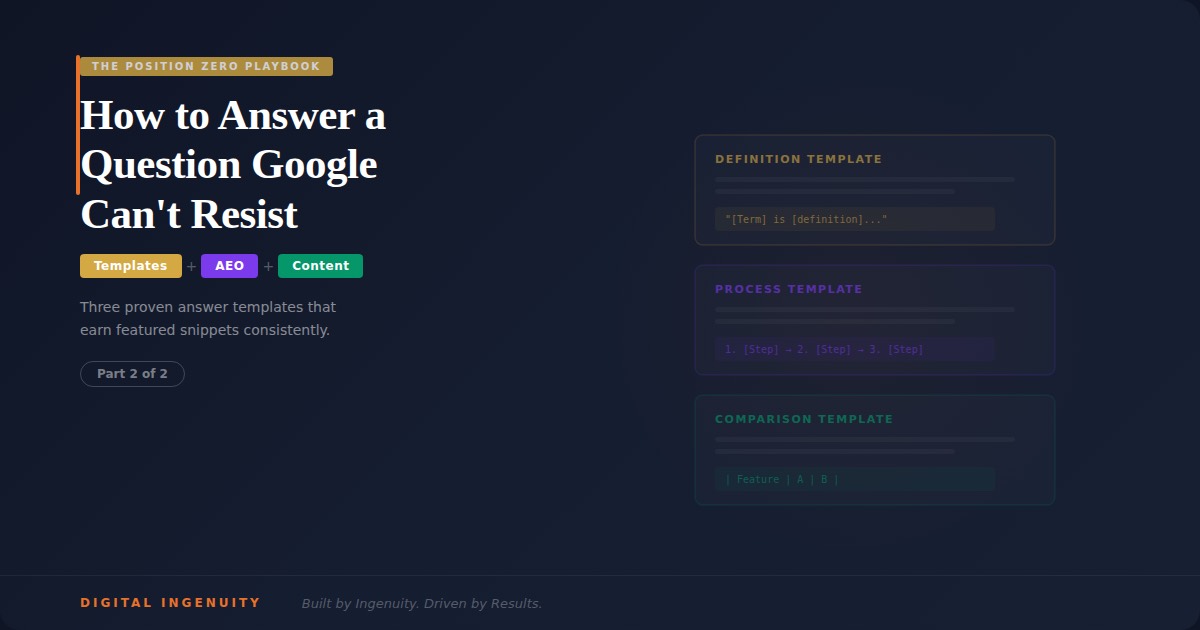
For “how to” queries, use a numbered list of 5-8 steps with action verbs. For “best of” queries, use a bulleted list with specific items and brief descriptions. For definition queries, use a clear, self-contained paragraph starting with “[Term] is...”
Place the answer within the first 200 words of your page content. Ensure the page has comprehensive, authoritative content beyond the snippet answer — Google needs to trust the page overall before featuring a snippet from it.
Series Navigation
Next →: How to Answer a Question Google Can’t Resist Featuring
Deep dive: Explore our AEO pillar →
Digital Ingenuity is a premium search optimization agency based in Plano, Texas. Book a discovery call →