Key takeaways
- Google AI Overviews now appear in approximately 30-40% of informational queries, and the percentage is climbing every quarter
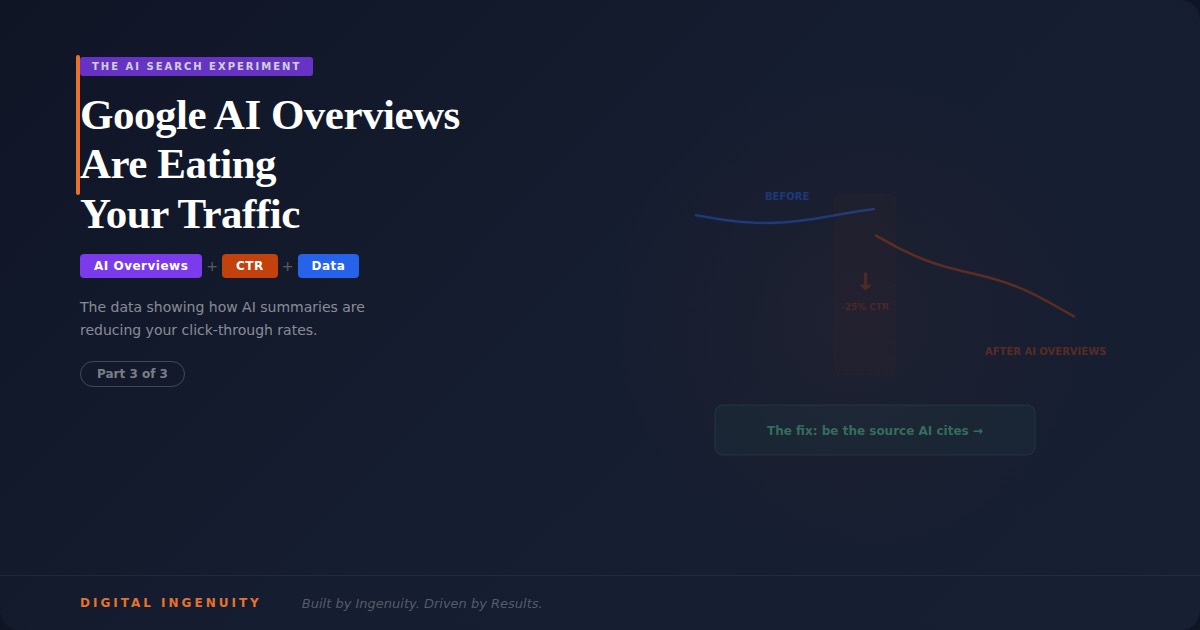
- Pages that rank #1 organically are seeing 15-25% CTR declines for queries where AI Overviews appear — the AI answers the question before anyone clicks
- This isn’t a reason to panic — it’s a reason to adapt. Being cited IN the AI Overview is now more valuable than ranking below it
- Businesses optimized for structured data, clear answer formatting, and entity authority are appearing in AI Overviews as cited sources — maintaining or even increasing their visibility
- The strategy shift: optimize to be the source the AI Overview cites, not just the page that ranks below it
The Traffic You’re Not Getting (And Don’t Know About)
If you’ve noticed a gradual decline in organic traffic over the past year despite stable or improving rankings, you’re not imagining it. And you’re not alone.
Google AI Overviews — the AI-generated summaries that appear above organic search results — are fundamentally changing the math of organic search. For certain query types, the AI Overview provides enough information that a significant percentage of searchers never scroll down to the organic results. They get their answer, and they leave.
The data is clear and it’s not a temporary experiment. AI Overviews are expanding to more query types, appearing in more markets, and consuming more of the click volume that used to flow to organic results.
But here’s what most of the alarmist coverage misses: the businesses being cited within AI Overviews are seeing increased visibility and brand recognition. The losers aren’t the businesses AI Overview mentions — they’re the businesses it doesn’t.
What the Data Actually Shows
Industry research shows AI Overviews appear in roughly 30-40% of informational queries — questions that start with “how,” “what,” “why,” and “best.” For transactional queries (“buy,” “hire,” “near me”), AI Overviews appear less frequently but are increasing.
For queries where AI Overviews do appear, the aggregate click-through rate to organic results drops. The effect is most severe for position #1, which historically captured 25-30% of clicks. When an AI Overview appears above position #1, that same page may capture only 18-22% of clicks.
That’s a meaningful decline. For a business getting 10,000 organic visitors a month, a 20% CTR reduction translates to 2,000 fewer visits — without losing a single ranking position. The rankings look fine. The traffic doesn’t.
Why This Isn’t a Reason to Panic
Here’s the nuance the doom-and-gloom articles leave out:
AI Overviews cite their sources. When Google’s AI generates a summary, it links to the web pages it drew information from. Being one of those cited sources is extremely valuable — arguably more valuable than ranking #1 below the overview.
When a user sees “According to Digital Ingenuity, the four pillars of modern search optimization include...” that’s a brand impression backed by Google’s implicit endorsement. Even if the user doesn’t click through, they’ve now associated your business with expertise in that topic. And if they do click, they arrive with a higher level of trust than a standard organic click.
The strategic question isn’t “how do I get my traffic back from AI Overviews.” It’s “how do I become the source AI Overviews cite.”
What Gets Cited in AI Overviews
Based on our analysis of hundreds of AI Overviews across different industries, the pages that get cited share specific characteristics:
They answer the query directly. The page’s content includes a clear, concise answer to the specific question within the first 200 words. Not buried in paragraph seven. Not hidden behind a sales pitch. A direct, useful answer positioned prominently.
They support claims with specifics. Pages that state “SEO takes 3-6 months to show results” get cited. Pages that state “SEO can help your business grow” don’t. Specificity and verifiable claims register as citeable information.
They have comprehensive structured data. FAQ schema, HowTo schema, and Article schema give AI Overviews clean, parseable content to draw from. These pages are easier for AI systems to extract information from accurately, which makes them safer to cite.
They already rank well. AI Overviews draw primarily from pages that already rank in the top 10-15 results. Traditional SEO isn’t irrelevant — it’s a prerequisite. But it’s no longer sufficient.
They have strong E-E-A-T signals. Author information, published dates, cited sources, and clear expertise indicators. AI Overviews prefer to cite pages that demonstrate experience, expertise, authoritativeness, and trust.
The Adaptation Strategy
The businesses that will thrive in the AI Overview era are the ones that shift their strategy from “rank higher” to “become the cited authority.”
This means creating content that’s structured for AI consumption — clear headings, direct answers, specific data points, and comprehensive schema markup. It means building the entity authority signals we detailed in the previous posts in this series. And it means accepting that some traffic will shift from clicks to brand impressions — and that’s not necessarily bad.
A searcher who reads your expertise cited in a Google AI Overview and then searches your business name directly is a higher-intent visitor than someone who clicked a generic organic result. The conversion path changes, but the conversions don’t disappear.
Series Navigation
← Previous: The Businesses ChatGPT Recommends vs. The Ones It Ignores
Explore the full GEO pillar: Generative Engine Optimization →
See how GEO connects to the bigger picture: The Four-Pillar Growth Engine →
Digital Ingenuity engineers AI search visibility for businesses across Texas. Book a discovery call →